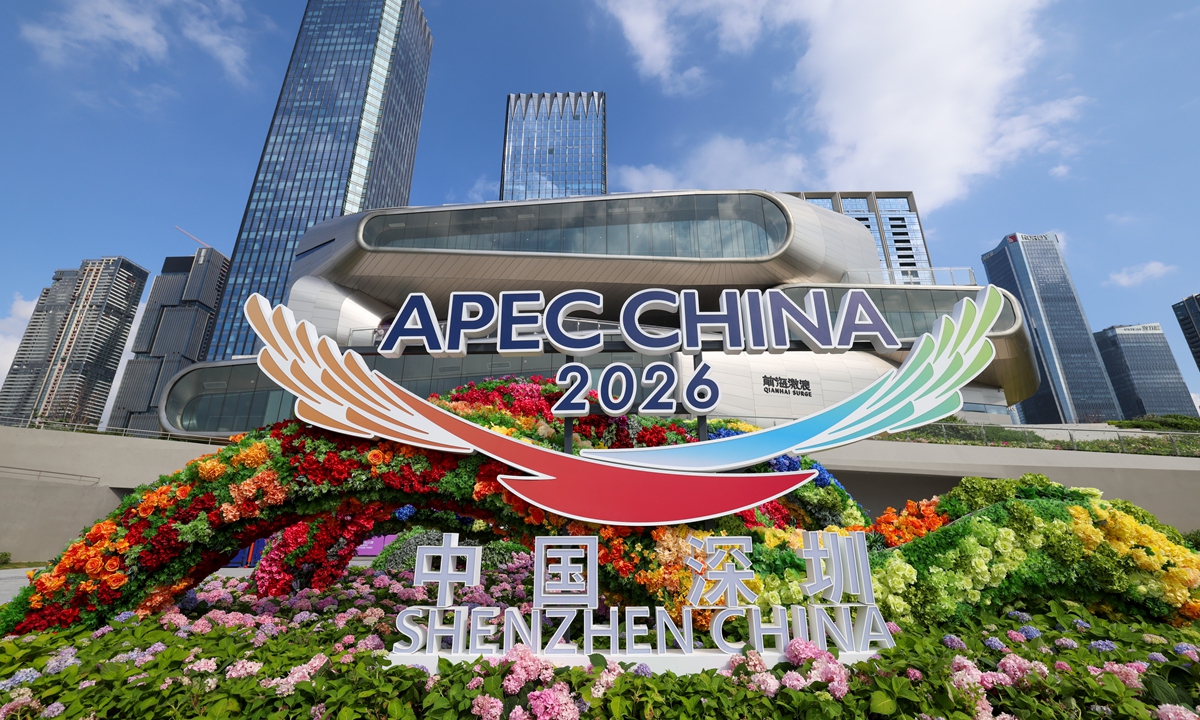
The APEC "China Year" logo decoration is seen at Qianhai Stone Park in Shenzhen. China will hold the 33rd APEC Economic Leaders' Meeting in Shenzhen from November 18 to 19, 2026. Photo: Xinhua
The upcoming trilateral meeting among the heads of state of China, Russia and the US on the sidelines of the APEC gathering in Shenzhen has drawn intense global attention. The meeting carries ground-breaking significance.
However, some Western media and commentators have been quick to draw parallels with the 1945 Yalta Conference, peddling a "Yalta 2.0" narrative that frames the meeting as a replay of great-power domination over the world order. This characterization is fundamentally a product of entrenched Cold War thinking, imposing an outdated paradigm of wartime power politics onto contemporary major-country relations.
It misrepresents both the historical nature of the two events and the true purpose of this latest meeting. In reality, China-Russia-US engagement is not about reviving the old playbook of carving out spheres of influence or dictating the fate of other nations. Rather, its core significance lies in creating opportunities to manage strategic differences and safeguard global strategic stability.
Three fundamental distinctions make the "Yalta 2.0" claim entirely untenable.
First, the historical context and agenda are worlds apart. The 1945 Yalta Conference took place in the final stages of World War II, centering on winding down the war against fascism, settling postwar arrangements for defeated nations and redividing global spheres of influence. It constituted a redistribution of power and interests by victorious nations, and was inherently marked by power politics and bloc confrontation. By contrast, the Shenzhen meeting will be held within the multilateral framework of APEC in an era of peace and development. It serves as a constructive diplomatic exercise in which major powers with existing differences conduct candid strategic communication and exchange policy views.
Second, the underlying logic and governing principles run counter to one another. The Yalta system was defined by power politics: A handful of major powers struck secret deals behind the backs of affected countries to carve up spheres of influence, sacrificing the sovereignty and interests of smaller states in exchange for great-power compromise. China, by contrast, has consistently adhered to the fundamental diplomatic principle of sovereign equality. It maintains that international affairs should be handled through consultation among all countries, and firmly opposes backroom deals among major powers that dictate the destiny of others. True to this principle, the Shenzhen meeting involves no interest bargains targeting third parties, nor any agenda or intention to divide spheres of influence. All exchanges will be conducted on the basis of respect for national sovereignty and territorial integrity.
Third, the broader era and structural trajectory are fundamentally different. The Yalta Conference set the stage for decades of Cold War bloc confrontation. Today's world is characterized by accelerating multipolarity, deepening globalization and intricately intertwined national interests. Emerging markets and developing countries have risen to become a major force on the international stage. Trilateral dialogue among China, Russia and the US represents a normal form of major-power coordination in a multipolar world, not the start of a new hegemonic order or bloc division.
Moving beyond the Cold War narrative to examine the realities of international relations, the true value of the trilateral meeting lies in managing differences, stabilizing expectations and addressing shared challenges.
For one thing, face-to-face communication in itself stands as the most meaningful outcome for current major-power relations. As the world's three most influential powers, China, Russia and the US inevitably have objective differences. Direct dialogue becomes all the more vital to reduce information asymmetry. The very fact that the three heads of state sit down for a formal meeting sends a clear signal: Despite deep differences, all sides choose dialogue over confrontation, and engagement over estrangement. This willingness to talk serves as a first line of defense against strategic miscalculation and escalation, creating favorable conditions for establishing regular, multi-level communication mechanisms going forward.
Furthermore, trilateral coordination plays an irreplaceable role in managing global risks. Today, the world faces simmering geopolitical conflicts alongside mounting challenges ranging from climate change and nuclear non-proliferation to AI governance and outer space security, none of which any single country can address on its own. Exchanging views and seeking common ground on these issues can help clear bottlenecks in global governance and enhance the effectiveness of multilateral mechanisms. On regional hot spots, trilateral communication can also inject positive momentum into peace promotion and mediation, preventing situations from deteriorating further.
The world has long left the Yalta era behind. Power politics and bloc confrontation are relics of the past. The "Yalta 2.0" narrative reflects a failure to adapt to multipolar trends and a lingering Cold War mind-set. True major-power responsibility lies not in carving up spheres of influence or dictating the fate of other nations, but in forging a new path of mutual respect, peaceful coexistence and win-win cooperation. The Shenzhen meeting will not be a replay of history, but a constructive attempt at great-power coordination in a multipolar age.
The author is an associate research fellow at the Institute of American Studies, Chinese Academy of Social Sciences. opinion@globaltimes.com.cn