Quad leaders revive meeting in Manila for ‘photo diplomacy,’ but loose grouping cannot shape path of Asia-Pacific: observers
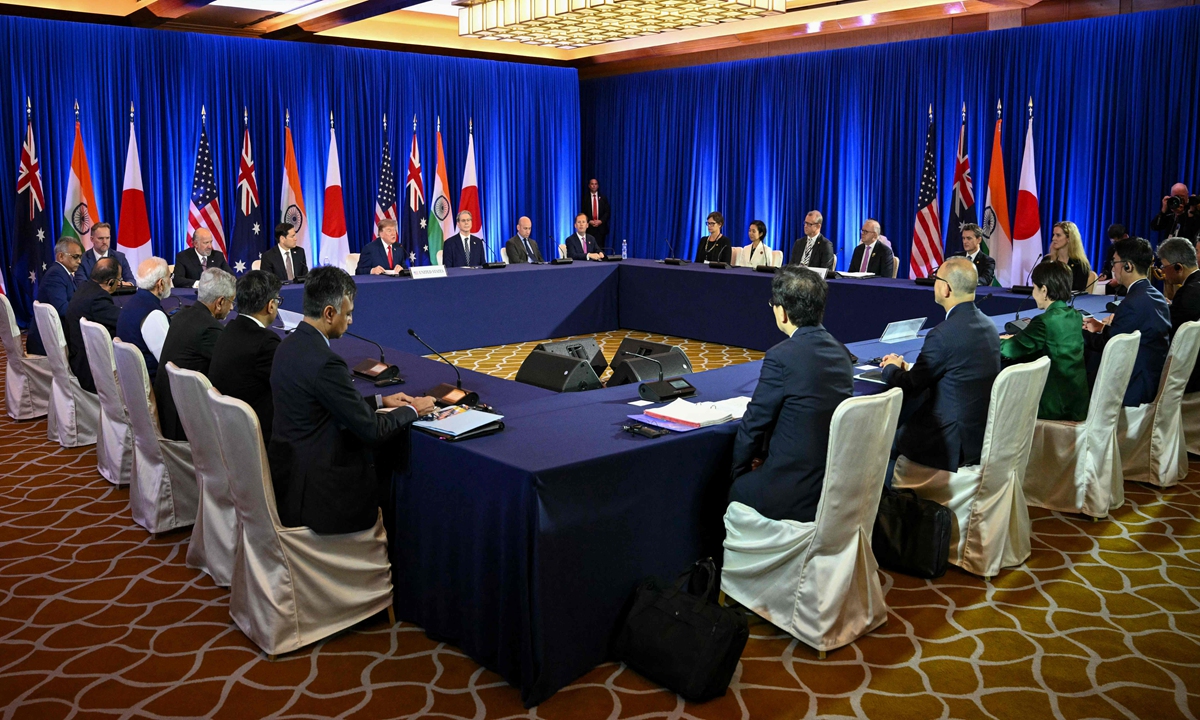
US President Donald Trump, Australia's Prime Minister Anthony Albanese, India's Prime Minister Narendra Modi and Japan's Prime Minister Sanae Takaichi take part in a meeting of the Quad group - the US, Japan, Australia and India - on the sidelines of the 49th Association of Southeast Asian Nations (ASEAN) Summit in Manila on November 17, 2026. Photo: VCG
Leaders of the Quad grouping, a four-nation bloc comprising the US, Japan, India and Australia, met in the Philippine capital Manila on Tuesday amid a series of ASEAN meetings, their first meeting since September 2024. Chinese observers noted that the revival of this mechanism will only further expose the bloc's characteristics of "photo diplomacy" that lead to few substantive measures.
US President Donald Trump on Tuesday evening met Australian Prime Minister Anthony Albanese, Indian Prime Minister Narendra Modi and Japanese Prime Minister Sanae Takaichi as he kicked off his Asia trip ahead of a planned visit to China, Reuters reported.
"These nations represent some of the most important partnerships in the entire world," the US president said. "They're among the most successful nations in the world, and in certain ways among the most powerful nations of the world," he said, according to The Guardian.
Holding the summit in Manila rather than in one of the bloc's member states is a convenient arrangement. It is clear that the US is reluctant to invest significant additional diplomatic resources or make specific arrangements for a multilateral Quad summit. It attempts to send a message to the Asia-Pacific region in a low-cost way that "the US is still present," Qian Feng, director of the Research Department at Tsinghua University's National Strategy Institute, told the Global Times.
Chen Hong, director of the Institute of Region and Country Studies at East China Normal University, dismissed analysis that interprets the revival of the Quad summit as "the US attaching greater importance to the Asia-Pacific."
The US has markedly shifted how it deploys strategic resources in the region. The US is seeking to retain its dominance over the regional security architecture, yet it is unwilling to keep bearing the excessive economic and security costs, Chen told the Global Times.
Although the other countries may expect the US to make some commitment, an apparent bustling meeting does not mean a strategic comeback, but is merely "photo diplomacy," Chen said.
The Guardian reported that the four leaders discussed closer cooperation in maritime security, critical minerals, AI and infrastructure.
"We want to ensure that the future of this critical technology is dominated by nations that share our values and our common interests and make sure that it turns out to be as good as it can be," Trump said, announcing the Quad would launch a new AI accelerator, per Reuters.
Looking at proposed cooperation in concrete areas, whether critical minerals or AI, Chen said the essence is leveraging political force to intervene in and restructure economic connections as the US aspires to shift costs onto its allies.
They also announced plans for new joint military exercises allegedly designed to contain China, while Albanese proposed a Quad business forum in 2027 to promote regional economic cooperation. Takaichi also played up the Quad's role as it "would help shape the future of the region," The Guardian reported.
The Quad is never a genuine alliance with shared objectives and coordinated operations. Instead, it resembles a "loose grouping" in which every member focuses only on its own national interests. Over its two-year pause, the bulk of pledged cooperation initiatives have remained only on paper. Its proposed joint supply-chain framework has not delivered tangible progress, and maritime security collaboration is limited mostly to basic joint drills, with little capacity for consistent coordinated operations, Qian said.
Chen noted that even if this Quad summit can make "some progress" in a few programs, it cannot form a unified mechanism because the competition logic in geopolitics and the cooperation demand in economic growth are inherently contradictory.
Taking all the diplomatic events this week into consideration, one ultimately sees that what will determine the Asia-Pacific's future is not which side can assemble more exclusive blocs targeting third parties [even without acknowledgement], but which can deliver tangible development opportunities, drivers for economic growth and public goods, Chen noted.
RELATED ARTICLES