Australian envoy follows Cold War thinking, casts China as common enemy to justify Japan’s military buildup: Chinese expert
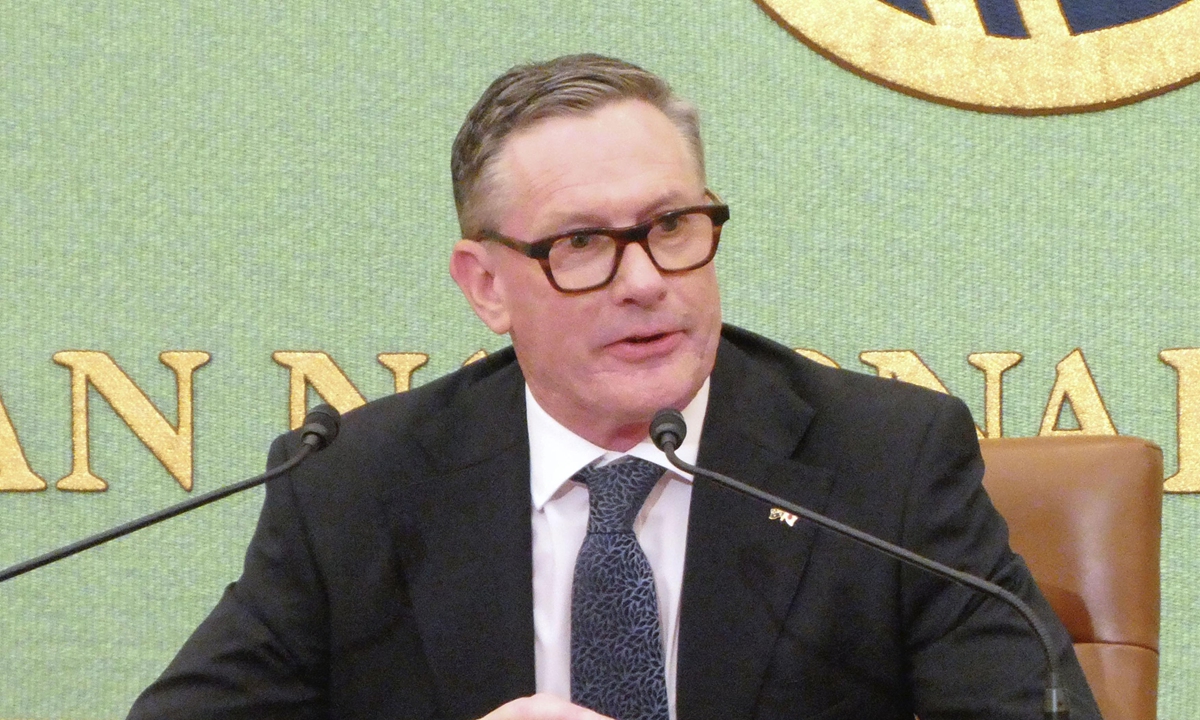
Australia's Ambassador to Japan Andrew Shearer holds a press conference at the Japan National Press Club in Tokyo, on September 9, 2026. Photo: VCG
Andrew Shearer, Australia's newly appointed ambassador to Japan, on Wednesday backed Japan's military buildup, including plans to test hypersonic missiles in Australia, and accused China of "economic coercion." A Chinese expert said the former intelligence chief's remarks reflected a Cold War mentality that casts China as a common enemy to justify Tokyo's military buildup.Speaking at the Japan National Press Club on Wednesday, Shearer said Australia had "welcomed and supported the evolution of Japanese policy to play a more active role in supporting security in the Indo-Pacific," Nikkei Asia reported.
His remarks reportedly came in response to a question from a Chinese media outlet about a recent defense agreement between Japan and Australia involving hypersonic missiles. Shearer claimed Japan was "taking modest, reasonable and appropriate steps to equip itself with deterrent capabilities ... in response to the development of advanced missiles of other countries, including hypersonic missiles."
He cited the missile arsenals of countries including China and Russia to justify Japan's missile development, according to Nikkei.
Japan is set to test hypersonic and other missiles in Australia under an expanded agreement reached after Australian Defense Minister Richard Marles met his Japanese counterpart Shinjiro Koizumi in Canberra, Bloomberg reported on August 18. The agreement would allow Japan to conduct launches at Australian firing ranges over the next decade.
According to Nikkei, Shearer also claimed that, given China's dominance "when it comes to missiles, I don't think anyone could genuinely have a concern about the development of missile systems by Japan."
Shearer's argument follows Cold War logic: to justify their own development of hypersonic missiles, Japan and Australia need to identify an enemy, Zhou Yongsheng, a professor at China Foreign Affairs University, told the Global Times on Thursday.
In Shearer's thinking and his interpretation of Australian policy, China is being cast as that shared enemy, Zhou said. Shearer was aligning himself with the Sanae Takaichi government's portrayal of China as Japan's greatest threat, Zhou added.
Australia previously hyped China's missile test, yet is now defending plans to allow Japan to test missiles on Australian territory, Zhou noted. This inconsistency reflects an approach that prioritizes ideological confrontation and reinforces the "China threat" narrative, treating China differently from other countries, he said.
Over decades of development, China has strengthened trade and economic ties with other countries through peaceful means rather than threatening them with force or launching wars, Zhou said. China does not oppose Australia strengthening its own defenses, but Australia should not use China as either a target or a pretext, he added.
Shearer, the former director-general of Australia's Office of National Intelligence, also alleged that "foreign interference in our political systems and our societies, and espionage against developed democracies, is an increasing threat globally," Nikkei reported.
Zhou said Shearer's intelligence background may make him more inclined to view relations between countries through a Cold War lens, emphasizing a stark division between opposing camps.
Countries should instead give greater weight to economic cooperation and cultural exchanges, rather than emphasize confrontation in ways that undermine relations, Zhou said.
On economic ties, Shearer said both Japan and Australia wished to engage and cooperate with China, mainly in pursuit of economic and business interests, despite differences in geography, history and culture. However, he claimed "we have also been economically coerced by China."
China and Australia have extensive economic exchanges and close trade ties, Zhou said. By raising the claim of Chinese "economic coercion," Shearer was treating Australia's largest trading partner as a threat risks damaging China-Australia relations and undermining regional peace, while lending support to Japan's promotion of the "China threat" narrative, Zhou said.
It is logically contradictory to seek economic gains from China while alleging "Chinese economic coercion." Bilateral trade frictions should not be distorted into economic coercion. Shearer's remarks politicize economic issues to serve geopolitical goals, echoing the Cold War mindset behind Japan-Australia military collaboration, some observers said.
RELATED ARTICLES