How Zhuzhou's rail transit industry illustrates the rise of China's smart manufacturing
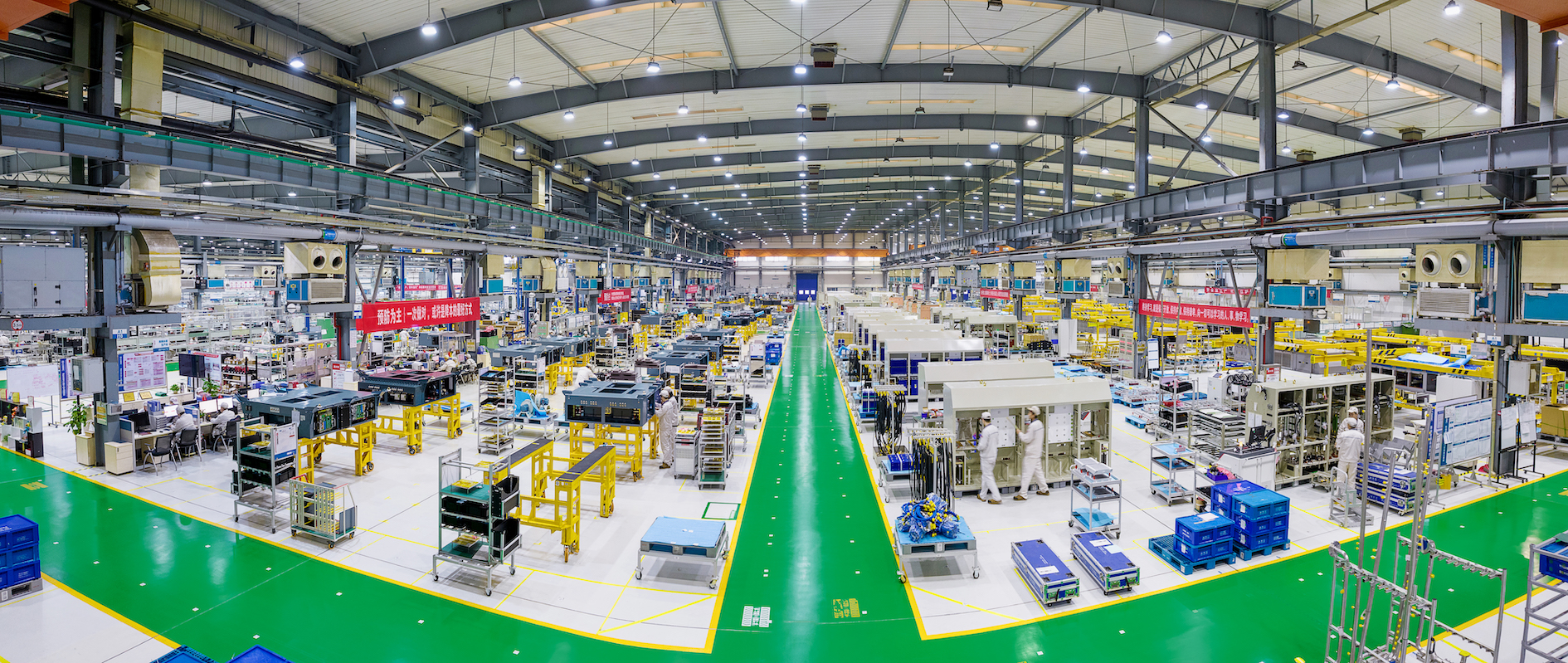
A view of an intelligent manufacturing center of CRRC Zhuzhou Institute in Zhuzhou, Central China's Hunan Province File photo: Courtesy of the institute
On the Lhasa-Nyingchi Railway at over 3,000 meters above sea level, Fuxing Electric Multiple Units (EMUs) thread through the Yarlung Tsangpo Grand Canyon, having carried more than 6.25 million passengers over the past five years.
Thousands of miles away in Mexico City, Chinese-made metro trains are serving the fully renovated Line 1 - 29 modern trainsets carrying a daily ridership of over a million, a symbol of the city's transport modernization.
From the Qinghai-Xizang Plateau to Mexico City, these Chinese trains that span mountains and seas share a common origin - Zhuzhou, Central China's Hunan Province. Zhuzhou leads China in EMU exports, boasting a rail transit industry cluster worth over 160 billion yuan ($24 billion), with products reaching more than 100 countries and regions worldwide.
Locals say the tens of thousands of parts needed to build an electric locomotive can be sourced "over a cup of coffee." What makes this seemingly bold claim possible?
The answer can be found throughout a city, which has made industrial coordination a way of life. Zhuzhou is not merely a place where trains are built; it is a place where China's smart manufacturing strength takes visible shape.
Complete supply chain
A stroll through Tianxin district reveals a rail transit powerhouse packed into a five-kilometer radius: CRRC Zhuzhou Locomotive (CRRC ZELC), the world's largest electric locomotive manufacturing base; CRRC Zhuzhou Institute, which develops the industry's technological "heart" and "brain"; and more than 400 suppliers, including Lince Group. With over 80 percent of components sourced locally, an entire industrial chain thrives within just a few streets.
Inside a CRRC ZELC workshop, locomotive assembly work progresses in an orderly manner. The carbody frames gradually took shape through welding and fabrication, data flickered on digital debugging platforms, and workers moved briskly between stations.
Also rolling out of this workshop is the green multiple unit that races along the Lhasa-Nyingchi Railway - the Fuxing bullet train on the plateau region. It has achieved multiple breakthroughs filling industry gaps, with a maximum operating speed of 160 kilometers per hour and a maximum operating altitude of 5,100 meters, reaching a world-leading level.
A research leader from CRRC Zhuzhou Institute told the Global Times that the "green giants" are an innovative fruit of industrial clustering and efficient collaboration. CRRC ZELC built the complete trains and solved challenges such as oxygen supply, lightning protection and cold resistance; CRRC Zhuzhou Institute interconnected the electric and diesel power systems, enabling free switching between the two - a world first.
Component suppliers play an equally indispensable role. Coordination with over 400 partner companies allows drawing changes to quickly become test-bench samples. Lince Group, for example, has developed cooling system, fans and dampers that hold a leading domestic market position, allowing main manufacturers to complete prototype trials and iterative modifications nearby.
"Zhuzhou's rail transit industry is not merely a clustering of companies, but a complete system led by complete-vehicle manufacturing and supported by coordinated component supply," Wang Lizong, vice chairman of Lince, told the Global Times. "Many parts do not need to be transferred across regions; design, trial production, testing, and improvement can all be completed in a closed loop within a short time."
Path to innovation
Zhuzhou's achievements did not come overnight. They are the result of decades of work by generations of researchers who started from scratch and overcame one formidable challenge after another.
From early technical exchanges to later joint development and independent innovation, CRRC ZELC has consistently cooperated with global partners in a spirit of openness. Its people knew: real competitiveness comes from one's own polishing.
Xie Guangming, a locomotive electrician who has worked at CRRC ZELC for 36 years, recalled what things were like in the 1990s.
"The foreign experts' documents were all in English, and nearly everyone in our team of twenty-odd workers carried a pocket electronic dictionary and a small notebook, writing down debugging methods and parameters one by one, then climbing aboard to check against the real thing," Xie told the Global Times. "A good memory is no match for a worn-out pen," he added.
Today, production that once relied on manpower and experience has shifted to smart factories and digital platforms, where even bolt torque data is automatically uploaded. "From an early importer, learner and customer, we have grown into a long-trusted local service provider and development partner," Xie said with pride.
That pride is backed by world-leading achievements.
In 2025, the CR450 EMU hit a test speed of 450 kilometers per hour in Hubei, setting a new world record for high-speed rail. Such performance demanded a more powerful "heart" - and the permanent magnet traction technology developed by Feng Jianghua and his team at CRRC Zhuzhou Institute was the perfect answer.
As the mainstream next-generation traction system for rail transit, the permanent-magnet synchronous traction system offers outstanding advantages over traditional asynchronous-motor systems: greater compactness, lighter weight, and higher energy efficiency.
But back in 2003, this was far from a proven path. The technology was still in its global infancy, with no benchmark to follow. The team had never worked with it - what they were researching was little more than a concept. "In the direct-current era, we were the catch-up players. In the alternating-current drive era, we aimed to run side by side with the leaders. In the permanent-magnet era, can we take the lead?" Holding this belief, Feng led his team onto the path of independent innovation.
Lacking technical references, they repeatedly studied the limited materials available. Without a ready-made verification platform, they built a permanent-magnet test rig from scratch. To develop a system with a wider speed range and higher efficiency, Feng's team tackled high-speed active field-weakening control technology.
The critical phase fell in August and September, when the laboratory felt like a giant steamer, temperatures soaring above 40 degrees. After more than a hundred rounds of technical comparisons and validations, the permanent-magnet motor field-weakening technology - combining high efficiency, high dynamic response and a wide speed range - was finally born in this "sauna room."
From Xie's worn-out notebooks to the "sauna room" where Feng's team proved the permanent-magnet path, the story of Zhuzhou is that of Chinese manufacturing itself - and today, that story is being rewritten on smart production lines.
Moving smarter
Inside the manufacturing center of CRRC Zhuzhou Institute, automated guided vehicles shuttle between intelligent production lines. In the vast smart workshop, each process operates independently yet coordinates seamlessly with the others in an orderly fashion.
According to the institute, the center has achieved intelligent manufacturing for more than 80 percent of its products. Over 20 advanced production lines are responsible for producing 30 percent of the world's and 70 percent of China's rail transit traction electric drive components, with an annual output value exceeding 10 billion yuan.
"Our products are equivalent to the 'heart' and 'brain' of a train," the head of the manufacturing center told the Global Times. The facility mainly produces train traction drive and control systems as well as new-energy power generation devices. Its annual capacity can meet the installation needs of the "hearts" and "brains" for 200 Fuxing EMUs, 1,000 standard metro trains, and 840 heavy-haul locomotives. The product range also covers train monitoring, industrial converters, and new-energy converters.
If traction and control systems are the "heart" and "brain" of a train, the bogie is its "chassis" - the structure that carries the vehicle, determines ride quality and passenger safety, and demands extreme precision across more than 2,000 parts. At CRRC ZELC Intelligent Manufacturing Workshop, the same smart-manufacturing logic takes a different form.
Inside the workshop, robotic arms work automatically, welding sparks bloom in orderly fashion, and material carts shuttle back and forth.
"Covering about 20,000 square meters, this is the world's first intelligent manufacturing workshop for rail transit bogies. By focusing on the full-process digitalization and intelligentization of bogie R&D, manufacturing, logistics and quality control, it has filled the gap in the digital and intelligent application of bogie technology," Qu Yuan, general manager of CRRC ZELC Bogie Manufacturing Center, told the Global Times.
"Digitalization and intelligentization" are the keys to the smart manufacturing in Zhuzhou - and across China. With the country's manufacturing industry becoming increasingly smart, more and more Chinese products like EMUs will reach far beyond "the Roof of the World" - the Qinghai-Xizang Plateau - and into regions around the world.
RELATED ARTICLES