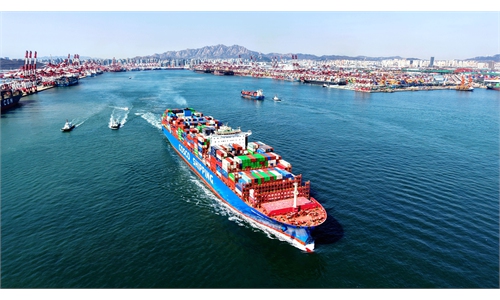
China's trade with APEC economies accounts for over 60% of total foreign trade, underpins stability: experts
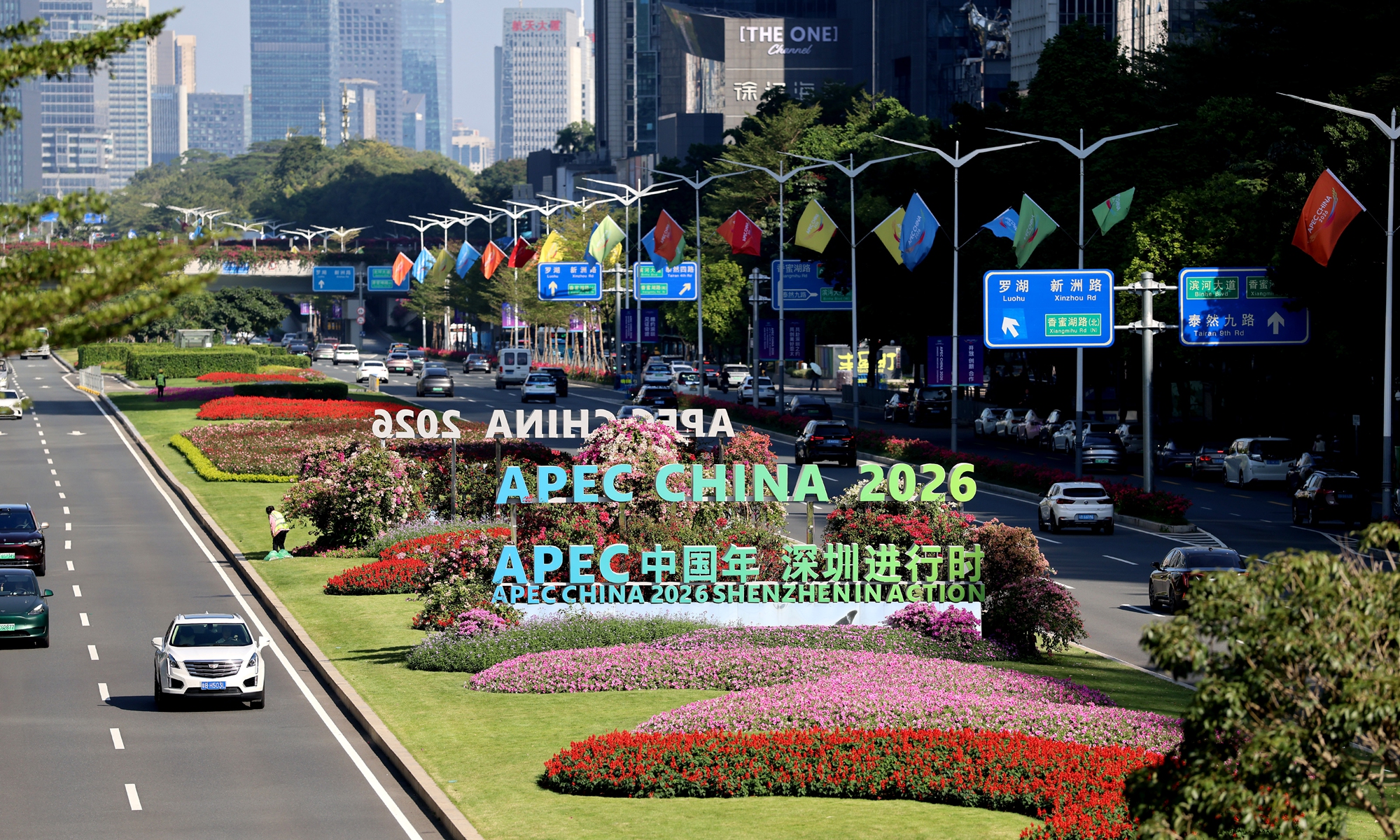
A section of Shennan Boulevard, a major traffic artery in Shenzhen, South China's Guangdong Province, is decorated by flowers on November 11, 2026 as the city is gearing up to host the APEC meetings. Photo: VCG
China's trade with other Asia-Pacific Economic Cooperation (APEC) economies surged 25.4 percent year-on-year to 27.08 trillion yuan ($4.06 trillion) in the first 10 months of 2026, accounting for 60.4 percent of the country's total foreign trade, according to data released by the General Administration of Customs (GAC) on Wednesday.
Chinese experts said the figures underscore the Asia-Pacific region's pivotal role in China's foreign trade, with closer regional economic ties providing a solid foundation for trade growth and strengthening the resilience of regional supply chains.
The growth rate was 5.4 percentage points higher than China's overall foreign trade growth during the period, while the share of trade with other APEC economies increased by 2.6 percentage points from a year earlier, according to the GAC.
China's exports to other APEC economies rose 22.6 percent year-on-year, while imports increased 29.1 percent, outpacing export growth by 6.5 percentage points, according to the GAC.
"APEC economies are a crucial pillar of China's foreign trade," Liang Haiming, president of the Belt and Road Research Institute at Hainan University and head of the Silk Road iValley Research Institute, told the Global Times on Wednesday.
"With other APEC economies accounting for 60.4 percent of China's total foreign trade, the Asia-Pacific region occupies a crucial position in the country's trade landscape. Maintaining stable economic and trade relations across the region is essential to safeguarding the fundamentals of China's foreign trade," Liang said.
China's trade with 14 of the other 20 APEC economies recorded double-digit growth in the first 10 months, with imports and exports with South Korea, Vietnam and Peru each expanding by more than 30 percent, according to the GAC.
Ningbo offers a tangible example of the broader trend reflected in the data released by the GAC.
According to Ningbo Customs, the city's trade with other APEC economies reached 705.98 billion yuan in the January-October period, up 10 percent year-on-year. Exports rose 14.3 percent to 458.87 billion yuan, while imports increased 2.9 percent to 247.11 billion yuan.
Major imports included bulk commodities and mechanical and electrical products, while exports included mechanical and electrical products and labor-intensive goods.
Wang Xiaodong, head of a Ningbo-based metal products company, said the firm had established a factory in Vietnam at an early stage and continued to optimize its cost structure by leveraging the institutional advantages of trade facilitation under the APEC framework.
"In the first 10 months, we imported 31.995 million yuan worth of intermediate goods, including connecting rods and standard sockets, from Vietnam, up 63.3 percent year-on-year," Wang said.
Another Ningbo-based company has also seen the benefits of cooperation during 2026 APEC "China Year," with orders from APEC economies including Mexico and Indonesia continuing to rise and production schedules already extending into 2027.
Chen Shuhui, general manager of the company's overseas resources center, said its exports of elevators and other products to APEC economies reached nearly 90 million yuan in the first 10 months, an increase of more than 20 percent year-on-year.
Liang said both the customs figures and the experiences of individual businesses reflect tangible achievements in regional cooperation and development, while demonstrating the solid market foundations of an Asia-Pacific community.
He noted that China is playing an increasingly diversified role in Asia-Pacific supply chains through the APEC mechanism, extending beyond its traditional role as the "world's factory" to become the "world's market," a regional production hub and a platform for innovation and the application of new technologies.
"These diversified roles have improved the overall efficiency of Asia-Pacific supply chains, lowered the costs of regional coordination and business cooperation, and strengthened the resilience of supply chains across the region, making them more stable and efficient," Liang said.
The GAC said closer economic and trade ties between China and other APEC economies, supported by an open and interconnected regional market, have deepened mutually beneficial cooperation and injected fresh momentum into global economic growth.
RELATED ARTICLES