IN-DEPTH / IN-DEPTH
Why America’s Gen Z is flocking to Chinese coffee and tea chains
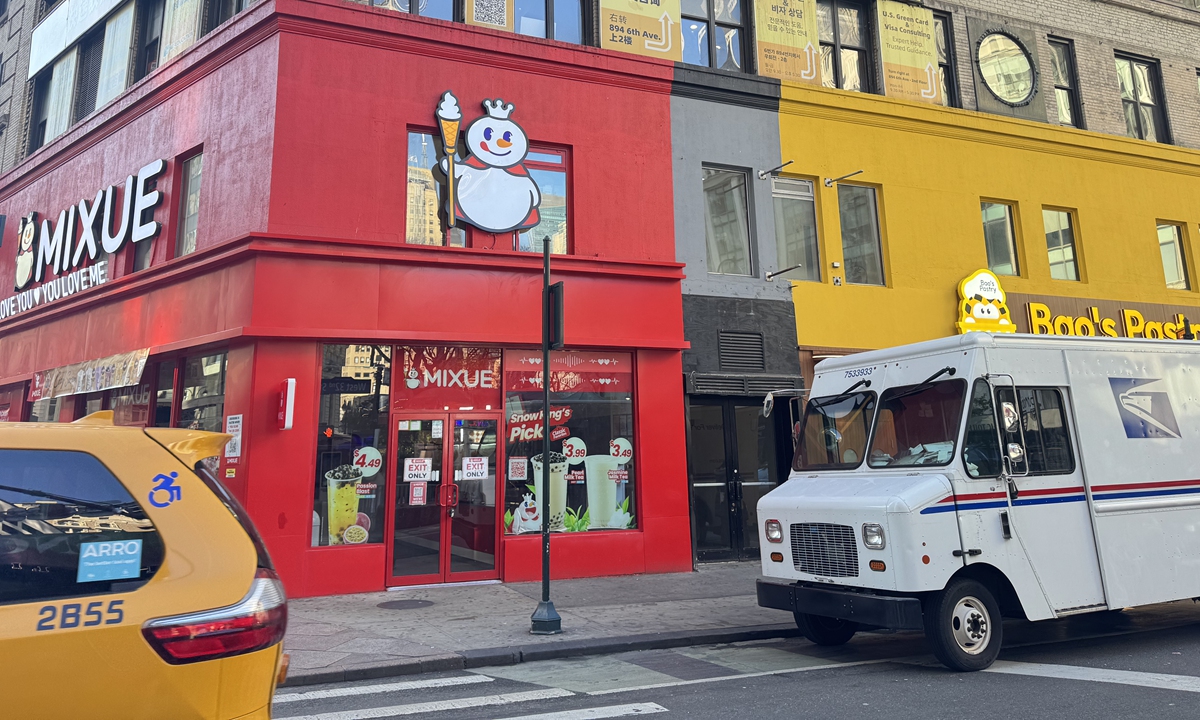
Chinese bubble tea shops and bakeries share the streetscape with postal trucks and taxis in Manhattan, New York. Photo: Courtesy of Helena Zhang
"There are American postal vehicles, New York's yellow cabs, and then Snow King and Baoshifu," Zhang told the Global Times, amused by the combination.
Her messages moved between spotting shops and planning purchases. She wanted to buy small cakes covered in meat floss at Baoshifu; farther along her commute, she would pass Heytea. Brands once associated with shopping streets in China were becoming landmarks on her working day in New York.
That visibility reflects a wider push by Chinese coffee and tea chains into the US. Luckin Coffee, Cotti Coffee, Heytea, Mixue and Chagee are competing for customers with fruit-infused drinks, tea lattes, promotional prices and convenient pickup.
Their arrival coincides with growing online interest in everyday Chinese lifestyles, particularly among younger consumers. The rapid product development and flexible operations honed in China's competitive domestic market are helping these brands attract attention overseas. Turning that interest into lasting demand, however, also requires adapting to higher operating costs and building reliable local supply networks.
Bringing a fresh consumption experience
Near Times Square in Manhattan and along the streets of Flushing in Queens, Global Times reporter has found queues outside some newly opened Chinese coffee and tea shops during afternoon peak hours. From New York to Los Angeles, the brands are bringing drinks, ordering methods and consumption experiences familiar to Chinese customers to the other side of the Pacific.
The first attraction is often the menu. Coconut lattes add another dimension to coffee, while fresh-fruit teas, cheese foam, milk teas made with brewed tea leaves and seasonal specials offer customers a wide range of flavors and textures. Some brands also sell ice cream, giving people another reason to stop by even if they are not looking for a drink.
In China, coffee and new-style tea have long been intensely competitive businesses. Product launches, seasonal flavors and collaborations are regular features of the market. That experience has encouraged companies to keep refreshing their offerings, giving customers reasons to try something different on their next visit.
The US menus combine signature products with local adaptations. Luckin, for example, introduced coconut and velvet lattes alongside Americanos and other familiar options, while adding raspberry and blood orange cold brews tailored to the US market, according to its launch announcement.
One November morning, a banker in Midtown Manhattan walked out of a Luckin carrying a caramelized coffee. Interviewed by Bloomberg, he cited prices, flavor variety, speed, taste and the convenience of ordering through the app as reasons for choosing the chain.
The price comparison can be striking, although promotions make a difference. Bloomberg reported that a 16-ounce pumpkin spice latte at a Starbucks in Penn Station cost $7.45. A nearby Luckin listed its pumpkin pie latte at the same price, but new app users could buy it for $1.99.
Stanley Rosen, a professor of political science and international relations at the University of Southern California, told Bloomberg that the Chinese chains had initially learned from Starbucks. Now, he said, "the Chinese brands have gone beyond Starbucks," pointing to their innovative drinks, ordering speed and competitive prices.
The pace of expansion is making those alternatives more visible. Bloomberg reported on November 14 that Luckin, which entered New York in June 2025, had more than 20 locations in Manhattan. Cotti, which first tested the US market in Honolulu in 2024, had also expanded to more than 20 US stores.
Tea-focused brands including Chagee, Heytea and Mixue are expanding alongside them. Chagee celebrated the grand opening of its first US flagship at Westfield Century City in Los Angeles in May 2025. Mixue's first US openings in Los Angeles and New York in late 2025 drew attention to its low-price offering.
For customers considering an unfamiliar brand, these prices lower the cost of trying something new. Alongside the novelty of the flavors, that gives the chains a practical way to reach people watching their daily spending.
Riding the 'becoming Chinese' wave
The brands' US expansion has coincided with a broader cultural moment. Their arrival is also linked to the "Chinamaxxing" or "becoming Chinese" trend, in which young social media users playfully embrace elements of everyday Chinese life.
On TikTok and other platforms, posts feature activities such as wearing slippers indoors, drinking hot water or tea and trying Chinese breakfast foods. The phrase "a very Chinese time" has become shorthand for this interest. For users living near one of the new shops, buying a Chinese-style drink offers another accessible experience.
Chinese American creator Sherry Zhu has helped popularize the trend through humorous videos sharing Chinese daily habits. CNA reported in February that one of her January videos had attracted 3.1 million views, illustrating the attention such ordinary routines could generate.
In a previous interview with the Global Times, Sun Lin, a researcher at the Center for American Studies at Shanghai International Studies University, told the Global Times that the "becoming Chinese" phenomenon highlights the "shared needs and aspirations embedded in different cultural and social contexts."
He pointed out that the essence of Chinese culture lies in the "ordinary and everyday," and the most natural way for international audiences to understand Chinese values is to experience Chinese life firsthand.
Meanwhile, inside these shops, digital service is another part of the appeal. Customers can order ahead through an app, receive promotional offers, pay and collect their drinks without waiting to place an order at the counter. This can fit a short break or a hurried commute.
New flavors and merchandise give customers further reasons to engage. Limited-edition plush toys, collectible pins and magnets can introduce people to a brand before they have tasted anything on the menu. Some brands are also developing products specifically around their new surroundings.
Singapore's Business Times, citing Bloomberg's reporting, noted that these companies had accumulated experience in customer service, social media marketing and responding to changing tastes while operating in China's vast consumer market. Crowded domestic markets then encouraged them to seek opportunities abroad.
For several brands, that journey began elsewhere in Asia. Mixue opened its first overseas store in Hanoi, Vietnam, in 2018, while Luckin began its international expansion in 2023. The US push follows earlier experience with operating across borders and adapting to different consumer markets
Their expansion carries that experience overseas: rapid product development, digital customer engagement, flexible promotions and brand communication aimed at younger consumers. Local partnerships and menu adaptations add another layer, helping the companies apply those capabilities in a different setting.
Ample room for growth
Global Times reporter has found in the US that Asian customers remain an important customer base at many of the shops, while consumers from other ethnic backgrounds are also coming through the doors.
Zhang's observations offer another view of that developing market. She felt that Chinese customers still accounted for much of the clientele she encountered. Some outlets around Times Square also appeared less crowded to her than during their earlier popularity, and she believed prices could still deter some American customers.
Her account captures one commuter's experience. The wider national market remains far larger than the neighborhoods where the brands have become most visible.
An August survey by consumer insights firm Langston for Bloomberg Businessweek found that 23 percent of Americans aged 13 to 74 had visited a tea or coffee chain originating in the Chinese mainland or the island of Taiwan. Among Gen Z, the figure was 38 percent.
The findings suggest room to reach new customers. They also measure whether people had ever visited, leaving the frequency of return visits as a separate question.
Costs present another challenge. Sandy Lim, S&P Global Ratings' lead analyst for China retail, told Bloomberg that Mixue had scaled back ambitious expansion plans in Japan after high labor and rental costs proved difficult to reconcile with its low-price model.
US operations face similar pressures. New York City's basic minimum wage rose to $17 an hour in January 2026, according to the city government. Rent, utilities, ingredients and distribution add further expenses that a shop's daily sales must cover.
The dense supplier networks that support large chains in China take time and investment to build overseas. Transport costs, tariff exposure and changes in cross-border trading conditions can complicate sourcing, while local procurement requires dependable suppliers and consistent standards.
Some brands are already putting that infrastructure in place. Heytea has established warehouses on the US East and West coasts and works with US distributor Sysco to source milk, fruit and other ingredients locally, according to EyeShenzhen. The company is also developing its global procurement network.
Mixue said at its US launch that it would strengthen sourcing, logistics, production capacity and product research as it expanded. Such investment supports the everyday work of keeping ingredients available and preparing products consistently across outlets.
The companies remain optimistic, although their ambitions extend over different time frames. Chagee told Bloomberg that the US was an important part of its vision of reaching 100 countries. Cotti said its plans went beyond New York and Los Angeles. Luckin's spokesperson put the next step in terms of what its US operations could demonstrate: "We'll scale as the market validates our model."
RELATED ARTICLES