ARTS / CULTURE & LEISURE
Four major archaeological findings give new insight into Yangtze River civilization
Discoveries offer new evidence for understanding the region’s long history
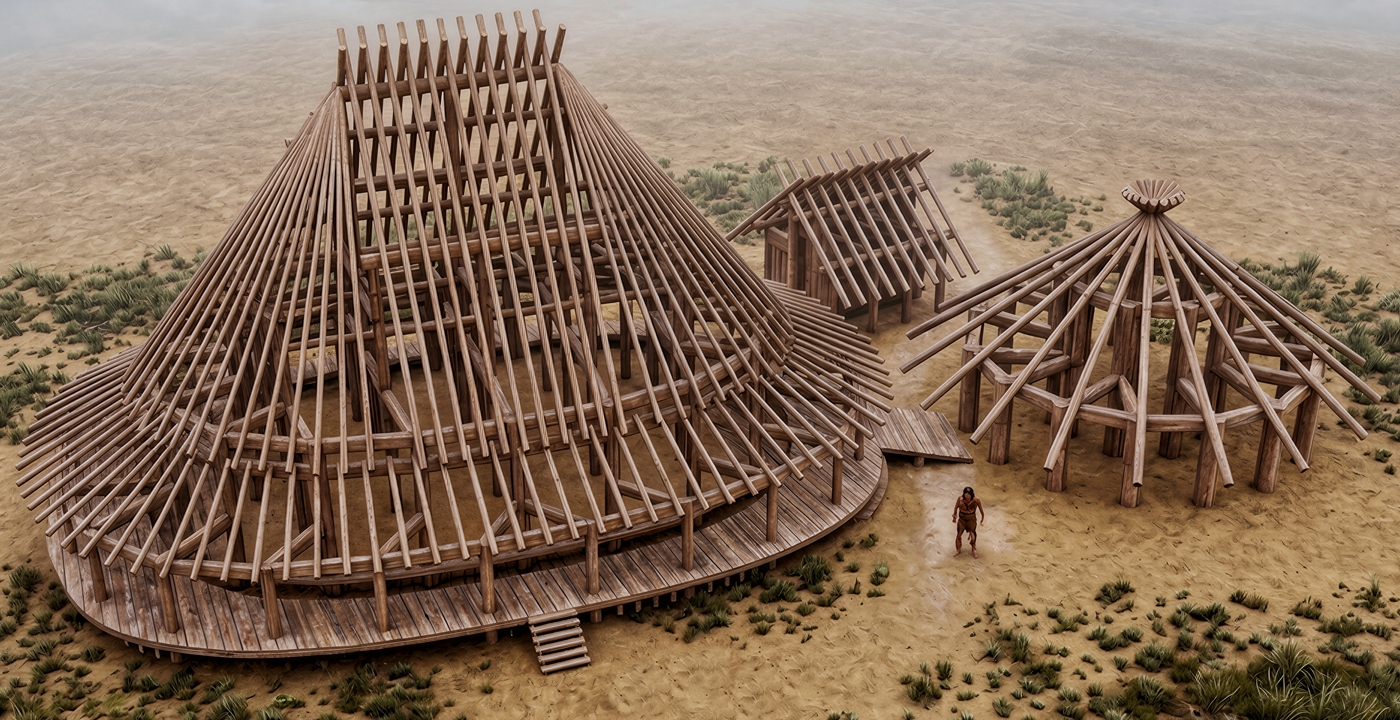
A reconstruction of the buildings at the Fanshan site in the northwestern part of the Liangzhu archaeological site in Hangzhou, Zhejiang Province Photo: Courtesy of the National Cultural Heritage Administration
From the earliest human communities demonstrating sophisticated settlement organization and spatial planning to the ceremonial expression of imperial authority in ancient states, newly unveiled archaeological findings have shed fresh light on the origins of humanity and the development of civilization along the Yangtze River, the National Cultural Heritage Administration (NCHA) told the Global Times on Wednesday.Four major archaeological discoveries were announced at a work conference held by the NCHA in Beijing on Wednesday, offering new evidence for understanding the region's long history and the diverse pathways through which early civilizations emerged and developed.
The new discoveries came from four archaeological sites along the Yangtze River: the Laohudun tomb site in Central China's Hubei Province, the Taohuahe site in Southwest China's Sichuan Province, the Liangzhu culture Fanshan site in East China's Zhejiang Province and the Lingtoushang site, a part of the Qiaomailing sites in East China's Jiangxi Province, according to a press release sent to the Global Times by the NCHA.
The world's third-longest river, the Yangtze River is China's longest waterway and the cradle of the Chinese civilization.
The Qiaomailing site cluster is a large group of pre-Qin (before 221BC) settlement sites, with the Lingtoushang site being one of its largest elevated settlement platforms, covering an area of approximately 60,000 square meters.
Rao Huasong, an associate research fellow at the Jiangxi Provincial Institute of Cultural Relics and Archaeology, told the Global Times that the Lingtoushang site offers new evidence of the cultural interactions between the Central Plains and the middle reaches of the Yangtze River.
The Lingtoushang site is located in a transitional zone between the middle and lower reaches of the Yangtze River. The settlement, dating to the late Neolithic period and the early Shang Dynasty (c.1600BC-1046BC), features diverse cultural elements, reflecting frequent cultural exchanges and interactions between communities in the middle and lower reaches of the Yangtze River.
The Shang Dynasty expanded its influence into the area in pursuit of sources of copper. Located just 40 kilometers from the Tongling ancient copper mining site cluster, the Qiaomailing site cluster has yielded crucibles, furnace wall fragments, copper slag and copper pieces associated with bronze production at the Lingtoushang site, Rao said.
These findings provide archaeological evidence of the Central Plains dynastic state's exploitation and control of metal resources in southern China, said Rao.
The Laohudun tomb site in Hubei is a burial site where the largest concentration of Qin Dynasty (221BC-206BC) bamboo slips was unearthed. The slips cover a wide range of fields, including politics, military affairs, literature, medicine, folklore and art, providing new historical sources for research into the development of the unified empires during the Qin and Han (206BC-AD220) dynasties, as well as models of grassroots social governance, said the NCHA.
Among the unearthed artifacts is a lacquered wooden box bearing the engraved inscription Guang Qinzhe (or literally one who expands Qin's territory). The tomb occupant's decision to have the inscription engraved on the lacquer box and buried with them suggests a sense of identity and pride associated with the expansion of Qin territory, the Hubei Provincial Institute of Cultural Relics and Archaeology told the Global Times on Thursday.
The term can be understood as referring to Qin people who promoted the Qin system of governance and expanded the state's territory. Closely associated with the period of Qin unification, the artifact provides direct material evidence of the formation of a unified state in China, said the institute.
Among the unearthed bamboo slips are materials related to the moral education of women, marking the first time such materials have been discovered through archaeological excavation in China, according to the institution.
Experts said the bamboo slips provide new evidence for exploring changes in the status of women in ancient times, deepen academic understanding of the Qin Dynasty's social governance measures, and shed light on how the dynasty sought to maintain social order through moral instruction.
The main occupation period of Sichuan's Taohuahe site dates back approximately 300,000 to 50,000 years. It is a Middle Pleistocene open-air central camp site with the highest concentration of archaeological remains discovered to date in the Yangtze River Basin, the NCHA noted.
Its distinctive standardized large-flake chopper industry, together with evidence of complex camp organization and spatial planning, is of great significance for research into the evolution of early humans worldwide, according to the NCHA.
The Fanshan site is located in the northwestern part of the Liangzhu archaeological site in Hangzhou, Zhejiang Province. It is the highest-ranking aristocratic cemetery of the Liangzhu Culture discovered to date.
This year marks the 90th anniversary of the discovery of the Liangzhu ruins. With the discovery, Liangzhu took its place alongside the early civilizations of ancient Egypt, Mesopotamia and the Indus Valley.
The discovery of enclosing walls, platforms and architectural remains at the Fanshan site has revealed an overall layout combining burial areas, spaces for ceremonial activities and surrounding enclosure facilities. These findings provide new archaeological evidence for exploring the ceremonial expression of imperial authority and the institutional development of the ancient Liangzhu state, according to the NCHA.
RELATED ARTICLES