China’s vehicle export trains hit 10,000 trip milestone amid surging overseas demand
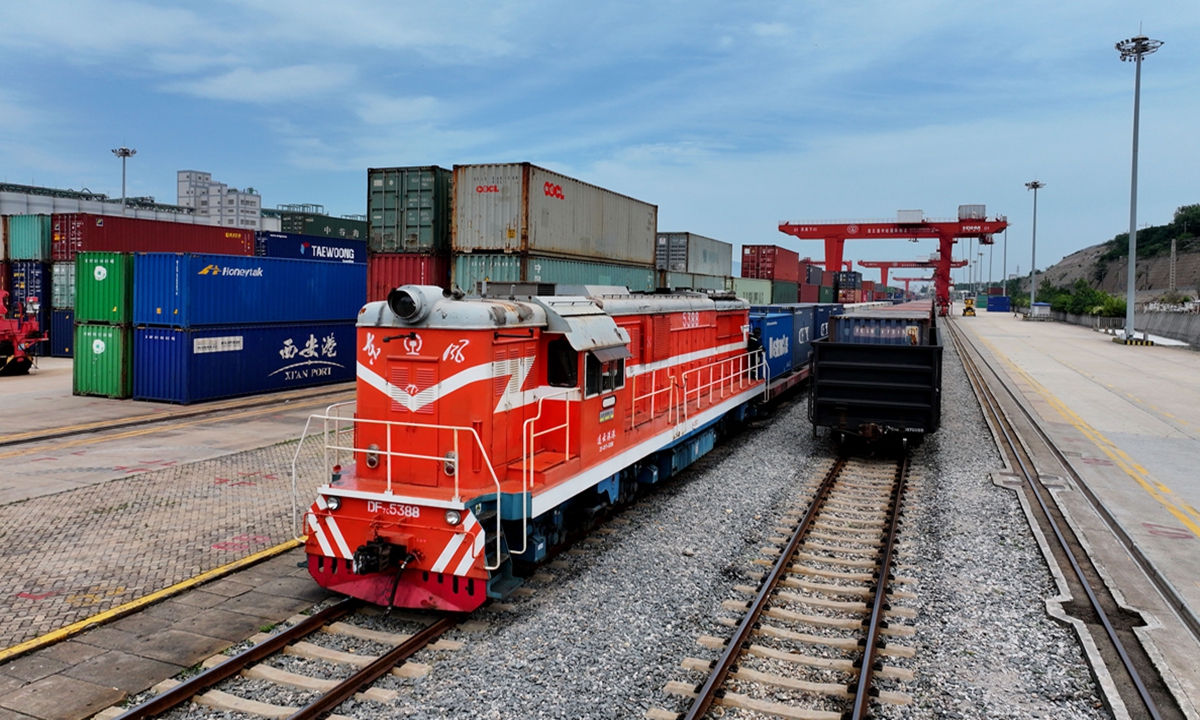
A China-Europe freight train leaves Lianyungang, East China's Jiangsu Province, from the China-Kazakhstan logistics hub, June 10, 2025. Photo: VCG
China's dedicated freight trains carrying domestically manufactured vehicles for export have made a cumulative 10,000 trips, a milestone in the country's expanding automobile exports as growing overseas demand and improving international logistics networks support the industry's global expansion.
The milestone was reached on Thursday when a train carrying 203 Chinese-made new-energy vehicles (NEVs) departed from Zhengzhou International Land Port in Central China's Henan Province, CCTV News reported. The vehicles will travel by rail to Shanghai before being loaded onto a roll-on/roll-off vessel bound for Australia, a journey of more than 10,000 kilometers.
The accelerating rail services reflect robust overseas demand for Chinese-made vehicles. More than 2.035 million vehicles have been transported for export by rail so far this year, up 79 percent year-on-year, according to CCTV News.
The growth comes amid a broader expansion in China's automobile exports. The country exported 9.271 million vehicles in the first 10 months of 2026, up 65.1 percent year-on-year, according to data from the China Association of Automobile Manufacturers released on November 11.
NEV exports reached 4.612 million units during the period, rising 130 percent year-on-year. October alone saw exports of 1.066 million vehicles, marking the fifth consecutive month that shipments exceeded 1 million units.
China's expanding presence in overseas markets has provided further momentum. Industry data showed that Brazil, Belgium, the UK, Australia and Thailand were among the leading destinations for Chinese NEV exports in the first nine months, reflecting demand across Latin America, Europe and the Asia-Pacific region.
Improvements in cross-border logistics have strengthened the industry's export capacity.
To meet growing demand for vehicle exports, railway operators have expanded regular routes through land ports including Horgos, Manzhouli and Alashankou, while using the China-Laos Railway to reach Southeast Asian markets. Combined with expanding rail-sea intermodal services, these routes are strengthening international logistics links for Chinese automakers, a Chinese expert noted.
The expansion of transport capacity and more efficient rail-sea connections are helping Chinese automakers reach overseas customers, underscoring how manufacturing competitiveness and logistics infrastructure are supporting the industry's growing role in global markets, Zhang Xiang, a visiting professor in the engineering department of Zhengzhou-based Huanghe Science and Technology University, told the Global Times on Thursday.
Global Times
RELATED ARTICLES