GT Voice: South Korea may face new test after hitting $1 trillion export milestone
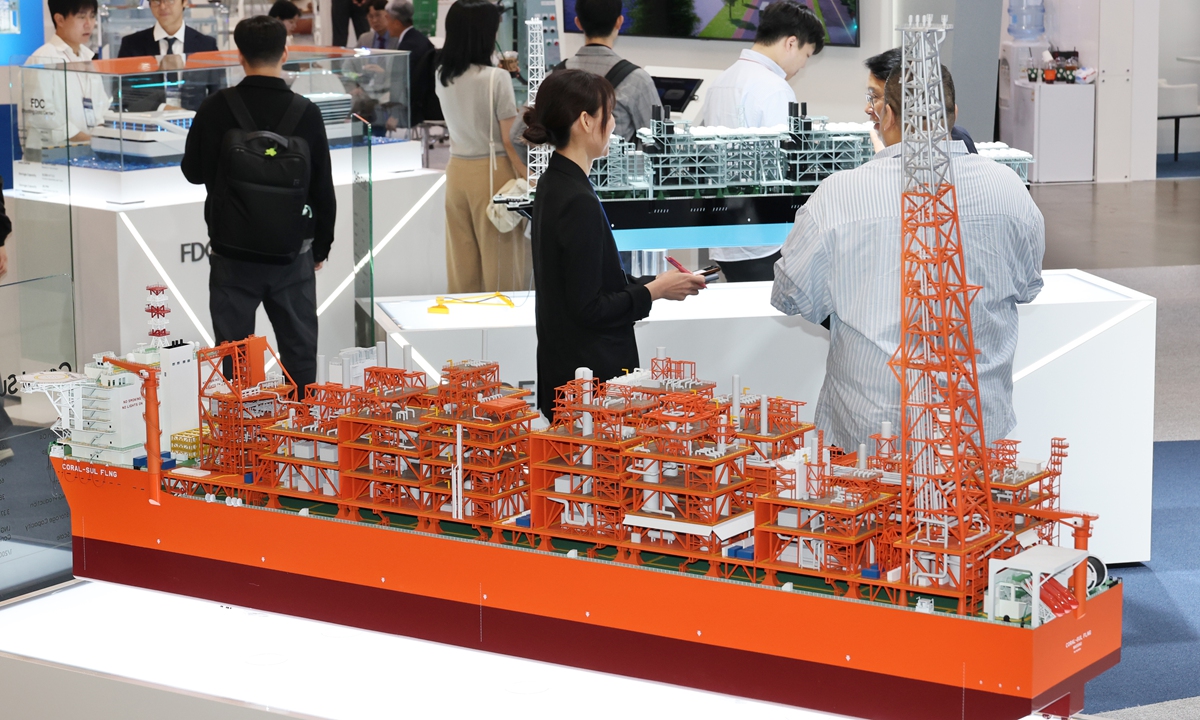
Visitors check out ship models at a booth during the Offshore Korea 2026 held in Busan, South Korea on October 14, 2026. Photo: VCG
South Korea's exports so far this year surpassed $1 trillion for the first time as of Thursday, according to local media reports, which said that the country had become the fourth country in the world to reach the milestone. The achievement reflects the country's manufacturing strength and global demand for its products, particularly semiconductors. But sustaining that success may depend on more than technological competitiveness.
According to The Korea Herald, South Korea is the first new entrant to the trillion-dollar export club in 19 years. What has changed to make this possible now?
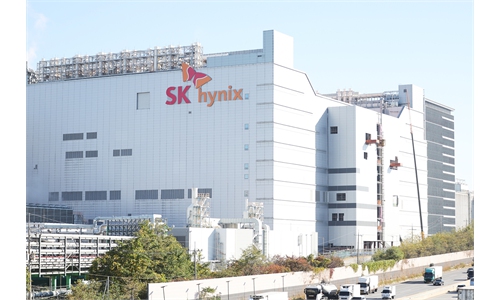
One answer lies in the global artificial intelligence (AI) boom. South Korea appears to have seized this opportunity well, establishing itself as an important export base for memory chips as demand for AI hardware takes off. Its semiconductor exports nearly tripled in the January-October period this year, accounting for 43 percent of the country's total exports.
The question now is whether South Korea can sustain this momentum. Calls for export diversification are understandable, given the country's heavy reliance on semiconductors. But diversification alone may not be enough to secure the next phase of growth.
The advent of AI represents a historic opportunity, creating a scale of global demand that few other industries are likely to match, at least in the near term.
Rather than treating its reliance on semiconductors simply as a vulnerability to be reduced, South Korea may need to build on its current advantage and further deepen its role in the global semiconductor supply chain.
One way to deepen that role is to support AI development in the markets that buy South Korean chips.
There are growing concerns in South Korea that its export success and the resulting trade surpluses could invite greater scrutiny from some trading partners, including India and Turkey, and put pressure on Seoul to address its trade imbalances.
This makes it all the more important for South Korea to demonstrate the broader value of its exports. Helping other economies develop their AI capabilities could make South Korean chips more integral to their technological development and support more lasting demand.
But this depends on South Korean chipmakers staying at the technological frontier and offering trading partners their most advanced products as AI requirements evolve.
These top-tier chips can help support the development of local AI industries and strengthen South Korea's place in the global semiconductor supply chain. Less advanced products are unlikely to play the same role.
That may be easier said than done. Washington increasingly views AI through the lens of global competition. How much freedom will South Korean chipmakers have to sell their most advanced products to other economies without US interference? There is a bad precedent for this.
In December 2024, the Korea JoongAng Daily reported that US restrictions on high-bandwidth memory exports to China threatened to choke South Korean chipmakers, jeopardizing some of their most lucrative dynamic random access memory sales to the world's largest semiconductor market.
The implications may extend beyond the Chinese market. As Washington treats semiconductors as a strategic industry and uses export controls to protect its advantage in AI, South Korea's expanding chip exports could expose growing differences between the interests of the two economies. Those differences could widen as chip exports help propel South Korea into the trillion-dollar export club.
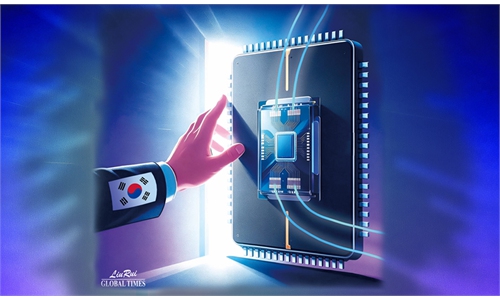
For South Korea, the test may go beyond economics. It will also involve finding room to expand its chip exports amid a complex geopolitical landscape, navigating potential US efforts to intervene more directly in global chip trade, and reaching more customers in developing economies, including China, with its most advanced products.
Having joined the trillion-dollar export club, South Korea now ranks among the world's largest exporting economies, giving it greater influence in global trade.
It has reason to make its voice heard in support of free trade and to turn that commitment into mutually beneficial trade cooperation with partners around the world.
At a critical juncture as the global economy enters the AI era, freer trade and resistance to protectionism and unilateralism can help expand AI-related trade and open up wider markets for South Korean chip exports.
RELATED ARTICLES