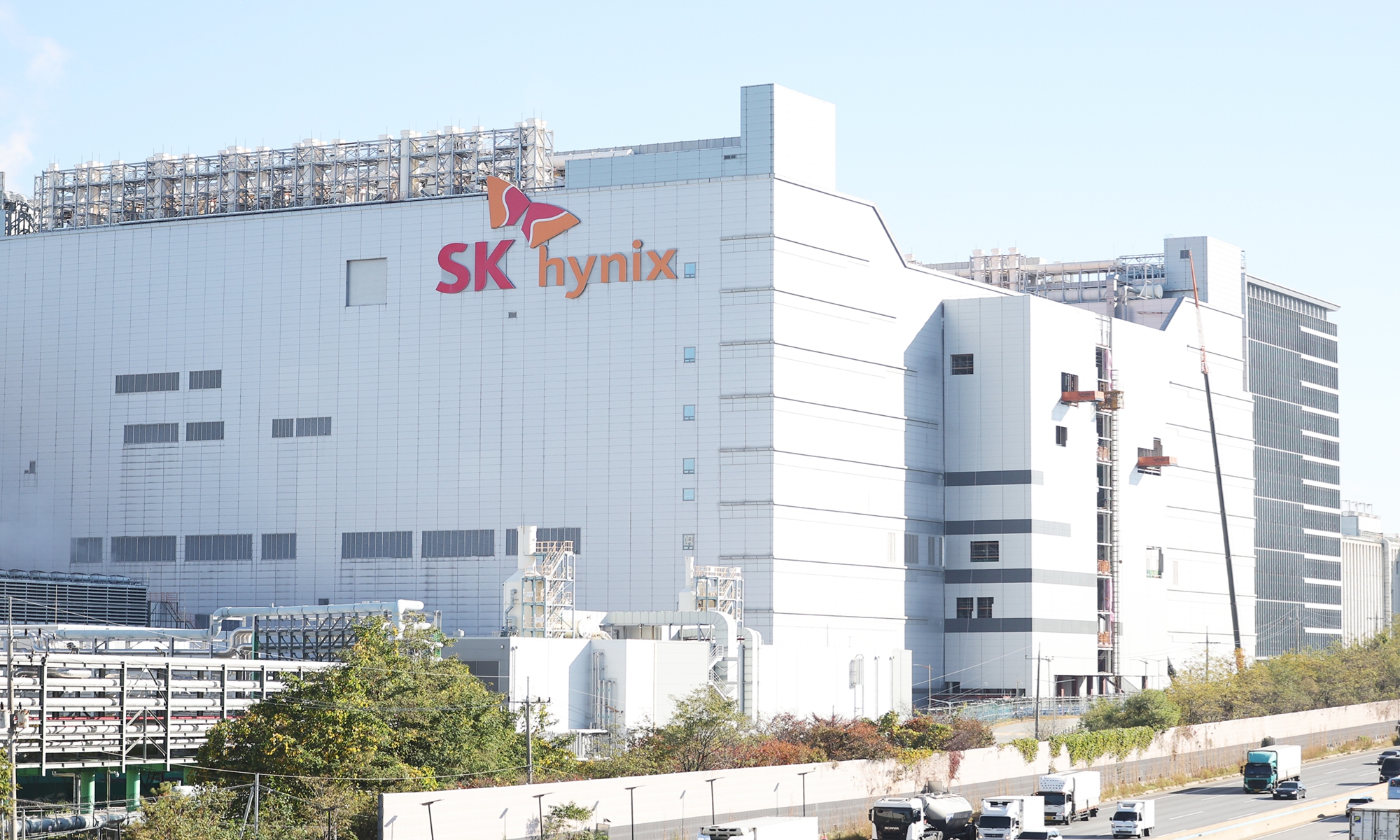
A view of SK hynix's headquarters building in Icheon, Gyeonggi Province, South Korea, on October 28, 2026. Photo: VCG
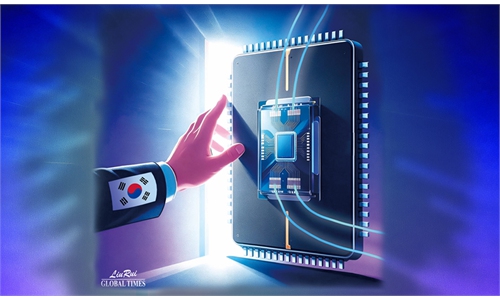
The artificial intelligence (AI) boom is propelling South Korea toward a $1 trillion export milestone. Its exports totaled $930 billion in the first 10 months of the year, putting the country on track to become the fourth nation, after the US, China and Germany, to surpass $1 trillion in annual exports, the Seoul Economic Daily reported on Monday.What lies behind South Korea's bid to join the $1 trillion export club? Several factors are at play, but one deserves particular attention: the global AI boom. International discussions of AI sometimes focus on the contest for technological leadership. Yet the economic demand stemming from the rapid development of AI deserves far greater attention. This demand is helping South Korea knock on the door of the $1 trillion export club.
The force of AI demand is clearly visible in South Korea's October export figures. Semiconductor exports jumped 259.4 percent to $56.44 billion, reflecting continued heavy investment by global technology companies in the AI industry. Computer exports soared 496.6 percent to $5.85 billion, as the spread of AI services drove greater investment in server infrastructure. Electrical equipment exports increased 74 percent to $1.99 billion, reflecting rising demand for transformers, wires, cables, and other equipment used in AI data centers.
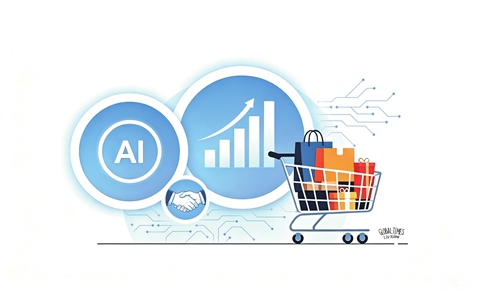
These figures point to a much bigger story. The global expansion of AI is generating enormous demand across industries. This is a powerful new source of growth for manufacturers and exporters around the world.
The 2025 World Trade Report issued by the World Trade Organization (WTO) estimates that with the right enabling policies, AI could boost the value of cross-border flows of goods and services by nearly 40 percent by 2040, thanks to productivity gains and lower trade costs.
South Korea's export figures raise two broader questions. First, can the country cross the $1 trillion threshold and sustain that level of exports? Second, could more economies join the club in the years ahead? The WTO's projections offer grounds for considering both possibilities. If AI continues to fuel global trade growth, the $1 trillion export club may have more members in the years ahead.
To tap into this demand, it is first necessary to understand what drives it. AI is not a single product or industry, but a complex, layered system built on semiconductors, data, computing infrastructure, energy, models and applications. South Korea's export figures offer a glimpse of just how finely specialized this supply chain has become. Alongside chips and computers, exports include transformers, wires, cables and other equipment needed to power and operate AI data centers. These components and capabilities are closely interconnected, linking companies and economies in a global network of production and trade.
Within this global network, China is becoming an increasingly important market as its AI industry advances rapidly. South Korea's trade figures offer a telling example. In October, its exports to China rose 133.6 percent to $26.98 billion, with semiconductors and wireless communication devices among the major export items. China's expanding technology sector is generating demand that reaches beyond its borders.
That picture is difficult to reconcile with claims that China's demand is faltering. In September, China's imports grew at a double-digit rate, while exports also continued to expand. As China's technology exports grow, it continues to import goods, creating opportunities for suppliers in other economies. This two-way trade makes China an important participant in the expansion of global trade in the AI era.
For South Korea to sustain its export growth, deeper integration into global supply chains and open trade will matter. The same applies to other economies seeking to join the $1 trillion export club.
The WTO's World Trade Report emphasizes the importance of an open and predictable trading environment in ensuring that the benefits of AI are widely shared. For South Korea and other economies looking to expand their exports, deeper integration into global supply chains, stronger industrial cooperation and support for open trade may be the keys to unlocking the door to the $1 trillion export club.
RELATED ARTICLES