SCI-TECH / FEATURE
Waste plant built beneath café: Shenzhen turns urban waste into green energy, establishing city where people, nature thrive together.
Waste plant built beneath café
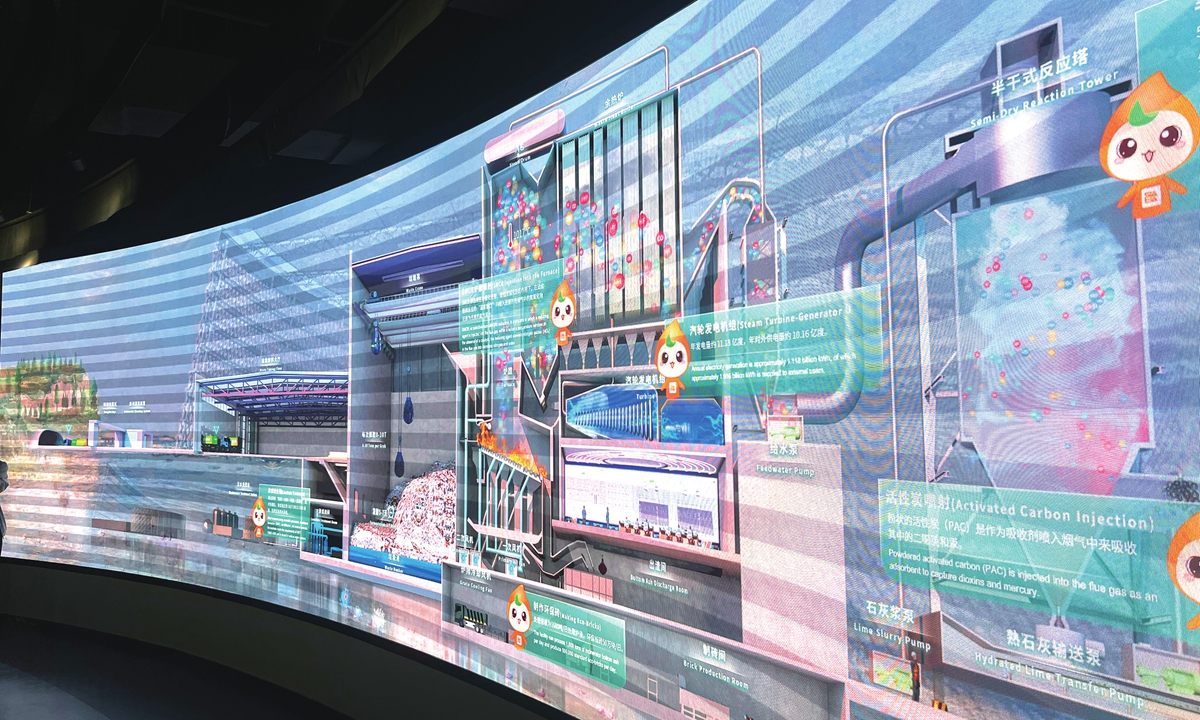
Demonstration of the whole process of garbage disposal
Imagine enjoying a cup of coffee at the Longgang Energy Ecological Park in Shenzhen, South China's Guangdong Province. Seated in a peaceful café, you can gaze through floor-to-ceiling windows at a lush green landscape, with no unpleasant odors in the air - only the aroma of freshly brewed coffee. What might come as a surprise is that beneath this tranquil setting lies a massive waste-to-energy plant that processes 5,100 tons of household waste every day.Having undergone seven rounds of site selection, the facility began operations in December 2019 and opened to the public in July 2023. What was once an industrial facility that might have raised concerns among nearby residents has become a space where people can enjoy coffee, exercise and learn about environmental protection.
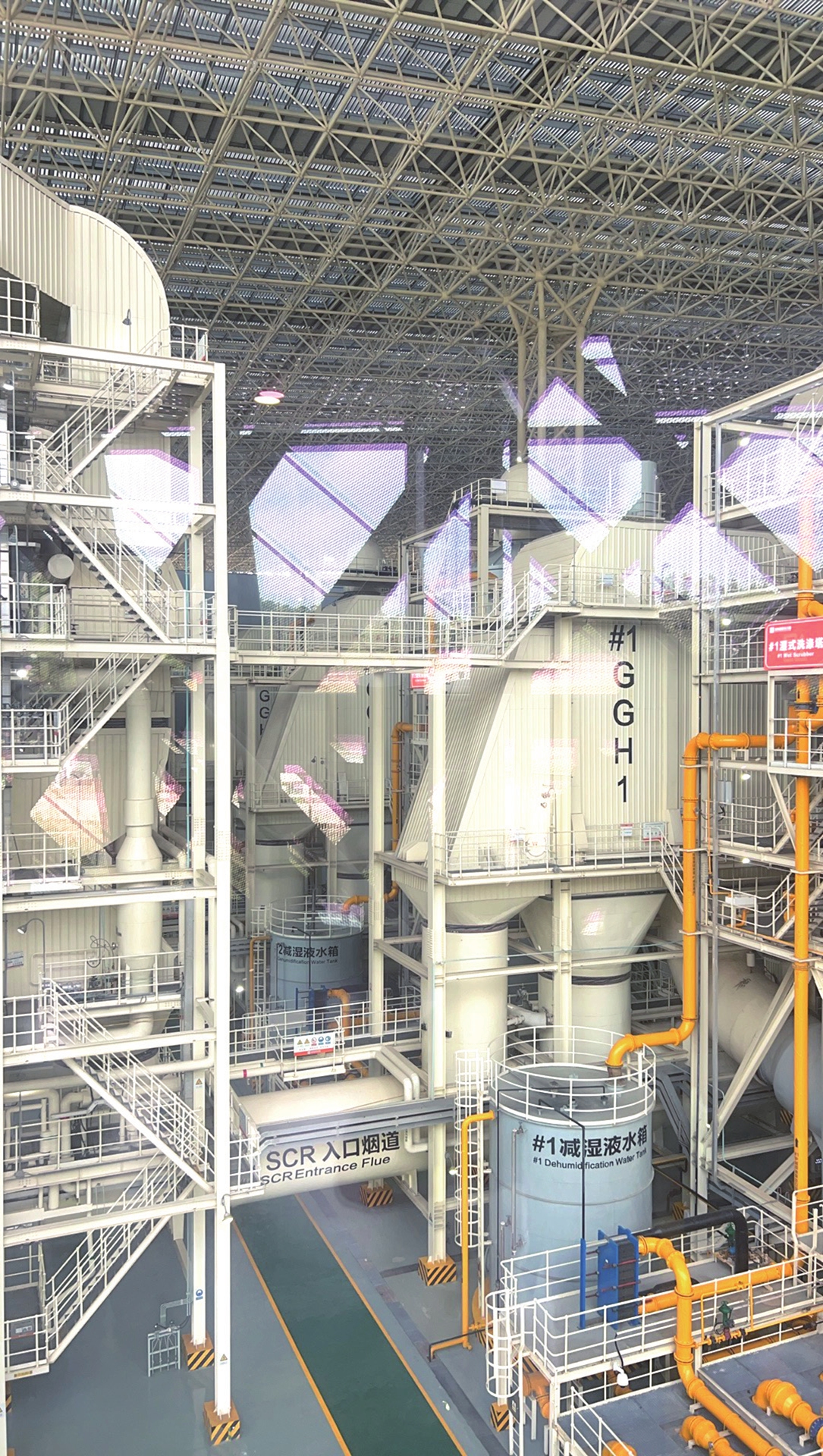
Reaction towers and tanks inside the ecological park
From waste to energy hubThe idea behind the park was to "build a factory while creating a park," Liu Hanjun, an official from Shenzhen Energy Environmental Protection Co Ltd, told the Global Times.
Guided by a "de-industrialization" design philosophy, the project incorporates architectural elements inspired by traditional Hakka residences, bringing industrial production, public education and recreational spaces together.
The fifth floor houses the café, while the seventh-floor rooftop features a circular running track and landscaped green space. Residents who once worried about having a waste treatment facility in their neighborhood can now bring their children here for a walk or enjoy a cup of coffee.
Behind the peaceful surroundings is an extensive energy recovery system. The plant operates six incineration lines and three generating units, producing approximately 3.2 million kilowatt-hours of electricity daily. Its annual power generation reaches around 1.2 billion kilowatt-hours, enough to meet about 60 percent of the industrial and residential electricity demand in the subdistrict. By the first half of 2026, it had cumulatively processed 14.18 million tons of household waste and generated 7.713 billion kilowatt-hours of electricity.
When a foreign journalist asked whether there was really no smell, a guide pointed toward the waste unloading hall, explaining that it operates under an enclosed negative-pressure system, which draws odors into treatment facilities and prevents them from escaping.
Environmental protection is central to the facility's operations. A seven-stage flue gas purification process ensures that emissions are below both China's national standards and EU standards. Real-time emissions data are connected to the national ecological environment monitoring platform.
The park is also home to another environmental innovation, "Lichun," China's first direct air capture (DAC) project to enter commercial operation. Developed by Deep Carbon Technology, the project captures carbon dioxide directly from the atmosphere, marking an important step in bringing DAC, an emerging carbon capture technology, from research and development into commercial application.
China's pursuit of carbon peaking and carbon neutrality also requires practical applications of such technologies. Against this backdrop, "Lichun" demonstrates how industrial facilities can become platforms for combining waste treatment, energy recovery and carbon removal.
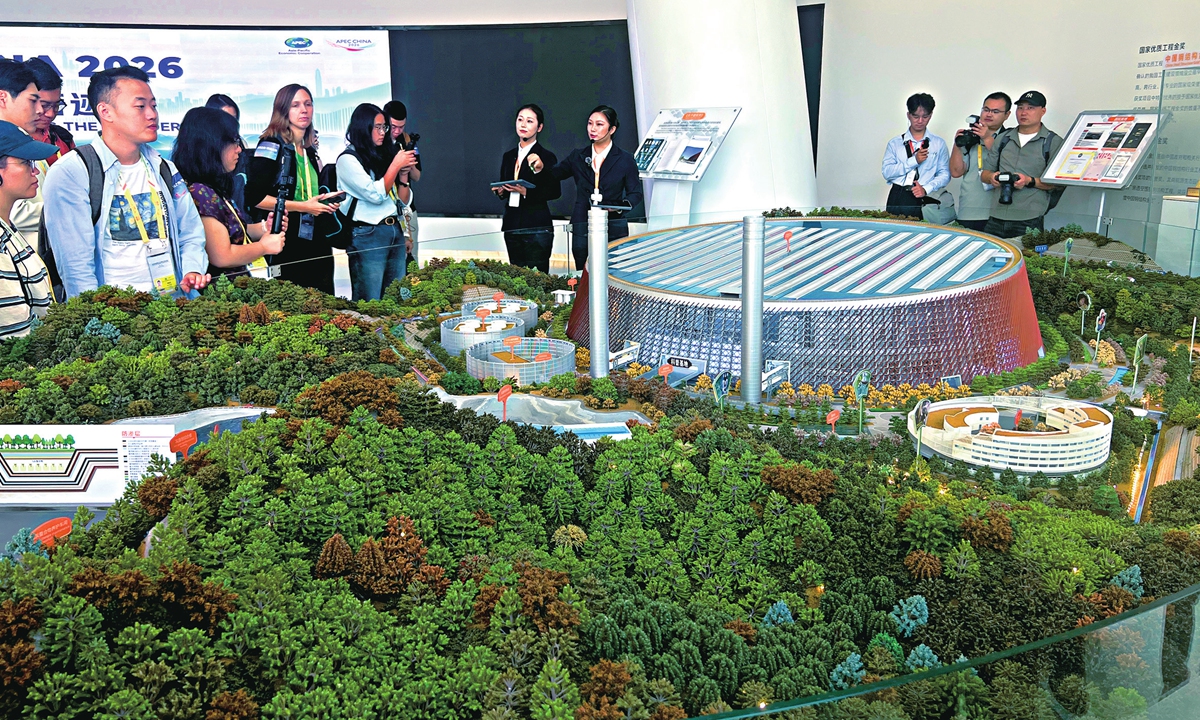
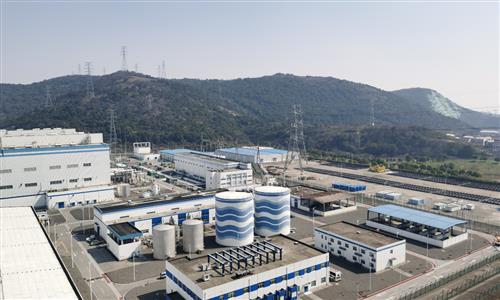
Chinese and foreign media reporters visit Longgang Energy Ecological Park in Shenzhen, South China's Guangdong Province, on November 17, 2026. Photos: Sun Langchen/Global Times
Harmonious coexistenceThe transformation of the Longgang Energy Eco-Park reflects a wider approach to urban development in Shenzhen. Beyond managing the demands of a rapidly growing population, the city is also seeking to preserve its natural ecosystems.
Vietnam National Television journalist Thi Thu Ha Tran, visiting China for the third time and Shenzhen for the first, was impressed by the city's development model. She told the Global Times that she saw a city where economic growth and ecological protection advance side by side, with a well-established industrial supply chain and technological innovations being rapidly translated into practical applications, alongside systematic ecological conservation.
Shenzhen covers approximately 2,000 square kilometers and is home to more than 20 million people and over 6,870 species. In 2025, its GDP approached 4 trillion yuan, while days with good or excellent air quality accounted for 97.5 percent of the year, according to local media report.
For a densely populated megacity, these figures reflect the city's ability to maintain ecological quality while sustaining rapid development.
Wei Fulei, an expert adviser on new energy and low-carbon industries, said Shenzhen's distinctive experience lies in its efforts to build a strong ecological foundation throughout more than four decades of rapid economic growth.
Rather than developing first and addressing environmental problems afterward, the city has made ecological priorities part of its development from the outset, Wei told the Global Times. Shenzhen is also seeking to share its experience with the international community. In July 2026, the city hosted the APEC Meeting of Ministers Responsible for Forestry. During the meeting, the global dialogue on urban governance and sustainable development was held, alongside the launch of the Shenzhen Urban Index System (UIS).
The UIS establishes a comprehensive evaluation framework covering six dimensions: innovation, livability, beauty, resilience, civilization and smart development. By integrating economic development, ecological protection, social governance and quality of life, it translates Shenzhen's urban development experience into a framework that can facilitate international exchanges and provide insights for other cities.
In August, Shenzhen released the white paper on Shenzhen's practices in promoting harmony between humanity and nature. As a key outcome of the APEC forestry meeting and an important component of the UIS initiative, the publication documents more than four decades of the city's efforts to coordinate high-quality economic development with high-level ecological protection.
From turning household waste into electricity to capturing carbon directly from the atmosphere and protecting natural ecosystems, Shenzhen is exploring different ways to balance urban development with environmental preservation. One approach improves the city's resource circulation, while another protects the natural environment that sustains biodiversity.
As Wei noted, the world needs Shenzhen not only as a "miracle city," but also for its exploration of how a densely populated megacity can coexist with nature. Beneath a café, a waste treatment plant is generating electricity; across the city, technological innovation and ecological conservation are shaping a different vision of urban growth. For Shenzhen, a greener future is not separate from development, but an integral part of it.
RELATED ARTICLES