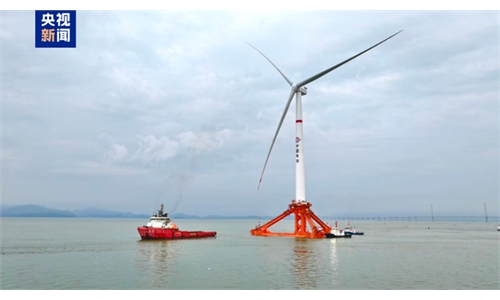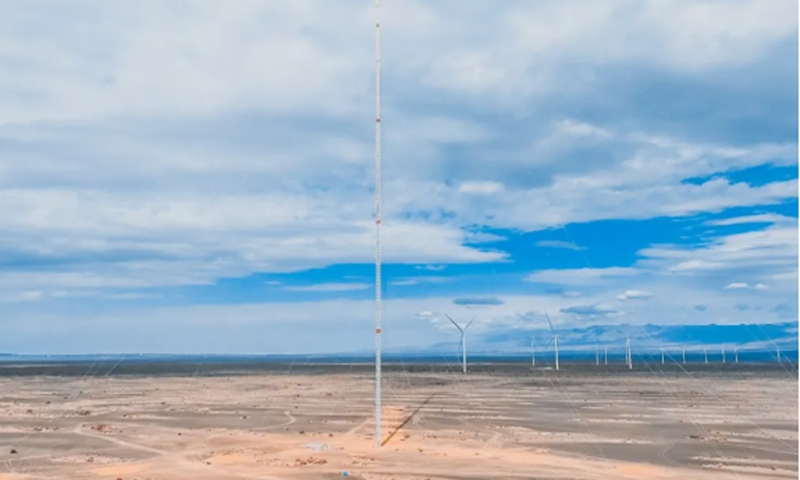
The 360-meter-tall wind measurement tower in Mulei county, Northwest China's Xinjiang Uygur Autonomous Region Photo: Science and Technology Daily
A 360-meter-tall wind measurement tower has been completed and put into operation at an 800,000-kilowatt experimental wind farm in Mulei county, Northwest China's Xinjiang Uygur Autonomous Region, making it the world's tallest wind measurement tower in the wind power industry, the Science and Technology Daily reported on Tuesday.
It marked a new step forward in China's capabilities in high-altitude wind observation and wind power technology validation, according to the report.
The tower is a major achievement in the construction of the Mulei experimental wind farm in the Changji Hui autonomous prefecture, and is expected to enhance China's ability to observe high-altitude wind resources and conduct testing and validation, the report said.
Zhang Ziping, executive deputy general manager of the Xinjiang Guochuang Wind Power Technology Co, told the Science and Technology Daily that the tower can conduct gradient observations of wind speed, wind direction, wind shear, turbulence intensity and atmospheric stability at different heights.
The data collected will support research into high-altitude wind energy and provide a basis for validating the design of larger wind turbines and the development of new power systems, Zhang said.
Leveraging the experimental base, the operator will focus on cutting-edge wind power technologies and establish an open and shared research platform, according to Zhang.
The platform is expected to promote closer collaboration among government departments, universities, research institutes and enterprises, while supporting the standardization of wind resource observation, the validation of theories and models, and the development of new wind measurement equipment, he said.
These efforts will provide technological support for China's energy transition and its "dual carbon" goals of peaking carbon emissions before 2030 and achieving carbon neutrality before 2060, he noted.
Mulei county lies in a core area of 10 major wind zones and five major solar energy zones in Xinjiang. In recent years, the county has accelerated the development of its new energy industry.
In 2025, Mulei completed Xinjiang's first county-level new energy base with both wind and photovoltaic power capacity exceeding 10 million kilowatts, further strengthening its position as a hub for renewable energy development.
By the end of 2025, Xinjiang had built six 10-gigawatt-class renewable energy bases spanning the entire region, with total installed renewable capacity reaching 169 million kilowatts, or 64 percent of its total power capacity, the Xinhua News Agency reported on September 7.
As a key generating end of China's west-to-east power transmission endeavor, Xinjiang had cumulatively transmitted 304.36 billion kWh of renewable electricity to other regions as of March 18, accounting for roughly 30 percent of its total outbound power supply, according to the local branch of State Grid, according to the report.
RELATED ARTICLES