Riding green wave: How Zhuzhou turns a locomotive legacy into a low-carbon future
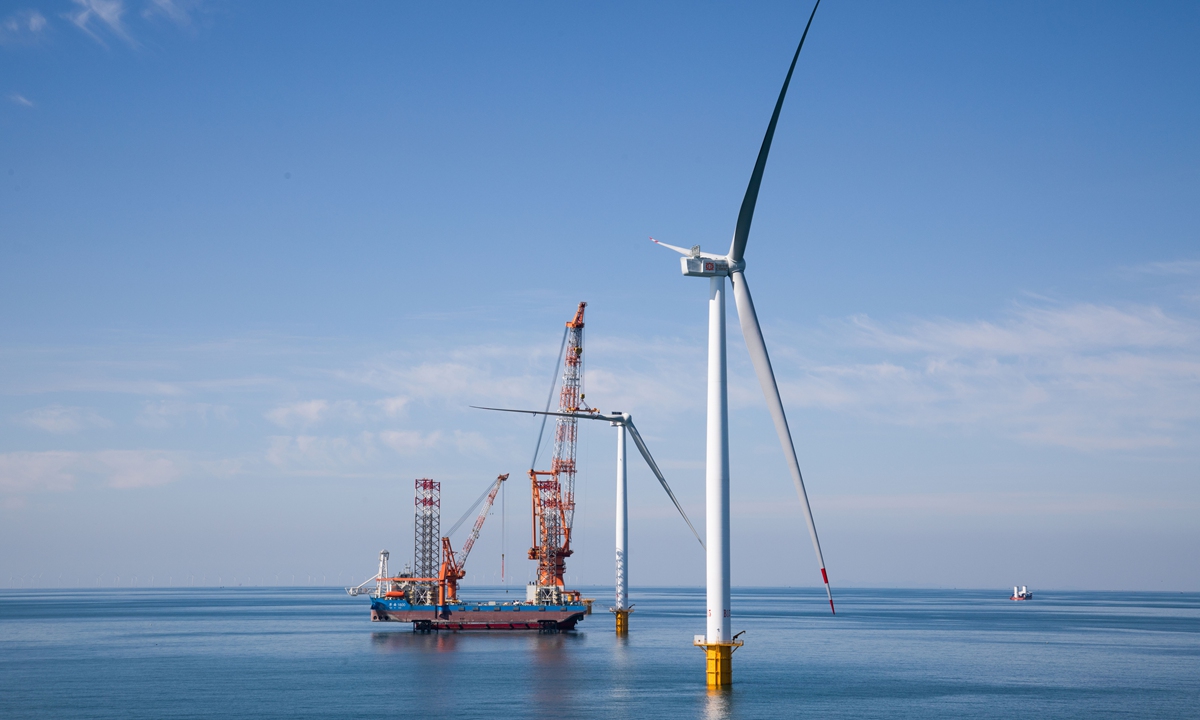
A view of an offshore wind power project of CRRC Zhuzhou Institute in East China's Shandong Province File photo: Courtesy of the company
Zhuzhou city, in Central China's Hunan Province, has long been known as "China's electric locomotive capital." In its Tianxin District, within a five-kilometer radius, the tens of thousands of parts needed for an electric locomotive can be gathered in a time span when one could finish a cup of coffee. Yet the city has now taken a new path — a green one.
In one of the city's workshops, an old diesel locomotive sits on the tracks. Its engine has been lifted out, leaving a wide-open compartment. Workers slide in the battery system, connect the wires, close the covers, and tighten the bolts — giving the lifelong diesel burner a new "green heart." This is the retrofit bay of Zhuzhou Lince Group, a traditional supplier of fans, cooling systems and structural parts for locomotives, now converting old diesel locomotives to battery power.
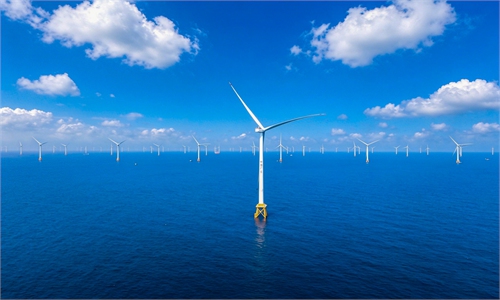
Just a few kilometers from Lince, CRRC Zhuzhou Institute has taken the power-conversion technology refined over decades on high-speed trains and put it to work in the wind. On the production line, workers assemble nacelles and hubs; complete turbines roll off one after another, heading to the Gobi deserts of the northwest and the snowy plains of the northeast, delivering a steady flow of green power.
It is a clear snapshot of China's manufacturing shift toward sustainability: more and more companies are riding the green wave, turning low-carbon from a slogan into real market opportunities and unlocking new growth along the way.
New 'green heart'
Speaking of the drivers behind the company's transformation, Wang Lizong, vice chairman of Lince, told the Global Times that the rail transit market is nearing its capacity ceiling. Against the backdrop of the country's "dual carbon" goals, the company shifted its focus to converting aging diesel locomotives to new energy, where demand for replacing the existing fleet is now being unleashed.
The transformation was far from straightforward. Li Changqi, head of the company's new-energy locomotive conversion project, recalled the challenges: his team had to take a diesel locomotive that had been in service for more than 20 years, remove its diesel engine, and replace it with a power battery pack, converter system, and intelligent control system.
Beyond the mechanical structural modifications, they also had to overcome a host of entirely new technical hurdles, including battery thermal management and energy control.
"With no ready-made conversion model to follow, we started from scratch — drawing up designs, running simulations, and conducting prototype tests. From blueprints to workshop retrofitting and debugging, we even followed the converted locomotive to a steel plant to collect real-world heavy-haul operating data," Li told the Global Times.
In the end, they preserved the locomotive's original main structure while completely replacing the diesel generator set with a power battery system. Overall efficiency rose by 15 percent, and energy costs dropped by 80 percent. Taking the DF4B diesel locomotive as an example, each converted unit cuts carbon emissions by 670 tons — equivalent to planting 36,700 trees.
Wang highlighted the advantages of the Tianxin industrial cluster. Taking the complete "diesel-to-electric" conversion of aging locomotives as an example, he said that the components came from core suppliers within the cluster, and the company completed traction and braking performance tests, car-body fatigue tests, and more.
"The first 'diesel-to-electric' locomotive went from project launch to rolling off the production line in just over four months — precisely because of the local supply-chain collaboration that enabled rapid prototyping and validation," Wang told the Global Times.
Standing 'high-speed rail'
The world's highest wind farm, located in Baxoi county, Xizang Autonomous Region, has been running stably since achieving full-capacity connection to the grid. The project with the highest nacelle at an altitude of 5,305 meters set a new record for China, as well as the world, in wind power projects in terms of altitude.
On the "Roof of the World," where the average elevation reaches 5,050 meters and peaks at 5,200 meters amid frequent extreme weather, the wind turbines developed by CRRC Zhuzhou Institute have demonstrated outstanding reliability and highly efficient power generation.
Within the company, wind power equipment is vividly likened to "high-speed trains standing upright." "At their core, both wind power and high-speed rail involve the conversion between mechanical energy and electricity; from a technical standpoint, the logic is exactly the same," Cao Xiao, general manager of the wind power division at CRRC Zhuzhou Institute, told the Global Times.
In the rail transit sector, CRRC Zhuzhou Institute's alternating-current electric-drive freight locomotives have operated in regions at altitudes of up to 5,000 meters, building deep technological expertise and a strong track record of success in overcoming challenges such as electrical insulation, ultraviolet protection, and lightning protection. "These application experiences have been effectively transferred to our wind turbine products, giving us a high starting point," Cao noted.
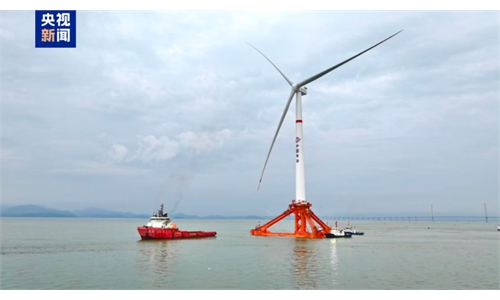
In addition to high-altitude applications, the institute is also actively developing wind power equipment tailored to Gobi-desert-wasteland, mountainous, as well as offshore environments. In January 2025, the world's then-highest-capacity floating wind turbine was successfully installed, marking a significant step forward in the company's exploration of ultra-large offshore wind turbines.
"High-speed rail technology is highly complex; what many other industries actually use is just one segment or section of it." So far, CRRC Zhuzhou Institute has helped incubate emerging industries such as photovoltaics, new-energy vehicles, and energy storage, and become a promoter and leader in realizing the country's "dual-carbon" goals.
The "high-speed train standing upright" is more than a metaphor inside CRRC Zhuzhou Institute. It captures what is happening across Zhuzhou: technology proven on rails is being "lifted off the tracks" and set down where the wind blows, while locomotives that once burned diesel are being given a second life with a green heart.
"One city, two directions — retrofitting the old, cultivating the new." That is the shape of China's manufacturing transition in miniature -- not a single breakthrough, but thousands of workshops quietly changing what they build and how they build it. That is how national climate targets become measurable outcomes — not in slogans, but on factory floors across the country.
RELATED ARTICLES