China's first offshore carbon injection project advances, targeting 1.75 million cubic meters of CO2 daily
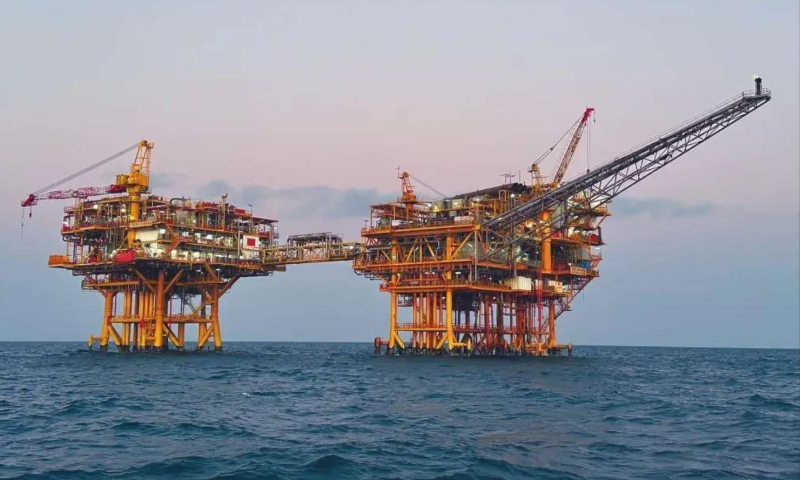
The carbon capture, utilization and storage project at the Dongfang 1-1 gas field in South China's Hainan Province. Photo: Xinhua
China National Offshore Oil Corporation (CNOOC) on Friday announced that the 17,000-ton central platform for a carbon capture, utilization and storage (CCUS) project at the Dongfang 1-1 gas field has been loaded onto a vessel, marking the completion of onshore construction and the start of offshore transportation and installation.Once operational, the project will be able to purify up to 1.75 million cubic meters of carbon dioxide (CO2) per day and permanently store more than 1 million tons of CO2 underground annually.
The platform has been loaded onto a vessel and is scheduled for offshore installation in December. The CCUS project is the country's first demonstration project for the application of offshore carbon injection technology to boost natural gas production.
Located in the Yinggehai waters in the northern South China Sea, the Dongfang 1-1 gas field is China's largest self-operated offshore gas field. Since starting production in 2003, it has produced over 50 billion cubic meters of natural gas.
As the field enters the middle and later stages of development, natural gas output has gradually declined while associated CO2 content has continued to rise, creating the need for innovative solutions, China Media Group reported on Friday.
The new CCUS central platform, standing more than 28-stories tall and has a total deck area of over 10,000 square meters, establishes a complete closed-loop system for offshore CO2 capture, purification, storage, and gas displacement. All key equipment is domestically produced. Energy consumption is 20 percent lower than traditional processes, and natural gas recovery rates are improved by more than 12 percent, according to CNOOC.
Carbon injection technology for enhanced gas recovery is a branch of the broader CCUS technology system. Its core principle is to turn CO2 produced during natural gas extraction from waste into a resource by capturing, purifying and pressurizing it before reinjecting it into gas-bearing formations. The injected CO2 then acts as a driving force to displace and recover hard-to-extract natural gas.
After being put into operation, the platform will connect with 12 other facilities in the Yingge waters area.
An industry insider told the Global Times that China's coastal provinces account for roughly half of China's CO2 emissions, yet suitable onshore storage sites nearby are limited.
"Marine geological storage is therefore an essential pathway for emission reduction. The Dongfang 1-1 project is not only extending the life of a mature gas field but also paving the way for the expansion of China's offshore CCUS capabilities," said the insider.
China previously deployed the country's first offshore oilfield CCUS project at Enping 15-1 oilfield in waters near the Pearl River and the first offshore gas field carbon capture and storage project at Ledong 15-1 gas field, also in Hainan.
Global Times
RELATED ARTICLES