All 9 recovered engines from China’s Zhuque-3 reusable rocket pass acceptance tests, qualifying for reflight
By Published: Nov 20, 2026 09:49 PM

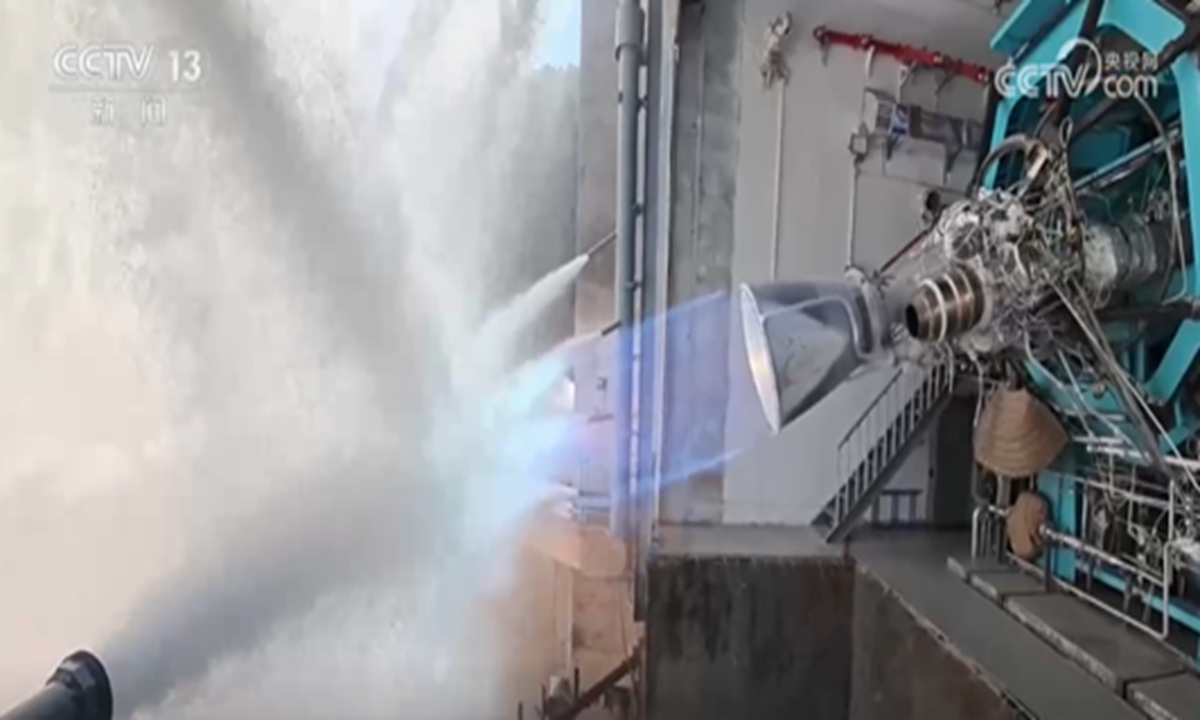
A recovered engine of the Zhuque-3 rocket undergoes a hot-fire test at a facility in Huzhou, East China's Zhejiang Province. Photo: Screenshot from media reports
Chinese private aerospace company LandSpace said on Friday that all nine TQ-12A liquid oxygen-methane engines recovered from the first stage of its Zhuque-3 Y2 rocket flight in August have completed ground acceptance testing, marking a milestone that moves China's commercial space industry closer to its first orbital-class reflight of a recovered booster.
A Chinese expert said the announcement indicated progress in mastering the reusable launch technology, which is a must-have in achieving mass launches.
The engines - which powered the August 19 flight that delivered China's first land-based landing of an orbital-class rocket first stage using deployable landing legs - were disassembled one by one after touchdown in Northwest China's Gansu Province, and shipped to the company's Huzhou powertrain base in East China's Zhejiang Province for maintenance and requalification.
According to a press release LandSpace sent to the Global Times, post-flight inspection showed normal function and strong data consistency. When compared with pre-flight telemetry, the performance curves met delivery criteria, clearing the engines for another flight.
According to LandSpace, the first stage accounts for about 70 percent of the Zhuque-3's total build cost, while fuel only accounts for 1-3 percent of launch expenses. Reusing the nine-engine cluster is expected to greatly reduce the per-kilogram price of a launch, with the company aiming to reduce launch costs of the Zhuque-3 to below 20,000 yuan ($3,000) per kilogram.
This is the first time LandSpace has carried out a systematic overhaul and re-ignition test on TQ-12A engines that have actually flown on a mission and been recovered - a step the company describes as "demonstrating the engineering feasibility of post-recovery refurbishment and reuse."
During the roughly 185-second hot-fire test, the engine was tested under varying thrust levels and mixture ratios. Hu Pengrui, deputy director of LandSpace's propulsion test department, said the test aimed to verify assembly quality and obtain post-flight performance data.
"The nine engines performed normally, with good data consistency matching pre-flight baselines," he said. "They fully meet the conditions for reuse."
It is the first time that LandSpace has recovered engines, after experiencing flight heat, vibration and landing shock, and then refurbished and tested them. Appraisals were done on some key parts and some fasteners were replaced or tightened.
Jiao Yamin, head of integrated planning at the Huzhou base, noted the hardest call was deciding the extent of the inspection: "Which parts must be opened, which can stay, what state still allows flight - that only comes from real flight data. Over time we will cut unnecessary teardown and strive for simple testing at the recovery site before the next flight."
As flight and recovery data accumulate, LandSpace said it will keep refining its post-recovery refurbishment process, streamlining unnecessary disassembly and repetitive checks as reliability allows and shortening the turnaround from recovery to reflight.
Yang Kewei, executive deputy director of the Commercial Space Research Center at the China Center for Information Industry Development, told the Global Times that developing and honing reusable launch technology occupies a critical position in the development of China's commercial space sector this year.
"Balancing reliability and costs, further improving industrial chain coordination, achieving a balance of manufacturing and application are all important aspects. Progress in these areas will be essential in unlocking the sector's commercial potential and delivering tangible economic and public-service benefits," Yang said.
The Zhuque-3 is a domestically developed, reusable launch vehicle that has been developed for large-scale satellite constellation networking missions. In addition to a reusable first stage, it features a stainless-steel body structure to reduce costs. It has a liftoff weight of approximately 570 tons and a total length of about 66 meters.
Its August flight came shortly after China's Long March-10B reusable rocket successfully completed its maiden flight and a sea-based net recovery test on July 10, marking a wave of breakthroughs in reusable launch technology.
RELATED ARTICLES