IN-DEPTH / IN-DEPTH
Chinese AI tools support emissions monitoring and climate resilience while building local expertise across Global South
Shared intelligence


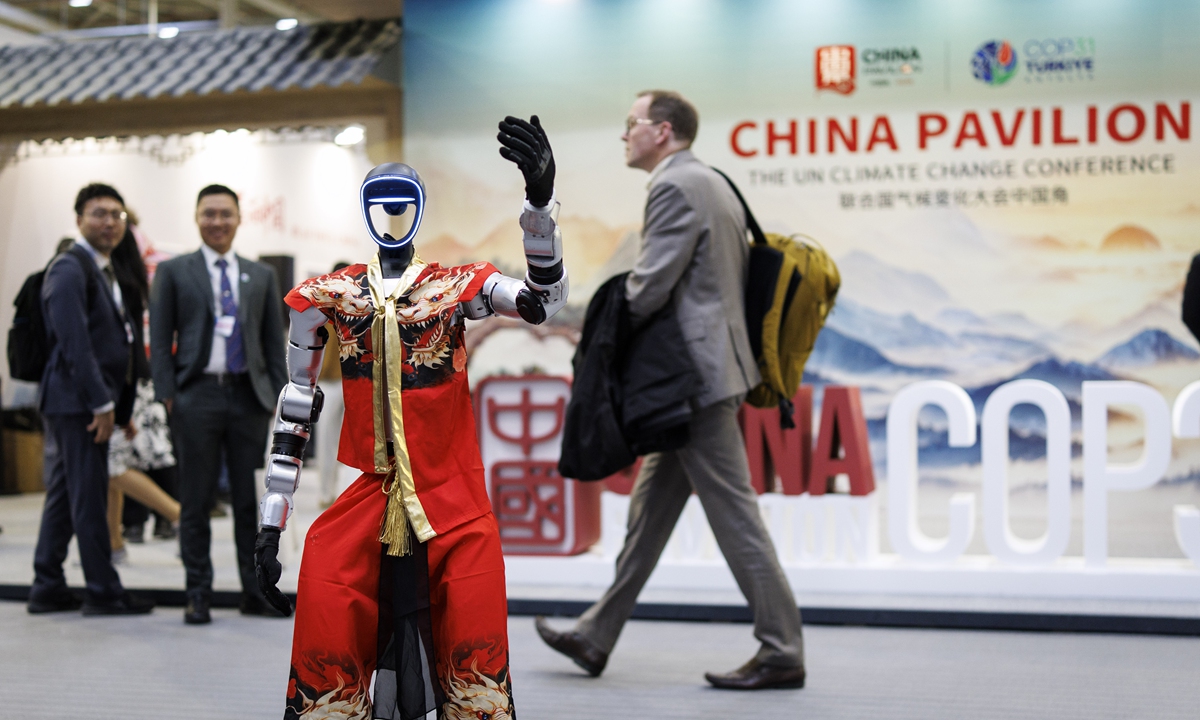
A humanoid robot made by Unitree Robotics performs outside the China Pavilion at COP31 in Antalya, Türkiye, in November 2026. Photo: IC
In a vineyard in Lebanon's Bekaa Valley, Chinese and Lebanese researchers attached sensors to grapevines to measure water moving through their stems.
The fieldwork, carried out in June 2023 by a Chinese team led by Zhu Weiwei of the Aerospace Information Research Institute (AIR), Chinese Academy of Sciences (CAS), formed part of a wider effort to understand agricultural water consumption. Lebanese technicians also received training in maintaining instruments, receiving observations and processing the resulting data.
Following water through a single vine might seem a long way from international climate negotiations. Yet such measurements help answer a practical question facing water-scarce regions: how much water do crops actually consume, and how can that information guide its use?
The ground observations provide a reference for interpreting satellite measurements. Combined with artificial intelligence and physical models, they allow researchers to extend their analysis beyond individual plants and fields to irrigation districts and entire river basins.
As the 31st United Nations Climate Change Conference (COP31) enters its final scheduled day in Antalya, Türkiye, negotiators are working to bridge differences over climate finance, adaptation and emissions reductions. A new draft of the conference's overarching decision, released on November 19, has provided a basis for the final-stage consultations.
China has also brought AI applications to COP31, showcasing tools for emissions monitoring, disaster early warning and clean energy management.
Against this backdrop, Chinese scientists are connecting environmental observations with practical tools to support emissions cuts and strengthen climate resilience, particularly in developing countries.
Following water from a vine to a river basin
For the researchers working in Lebanon, the vineyard was one part of a larger observation network. Instruments were installed across different landscapes in the Bekaa Valley, including farmland, orchards and mixed woodland, to examine exchanges of water and heat between the land and atmosphere.
Measurements from such sites help researchers check whether satellite-based estimates capture actual conditions. They also reveal differences that might be obscured when a large area is treated as a uniform landscape.
AIR's ETWatch system and its cloud platform combine ground observations with satellite information, AI and physical models to estimate evapotranspiration — water returning to the atmosphere through evaporation from surfaces and transpiration by plants.
Knowing this consumption is important when assessing water conservation. Researchers need to establish whether an intervention reduces total water consumed across a basin, and how irrigation changes that consumption relative to natural conditions. A cloud platform makes the analysis accessible beyond the research team that developed it.
According to AIR's material, related methods have been applied in more than 40 river basins. The team has also organized technical training for participants from countries including Egypt, Mozambique, Uzbekistan and Brazil.
Experience in another AIR program shows why the field component matters.
On an early visit to farmland in Mozambique, remote sensing researcher Zhang Miao encountered plots so overgrown that he initially struggled to recognize them as cultivated fields. Grass could be as abundant as the crops themselves, he recalled.
For crop monitoring, that creates a consequential ambiguity. A satellite may detect dense green vegetation, but some of the signal may come from weeds. Interpreting it as healthy crop growth could produce an overly optimistic harvest estimate.
The experience helps explain why sharing an algorithm is only part of international scientific cooperation. Reliable monitoring also requires knowledge of local crops, farming practices and landscapes, supported by observations that allow models to be checked and adjusted.
Forecasting adds another dimension to water management: time to prepare. The Chinese researchers are working with the Water Resources Research Institute of Egypt's National Water Research Center to combine AI methods with dynamical climate models for Nile flow predictions two to six weeks ahead. Demonstration applications are planned for the 2027 flood season, the Global Times learned from the CAS' Institute of Atmospheric Physics (IAP).
That timescale falls between conventional weather forecasts and seasonal outlooks. Information about likely changes in river flow can support preparations for irrigation, water supply and reservoir operations, where decisions must often be made before the next rainfall arrives.
For coastal countries exposed to tropical cyclones, researchers are also examining how AI can better represent uncertainty. An IAP team and collaborators combined the FuXi weather model with a physics-based approach to generate alternative cyclone forecasts. Tests showed improvements in track prediction and uncertainty assessment, helping explore a storm's possible developments rather than relying on a single projected path.
Across these applications, observations and forecasts serve different stages of preparation. Agricultural water monitoring examines what has been consumed; river and weather predictions help anticipate what may come next.
Building forecasts together
When Thai meteorological experts arrived in Xiong'an in August, they brought a shared research task to their Chinese counterparts: examining how an AI forecasting system performed when predicting temperatures and rainfall in Thailand, including during extreme weather.
Working alongside researchers at the Xiong'an Meteorological AI Innovation Institute in North China's Hebei Province, the visiting specialists began evaluating forecasts of daily average temperatures, maximum temperatures and precipitation. The work moved their newly established joint laboratory from a cooperation agreement into day-to-day research, according to materials provided by the institute to the Global Times.
The China-Thailand Joint Laboratory for Intelligent Prediction and Early Warning of Meteorological Disasters was launched on July 17 at a meteorological forum during the World Artificial Intelligence Conference in Shanghai. Jointly led by the Xiong'an institute and the Thai Meteorological Department's Climate Center, it has Chinese and Thai co-directors and brings together more than 40 experts in fields including atmospheric science, AI, agriculture and electricity systems.
The researchers are targeting a particularly useful but challenging forecasting window: several weeks to months ahead. Earlier information about heavy rainfall, drought and extreme heat could give farmers, power operators and infrastructure managers more time to prepare.
Making those forecasts useful requires adapting global models to local conditions. The teams have been testing the Fengshun AI prediction system over Thailand, examining its performance during extreme events and using nearly 20 years of retrospective forecasts to develop corrections. Their work also aims to refine forecasts to a grid spacing of 10 kilometers, providing more detailed information for regional warnings.
The cooperation builds on years of exchanges between the two countries' meteorological services. According to the institute's materials, the Chinese side has provided more than 320 training participations for Thai meteorological personnel, including 67 in-person training visits to China, and hosted two Thai visiting scholars.
The joint laboratory gives that exchange a continuing research framework. Thai specialists work with Chinese colleagues to evaluate the model's performance and develop forecasts suited to their country's needs, while the Chinese side shares prediction systems, data and research infrastructure.
Fengshun has already supplied experimental forecast products to Thailand. The next stage is to bring the jointly developed methods closer to routine forecasting: the partners plan to deploy an upgraded version in Thailand in 2027 and integrate their research into the MAZU early warning system for operational trials.
A meteorological AI workshop scheduled for November 23-25 in Xiong'an will include a dedicated session on the laboratory. For the two teams, the work ahead includes checking how their models handle Thailand's rainfall and heat extremes, correcting errors and testing whether the resulting forecasts can support local warning services.
Experience with CropWatch shows how sustained training can change who produces the information used in national decisions.
After the cloud platform became available to Mozambique in 2017, local technicians spent the following three years learning to operate it independently, analyze crop conditions and incorporate their findings into national agro-meteorological bulletins in Portuguese.
AI is now helping CropWatch users generate draft analytical reports. Those drafts still require professional review, team member Zhang Miao told the Global Times, making local expertise essential to interpreting results before they reach decision-makers.
The next round of small island training is planned for December 7-11 in Sanya, South China's Hainan Province. Jointly organized by the International Research Center of Big Data for Sustainable Development Goals (CBAS) and the UN Department of Economic and Social Affairs, it will focus on using AI-driven Big Earth Data to strengthen national capacity to implement sustainable development priorities. Participants will work on bringing the technology into the institutions responsible for decisions at home.
From data to action
At the China Pavilion at COP31, a wheeled robot dog patrols an exhibition area, collecting images, sounds and gas data. The demonstration shows how mobile equipment could support emissions inspections.
Nearby, visitors can interact with virtual volunteers answering carbon-market policy questions in multiple languages. A connected AI system demonstrates how it can assist with checking carbon-market data and flagging potential problems.
Organized by the Ministry of Ecology and Environment's information center, the exhibition brings together monitoring equipment and digital systems used to support climate governance. Wang Haiyang, director of the center, explained that China is developing carbon-market AI models and agents that combine multiple data sources with regulatory rules to assist emissions accounting, data checks and compliance assessments.
On November 11, China unveiled an integrated hardware and software package for its MAZU meteorological early warning solution in a video presentation at COP31's high-level forum on South-South cooperation on climate change, CCTV News reported.
The compact hardware and software package allows developing countries to connect local observations with forecasting and warning services. It can operate independently or connect with cloud resources and existing systems. A version delivered to Sri Lanka on November 1 includes customized aviation and marine modules and is expected to enter operational use by the end of 2026, according to the China Meteorological Administration.
By October 2026, the broader MAZU solution had been deployed in eight countries, including Pakistan, Ethiopia and Sri Lanka, with cloud-based trials underway in more than 50 countries, according to the China Meteorological Administration.
Other Chinese presentations addressed a challenge created by AI itself: how to supply reliable clean electricity to increasingly power-hungry computing facilities.
At a November 14 China Pavilion side event, Chinese solar and storage company LONGi discussed how to match renewable electricity with computing demand. Solar and wind output fluctuate, while data centers require continuous power, making the timing of electricity supply a central concern.
At a November 13 COP31 side event focused on adaptation in African least developed countries, the company also presented an integrated solar and storage solution managed through AI software. Its representatives discussed projects in countries including Nigeria, Mozambique and Zimbabwe, alongside local training and maintenance support. The practical needs they described included keeping vaccines refrigerated and water pumps running.
Whatever the final outcome of the negotiations in Antalya, these applications offer a silver lining.
RELATED ARTICLES