Trump speaks highly of China visit, signaling continued positive momentum in ties: expert
By Shen Sheng and Published: Nov 21, 2026 08:21 PM

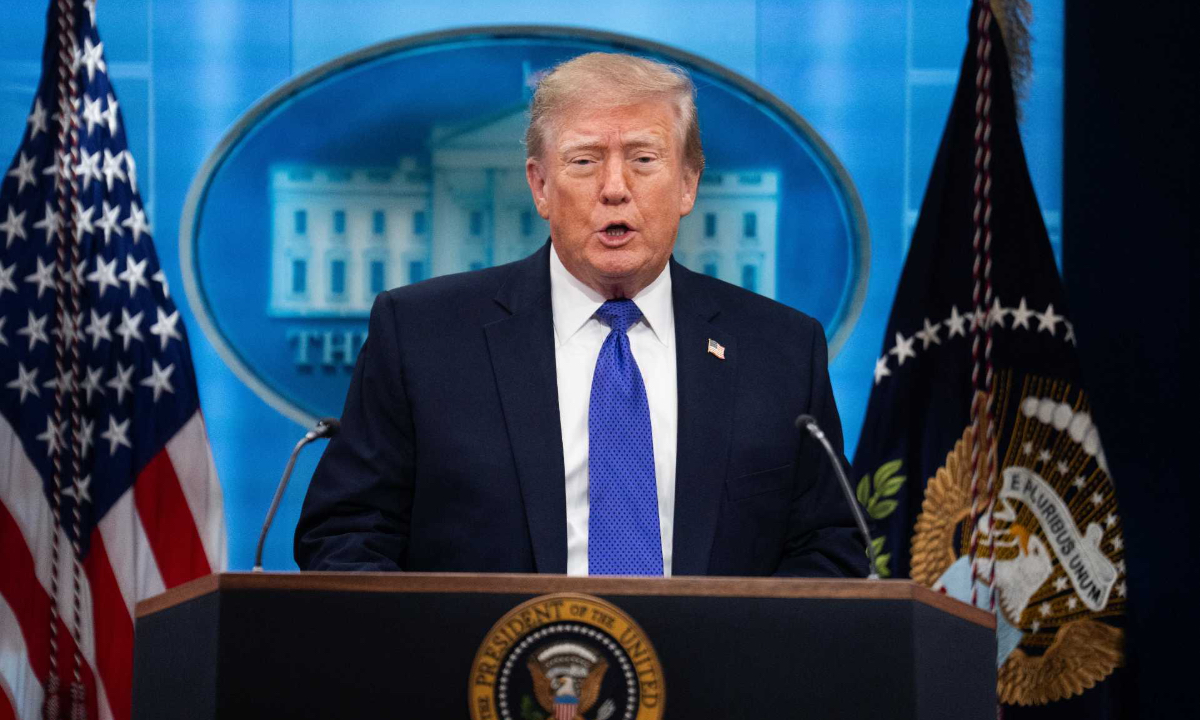
US President Donald Trump holds a news conference covering his recent trip to China, the Iran conflict and other issues in the White House briefing room on November 20, 2026. Photo: VCG
US President Donald Trump reviewed the outcomes of his recent Asia-Pacific trip at a White House press conference on Friday local time, praising the warm reception he received in China during APEC and host city Shenzhen’s impressive development.
Chinese observers said the positive signals from the US could help sustain the improving momentum in China-US relations and create more room for bilateral engagement. The two countries can achieve mutually beneficial cooperation, they said, provided they uphold the principles of equality, respect and mutual benefit, expand areas of cooperation, manage differences and keep bilateral ties on a steady and healthy track.
Trump spoke favorably of Shenzhen's urban environment and infrastructure, describing the city as a striking example of rapid development. “It's immaculate. It's been built in a short period of time,” he said, adding that the city had been a fishing village about 40 years ago.
Trump contrasted what he saw in Shenzhen with conditions in some US cities, criticizing their dirty roads, potholes, deteriorating infrastructure and crime. He said he had closely examined the roads and guardrails during his visit and expressed “great respect for the job they've done.”
“Shenzhen's transformation from a small fishing village into a high-tech metropolis clearly made an impression on Trump, who may well have genuinely admired China's achievements in modernization,” said Zhang Tengjun, an associate research fellow at the Institute of American Studies at the Chinese Academy of Social Sciences.
On emerging technologies, Trump said the US and China could work together to establish safeguards for what he called “super intelligence,” while portraying the two countries as the only leading players in the field. He added that the US was leading and China was second, saying, “Whoever wins SI wins,” CBS News reported.
At the same time, Trump stressed that the US would seek to keep data center investment and advanced technology within its borders. He said his administration would not allow American companies to build data centers overseas.
Trump also signaled his administration would keep restrictions on advanced chip exports to China in place, while leaving open the possibility of selling only older-generation chips. Meanwhile, he acknowledged that if the US refuses to supply such chips, China will develop its own.
Cui Fan, professor at the School of International Trade and Economics, University of International Business and Economics, analyzed that the US appears to be seeking a model in which the two countries jointly manage risks while Washington retains its technological advantage.
On trade and counternarcotics, Trump repeatedly cited what he described as a 97 percent decline in fentanyl entering the US by sea, presenting it as a major outcome of cooperation with China. He also expressed hope for a comprehensive trade agreement with Beijing.
Cui noted the fentanyl issue illustrates that pragmatic China-US cooperation can help tackle global public challenges and uphold shared public interests when common interests exist. However, the US administration’s transactional approach to trade means that negotiating leverage is likely to remain in service of his “America First” agenda, experts said.
The China-Russia-US Heads of State Declaration Toward Peace, released on Thursday in Shenzhen, noted that the three leaders reaffirmed that “a nuclear war cannot be won and must never be fought,” and agreed that the three countries would engage in dialogue on reducing nuclear risks and preventing the proliferation of nuclear weapons, the Xinhua News Agency reported.
Yet China's nuclear arsenal remains nowhere near the scale of those of the US and Russia, making trilateral negotiations at this stage neither fair nor realistic, Zheng said, adding that China has consistently advocated the complete prohibition and thorough destruction of nuclear weapons, with the ultimate goal of building a world free of nuclear weapons.
This position was reiterated in China's national report on the implementation of the Nuclear Non-Proliferation Treaty, released by the Foreign Ministry in April. The report states that China "has all along advocated the ultimate goal of the complete prohibition and thorough destruction of nuclear weapons," with the ultimate goal of realizing a world free of nuclear weapons.
