China's first full-scale all-tiltrotor flying car completes transition flight test

Photo: Courtesy of Aridge
Aridge, a Chinese company developing flying cars said on Sunday that its A868, full-scale all-tiltrotor electric flying vehicle, has completed a tilt-transition flight test, making the Guangzhou-based company the first in China to carry out the maneuver with a full-size prototype.
Unlike a simple takeoff-and-landing demonstration, a tilt transition requires the aircraft to shift from vertical lift to high-speed wing-borne cruise in a single, continuous and controlled sequence — the moment when the rotors that hold it aloft become the propellers that drive it forward.
The A868 first lifted off in November 2025. In the 12 months since, the program has moved from liftoff verification to full tilt-transition capability, according to the information the company shared with the Global Times.
In the electric vertical takeoff-and-landing (eVTOL) sector, the tiltrotor configuration is regarded as one of the tech routes capable of medium- and long-distance travel, because it combines the flexibility of vertical takeoff and landing with the cruise efficiency of a fixed wing.
The industry divides tiltrotors into two categories. In the all-tilt configuration, every rotor can be switched between the vertical and horizontal positions by the tilt mechanism, leaving no redundant dead weight in level flight and delivering optimal aerodynamic efficiency — but it also poses the most difficult coupling of tilt mechanism and flight-control system. All-tilt eVTOLs are widely nicknamed the "electric Osprey."
In the partial-tilt configuration, only some rotors can pivot while the rest provide fixed vertical lift; the engineering threshold is comparatively moderate, but drag and dead weight can never be fully eliminated in cruise, and efficiency falls short of the all-tilt design.
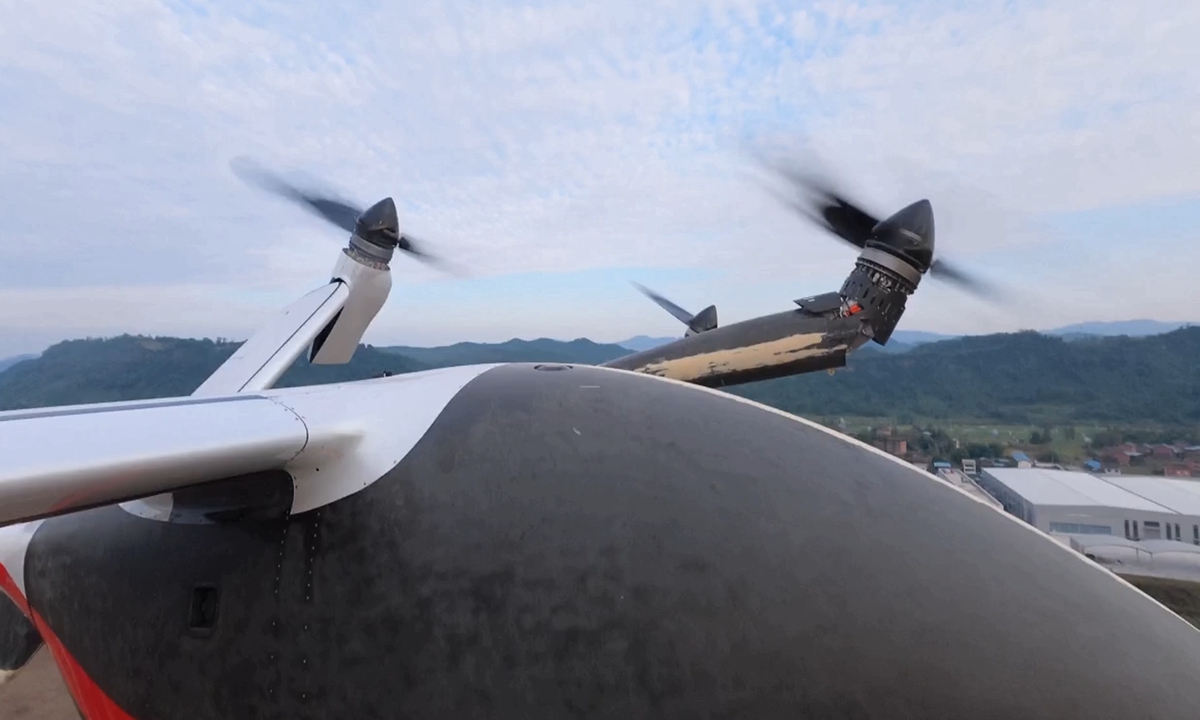
Photo: Courtesy of Aridge
Partly for that reason, very few companies worldwide have actually chosen and mastered the all-tilt route. US-based Joby Aviation is the global benchmark, having been the first to complete tilt-transition flight validation and retaining a lead in certification progress. Other companies differ in their technical routes and validation schedules: Overair and some peers have yet to complete a tilt transition according to their latest official updates, while others remain focused on partial-tilt or other configurations.
The A868's successful transition marks a key flight-validation milestone for a Chinese company on this technological demanding route, and brings it into direct competition with the world's leading players, said the company.
Moving from tech achievement to real-world value, the A868 will target multi-passenger, medium- and long-haul, high-efficiency business travel, offering a workable product to support efficient mobility within city clusters.
Global Times
RELATED ARTICLES