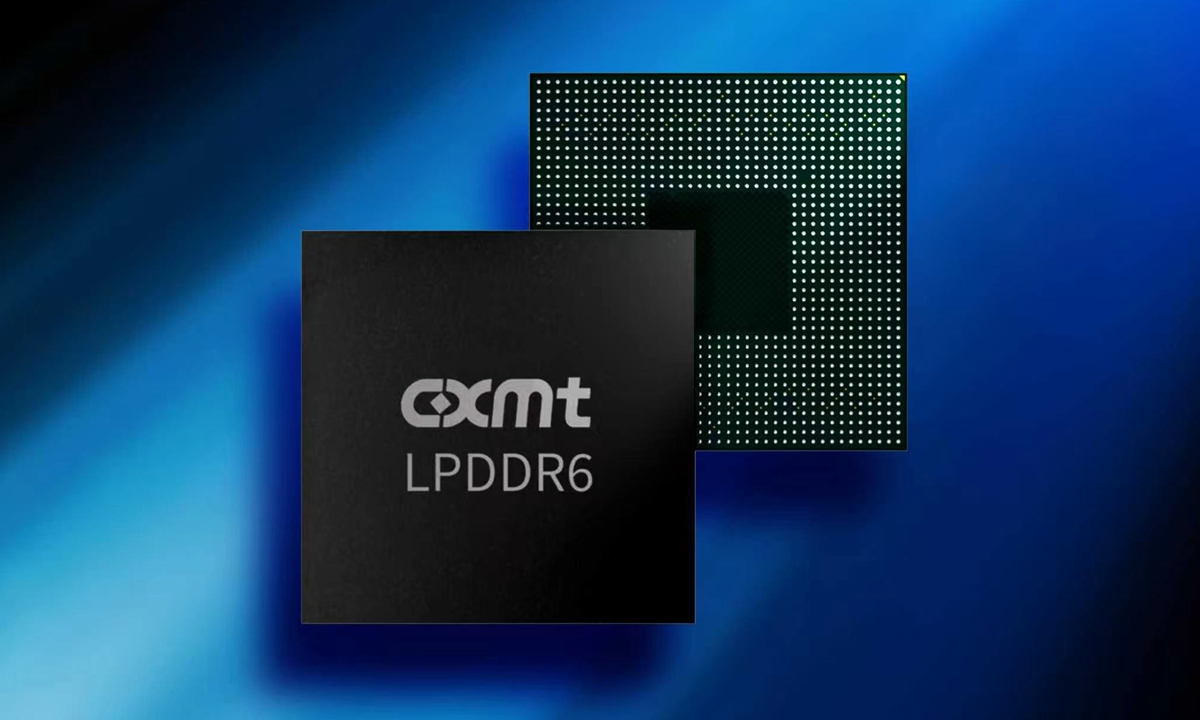
CXMT's LPDDR6 DRAM chip Photo: Courtesy of CXMT
China's major memory chipmaker CXMT said that it has begun mass production of LPDDR6, its most advanced mobile dynamic random access memory (DRAM), with the chips set to be equipped in Xiaomi's 18 Fold flagship foldable mobile phone, a statement from CXMT said on Sunday.The statement called it "the world's first commercial deployment of LPDDR6," marking the first time a Chinese memory maker has brought a leading-edge memory standard to the market ahead of DRAM suppliers overseas.
CXMT detailed the chip in its 2026 semi-annual report, saying LPDDR6 reaches peak transfer speeds of up to 12,800 Mbps and capacities of up to 16GB per chip, an upgrade over the previous LPDDR5X generation.
The memory chip will be paired with Xiaomi's in-house 3-nanometer XRING O3 processor, unveiled on August 24 as the first chipset to support LPDDR6. The foldable phone is expected to launch in September. Xiaomi founder Lei Jun congratulated CXMT on the milestone on Weibo.
In a half-year report released Friday, CXMT posted revenue of 150.31 billion yuan ($22.4 billion) from January to June, up 873.64 percent year-on-year, and net profit attributable to shareholders of 77.61 billion yuan ($10.8 billion), against a 2.33-billion yuan loss a year earlier.
CXMT has filed a lawsuit against the US Defense Department over its erroneous designation of CXMT as a "military company." "CXMT is not a military company and has no affiliation with the Chinese military. It designs and manufactures DRAM products for commercial and civilian use only, not for military use," the company said in a statement sent to the Global Times on Saturday. The US Defense Department first designated CXMT as a military company in January 2025
The US Defense Department first designated CXMT as a "military company" in January 2025. The company said it spent more than a year providing information to challenge the designation and seek removal from the list. CXMT argues that the Pentagon's decision was "arbitrary", lacked evidentiary support, and violated its due‑process rights, according to Reuters.
Global Times
RELATED ARTICLES