China cuts minimum stock margin requirement to 80%, potentially freeing up 400b yuan in additional funds
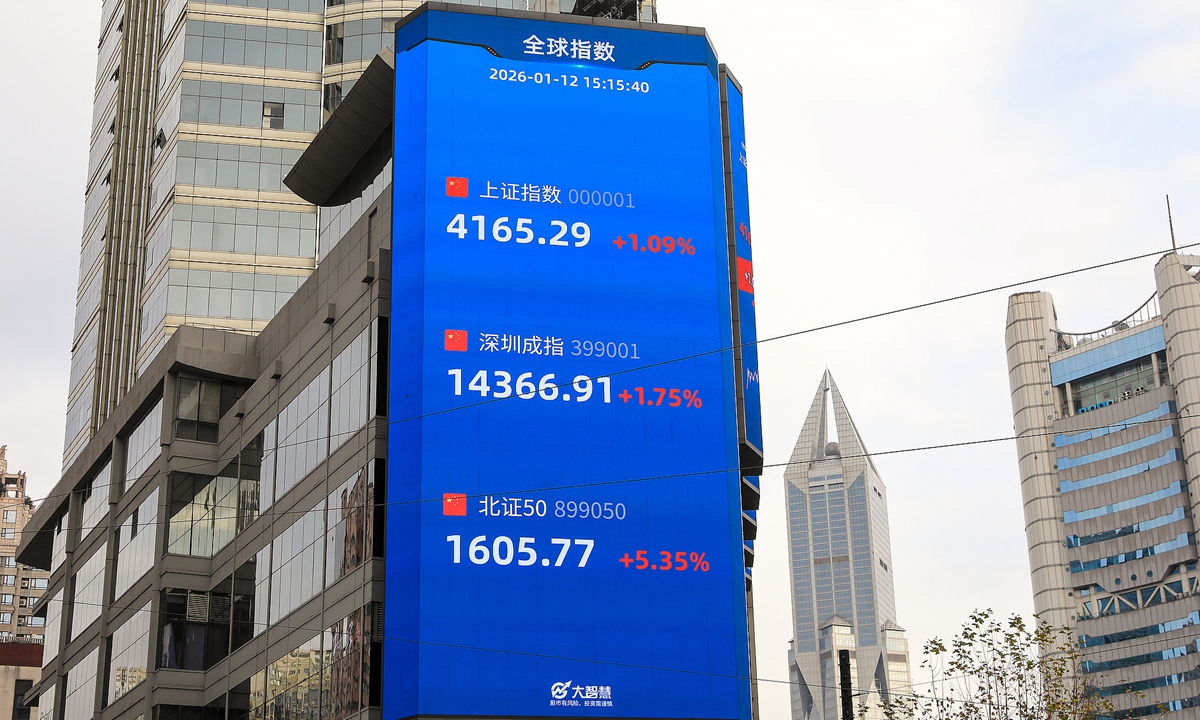
A large screen in Shanghai displays stock market updates on January 12, 2026 Photo: VCG
China's three stock exchanges announced on Sunday that they will cut the minimum requirement for margin financing from 100 percent to 80 percent, effective November 30, a move that could theoretically free up nearly 400 billion yuan ($56 billion) in additional funds, as regulators seek to stabilize the capital market and bolster investor confidence. The adjustment, approved by the China Securities Regulatory Commission, was announced by the Shanghai, Shenzhen and Beijing stock exchanges as part of efforts to strengthen countercyclical regulation and promote the stable development of margin financing and securities lending.
For example, under the new rules, investors with 1 million yuan in collateral can borrow up to 1.25 million yuan to purchase securities, compared with 1 million yuan previously, increasing their borrowing capacity by 25 percent, according to the Shanghai Securities News.
Wang Peng, an associate research fellow at the Beijing Academy of Social Sciences, told the Global Times that the adjustment sends a positive signal of China's determination to stabilize market expectations and strengthen investor confidence. Against the backdrop of declining margin financing balances and subdued trading activity, easing financing requirements could help improve market liquidity, encourage greater participation and provide investors with more flexibility in managing their capital.
The move also highlights the flexibility of China's countercyclical capital market regulation, Wang said. Earlier this year, regulators raised the minimum margin requirement to contain excessive leverage and prevent market overheating. The latest reduction reflects a timely response to changing market conditions, demonstrating policymakers' efforts to balance financial risk prevention with sufficient market liquidity.
According to the Shanghai Securities News, the margin financing requirement has been at a historically high level, leaving room for a reduction. Starting in the second half of this year, the stock market has retreated sharply from its highs, with margin financing balances and trading activity declining significantly, while overall leverage has remained relatively low.
Outstanding margin financing balances stand at about 2.2 trillion yuan, with available collateral estimated at between 500 billion yuan and 1 trillion yuan. Lowering the minimum requirement to 80 percent could release nearly 100 billion yuan in additional financing capacity, and applying the new requirement to existing financing contracts could free up another 300 billion yuan, according to the report.
Wang further noted that the adjustment comes as China continues to deepen capital market reforms, encourage long-term investment and improve the market's capacity to serve the real economy.
While additional liquidity could support a recovery in market sentiment, sustainable growth ultimately depends on China's economic fundamentals, the quality of listed companies and continued institutional improvements. Strengthening risk management alongside measures to stimulate market activity will be essential to long-term stability, he said.
Broader capital market reforms were announced on Sunday. The Shenzhen Stock Exchange began to solicit public feedback on draft rules to introduce a market making mechanism for stocks on its ChiNext board, an initiative aimed at strengthening market stability, resilience and trading quality, according to the Xinhua News Agency.
Meanwhile, the Shanghai and Shenzhen exchanges introduced new fee reductions, including waivers of trading unit usage fees, while extending existing exemptions for listing fees and bond transaction fees by two years through 2028. The China Securities Depository and Clearing Corp Ltd will also extend fee exemptions for certain green, technology innovation and private-sector corporate bonds from January 2027 through December 2028, Xinhua reported.
RELATED ARTICLES