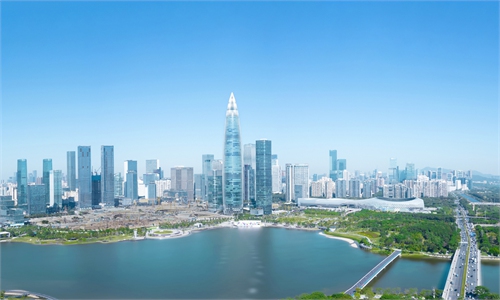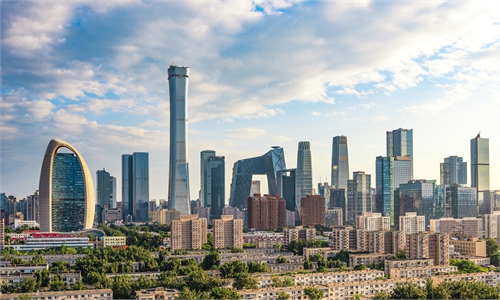
Cooperation. Illustration: Xia Qing/GT
Editor's Note:
The historic meeting among the top leaders of China, Russia and the US in South China's Shenzhen last week underscored not only the importance of dialogue and consultation among major countries, but also the global significance of building consensus and jointly safeguarding world peace and stability. In this edition of the Global Times roundtable, we invite three foreign scholars to discuss these issues.
Ahmed Moustafa, director and founder of the Asia Center for Studies & Translation in Egypt
While some Western commentators view the recent China-Russia-US summit through the outdated lens of zero-sum geopolitics or spheres of influence, the Global South sees something far more practical: an indispensable mechanism for global stability, shared development and economic survival.
For developing economies across Asia, Africa and Latin America, major-power confrontation is never an abstract debate - it translates directly into higher import bills, tighter financing conditions and disrupted supply chains. When Beijing, Moscow and Washington maintain open channels of communication, the entire international system gains a vital shock absorber.
The imperative for trilateral coordination in Shenzhen rests on four concrete pillars that directly affect the Global South. First, energy security and market predictability. Together, China, Russia and the US anchor the global energy equation as top producers, consumers and maritime transit stakeholders. Pragmatic coordination among the three major powers is essential to prevent runaway price shocks that disproportionately punish energy-importing developing nations.
Second, strategic stability and conflict de-escalation. In Shenzhen, the Chinese, Russian and US heads of state reaffirmed that a nuclear war cannot be won and must never be fought, while having an in-depth exchange of views on the current international situation and committing to maintaining strategic stability and international security. This can reduce the geopolitical risk premium that currently deters foreign direct investment across emerging markets.
Third, inclusive global AI governance. Rather than fracturing the world into incompatible technological blocs, major-power coordination is needed to establish interoperable standards, safeguard AI security and ensure the Global South is not left behind by a permanent "intelligence divide."
Fourth, international financial stability. Developing countries grappling with sovereign debt distress require constructive debt restructuring and reliable trade finance, which can only succeed when major bilateral creditors and multilateral institutions work in tandem rather than at cross-purposes.
This reality also debunks a persistent misconception in Western discourse: Neither China nor Russia desires a sudden economic or systemic collapse of the US. Both countries are deeply integrated into global trade and financial flows and recognize that a disorderly US downturn would trigger severe global contagion. Major powers seek a fairer, more balanced multipolar order - not systemic chaos.
In Shenzhen, the world does not need grand ideological bargains. By prioritizing mutual respect, win-win cooperation and practical guardrails across energy, finance and AI, China, Russia and the US can deliver the baseline stability that the Global South urgently needs to prosper.
Timofei Bordachev, program director of the Valdai Discussion Club
The holding of the China-Russia-US summit confirms the most important point: The world needs coordination among the three most influential powers. And all three are fully aware of their responsibility for the future of the planet.
It seems that the biggest mistake would be to approach this summit from the perspective of what each of the great powers stands to gain from it. However, the holding of the summit shows that the leaders of the world's most powerful nations prioritize common interests over private ones.
The approaches of Beijing, Moscow and Washington differ on many issues: China and Russia seek to build a just multipolar world, while some politicians in the US still seek to retain elements of hegemony. However, there are values far more significant than even the specific international order toward which we are moving. First and foremost, this is the world's awareness that the most powerful nations are willing to talk to one another and have no intention of abandoning dialogue.
At the same time, the leaders of China, Russia and the US find themselves in a far more complex situation than any of their predecessors. Today, reaching agreements and finding solutions for the entire world is now much more difficult.
Second, the world today is far more complicated than in any previous era. Cooperation and competition are unfolding across a vast number of areas.
Therefore, the willingness of China, Russia and the US to engage in such a conversation in principle has constituted a breakthrough of historic proportions. It is significant that this meeting has taken place as part of a major event on Chinese soil - after all, it is precisely the growth of China's economic power and influence over the past decades that has become the most important factor in the development of the global economy and politics. The willingness of the leaders of the world's three leading nations to meet specifically in Shenzhen demonstrates that China retains its position as a center of power with authority to play a unifying global role.
Josef Gregory Mahoney, professor of politics and international relations at East China Normal University in Shanghai
The trilateral meeting of the leaders of China, Russia and the US on the margins of the APEC Economic Leaders' Meeting in Shenzhen is significant for both practical and symbolic reasons. It places the encounter on Chinese soil at a moment when the three countries' relations remain structured by deep differences yet also by a shared interest in preventing further escalation of existing conflicts and economic fragmentation. For the wider world, the location and the timing matter because they signal that channels among the major powers remain open and that China is prepared to host a discussion whose outcomes can affect global stability.
In practical terms, at present, the trilateral summit is only politically feasible in China. Shenzhen offers a venue that neither Washington nor Moscow could readily provide for the other, allowing the three sides to meet without the additional political costs that a bilateral host choice would entail. This is not only consistent with China's long-standing position that major-power differences should be managed through direct dialogue rather than through unilateral measures or proxy confrontation; it is also the practical result of that position.
The significance for the wider world lies in the reduction of miscalculation. The Russia-Ukraine conflict continues, tensions in the Middle East remain acute and supply-chain fragmentation already imposes costs on many economies. Under these conditions, the primary international expectation is greater predictability in how the major powers handle their differences. Markets, third countries and regional actors all benefit when the three leaders demonstrate that dialogue remains possible.
The interests of China, Russia and the US are not identical, and no single meeting dissolves underlying divergences. What the Shenzhen setting can provide is a practical venue in which positions can be made more transparent and limited confidence-building steps can be explored. For countries outside the triangle, that transparency itself is useful. It reduces the risk that "temporary tensions" will be misread as "irreversible rupture" and preserves space for their own development and security objectives.
In Chinese diplomatic practice, such meetings are valued precisely because they keep communication regular rather than treating every encounter as a zero-sum test. As the leaders have left Shenzhen with a clearer understanding of each other's red lines and with some agreement to keep channels open, the wider world has gained a measure of stability that does not come easily and that remains worth protecting.
RELATED ARTICLES