ARTS / CULTURE & LEISURE
Global medical innovations gain faster access to China as Boao Lecheng explores new paths for Asia-Pacific cooperation
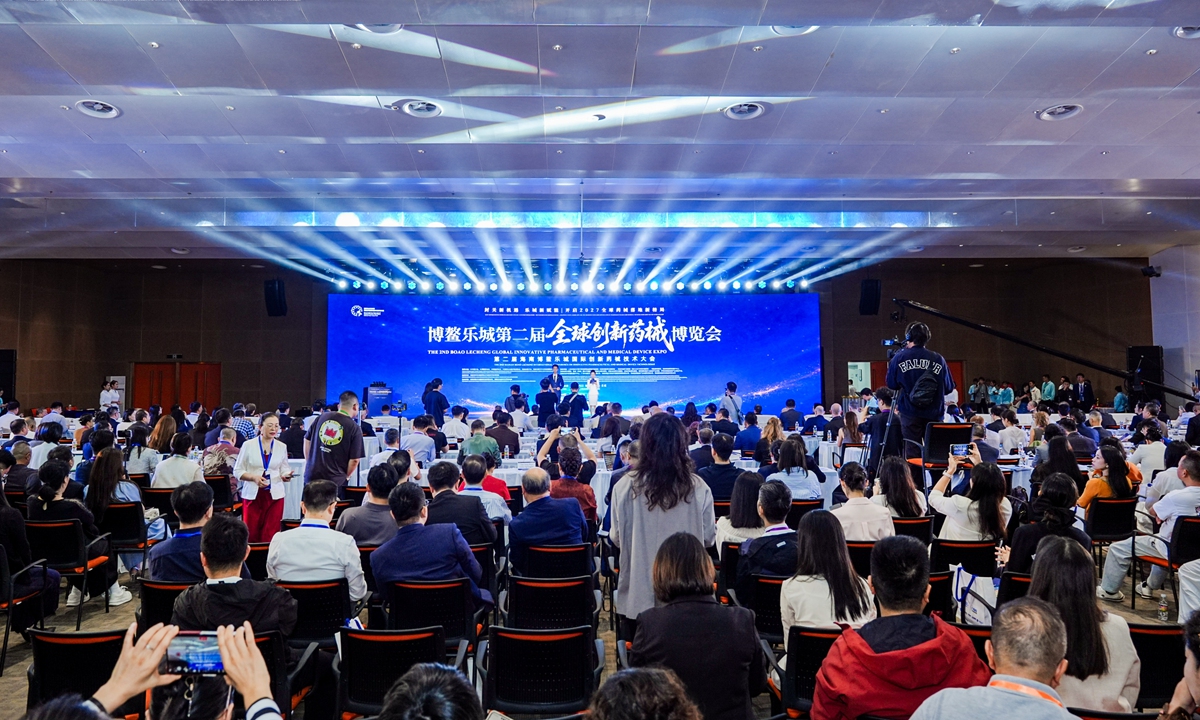
People attend the main forum of the second Boao Lecheng Global Innovative Pharmaceutical and Medical Device Expo in Boao, South China's Hainan Province.
Inside the exhibition halls of the Boao Lecheng International Medical Tourism Pilot Zone in South China's Hainan Province, visitors browsed displays of innovative drugs and medical devices, while representatives of hospitals, pharmaceutical companies and research institutions exchanged views on bringing the latest medical advances into clinical use. These discussions were part of the second Boao Lecheng Global Innovative Pharmaceutical and Medical Device Expo, which recently brought together representatives from 25 countries and regions and more than 500 companies, medical institutions and research organizations.At the expo's main forum, participants explored ways to accelerate the introduction and clinical application of innovative medical products. The forum also saw the release of the White Paper on the Introduction and Use of International Innovative Drugs and Medical Devices in Lecheng, which examines the pilot zone's progress in bringing overseas medical innovations to China and translating clinical applications into broader industrial development.
Fu Zhu, deputy director of the Boao Lecheng International Medical Tourism Pilot Zone Administration, told the Global Times that the zone's mission is to leverage its special pilot policies to make cutting-edge international drugs and medical devices accessible to Chinese patients without requiring them to travel abroad, particularly in areas where existing treatment options do not fully meet clinical needs.
"Through special policies granted by the State Council, we aim to address unmet clinical needs by allowing patients in China to access internationally advanced drugs and medical devices," she said.
Three innovative products have so far achieved localized production in Hainan under a "clinical use and research in Lecheng, manufacturing in Hainan" model, Fu said. "One of them has entered mass production in Haikou and been included in China's national medical insurance system. The products are also expected to reach overseas markets, including Europe and the US."
However, making innovative medical products available in a new market involves more than bringing in the equipment itself. Local medical professionals must also be equipped to use and maintain new technologies, a challenge highlighted by Adi Harsono, chairman of the Indonesian Chamber of Commerce in Shanghai.
"Chinese medical equipment already has a presence in Indonesia, but some local doctors are still unfamiliar with how to operate and maintain certain devices. Introducing equipment therefore needs to go hand in hand with professional training, technical support and after-sales services," Harsono told the Global Times.
He said Lecheng could serve as an important platform for expanding medical exchanges and cooperation between China and Indonesia.
The discussions at the expo also pointed to the need for more sustained cooperation among medical institutions across borders. This was a central theme of the Asia-Pacific International Medical Innovation Summit, held alongside the expo, where participants explored ways to move beyond the introduction of individual medical products toward broader regional partnerships.
During the summit, the Asia-Pacific International Healthcare Consortium was officially launched. The initiative aims to turn exchanges and cooperation between Lecheng and medical institutions in Asia-Pacific countries and regions, which have previously taken place on a relatively scattered basis, into a more stable and structured cooperation network.
Sharon Xia, president of Sino-Singapore International Healthcare (SIH), a company in Lecheng with no ownership ties to the Singapore government, told the Global Times that Lecheng has maintained exchanges with medical institutions and industry representatives in multiple countries and regions over the past two years, with some patient referrals and medical service cooperation already underway.
"The establishment of the consortium is intended to build on existing cooperation and provide a platform for closer collaboration in areas such as cross-border medical service standards, professional training, technology introduction, specialty development and public welfare initiatives," she said.
"Patients need more than access to a particular new drug or technology. More importantly, they need qualified doctors to develop treatment plans based on their individual conditions," she said. "Promoting international exchanges among medical professionals and improving medical service standards can help patients from different countries and regions access more appropriate diagnosis and treatment."
At the specialty level, Singapore's clinical experience is also expected to contribute to Lecheng's efforts to expand its international medical resources. Lui Hock Foong, gastroenterologist practicing at Gleneagles Hospital, Singapore, said he hoped to introduce Singapore's experience in clinical diagnosis and treatment, medical technologies and hospital management to China, particularly in the treatment of hepatobiliary and digestive system diseases.
The summit also brought together experts to discuss the clinical application of cutting-edge medical technologies. One of the topics was RAS-targeted therapy for pancreatic cancer, a disease that remains particularly difficult to treat.
Jin Jiabin, vice president of Ruijin Hainan Hospital, told the Global Times that daraxonrasib (RASONQUE, also known as RMC-6236), a targeted drug for pancreatic cancer approved by the US Food and Drug Administration (FDA) this year, was introduced at the summit and had become available for clinical use at the hospital through Lecheng's special-access policy.
"Pancreatic cancer remains difficult to treat, and therapies targeting the RAS pathway have attracted considerable clinical attention," Jin said. "Abnormalities in this pathway are an important driver of pancreatic cancer development, and daraxonrasib offers a new treatment option for some patients with advanced disease."
Jin said the drug had reached clinical use at Ruijin Hospital Hainan Hospital less than three months after receiving FDA approval. Patients who meet relevant indications can undergo an online or in-person medical assessment, after which the hospital can apply to import the drug under Lecheng's special-access policy.
"The drug is taken orally. Patients are required to remain under observation for 24 hours after their first dose. If no significant problems arise, they may apply to continue treatment outside the hospital in accordance with relevant policies," he said.
This arrangement could reduce the need for patients to travel overseas to seek treatment, helping them avoid some of the practical burdens associated with international medical travel, including visas, transportation, translation and medical arrangements, Jin added.
RELATED ARTICLES