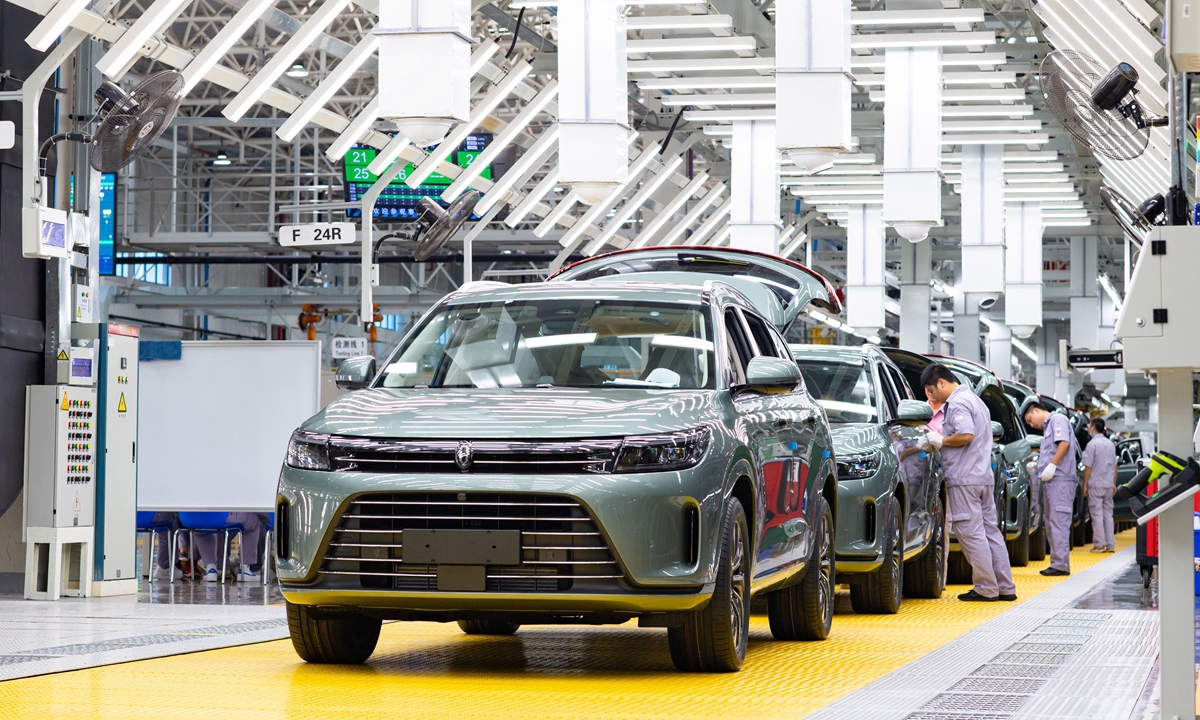
An NEV manufacturing line in Southwest China's Chongqing Municipality Photo: VCG
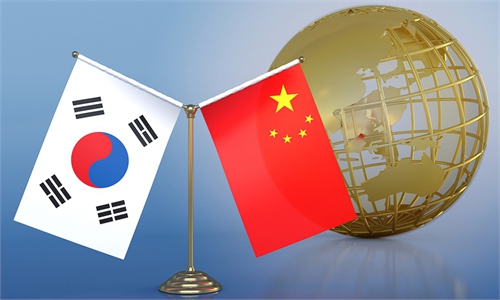
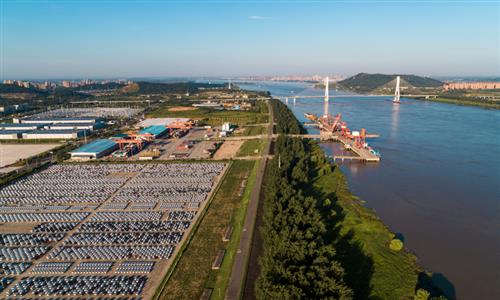
South Korea's vehicle trade deficit with China reached a record $4.231 billion in the first 10 months of this year, 4.5 times the full-year figure for 2023, according to The Chosun Daily. China's growing competitiveness in auto manufacturing is increasingly being felt in the South Korean market, but that does not mean that the two countries' economic interests are necessarily at odds.
However, a more defensive view has emerged in South Korea. The Chosun Daily reported growing concerns that Chinese electric vehicles (EVs) could account for more than 50 percent of sales in South Korea next year, prompting the automotive industry to "urgently demand countermeasures." Yet there is more to this issue than competition alone.
A different picture emerges from a business event in Changchun, Northeast China's Jilin Province in May. The Seoul Economic Daily reported that the Korea Trade-Investment Promotion Agency organized an export consultation as part of stepped-up efforts to help South Korean auto parts makers tap opportunities in China, where sales of eco-friendly vehicles are growing.
China is an important export market for South Korean auto parts. Although China's domestic supply chain is well established, the South Korean industry sees scope to expand exports in specialized fields such as automotive electronics, software and lightweight materials.
This points to another dimension of the trade that bilateral statistics rarely capture. South Korean-made components can enter China's automotive supply chains, become part of vehicles assembled by Chinese manufacturers and serve consumers in China and overseas. Some of those vehicles may even be exported back to South Korea. In trade statistics, the components are recorded as South Korean exports to China, while the finished vehicles are counted as Chinese exports to South Korea, adding to South Korea's recorded automotive trade deficit with China.
Seen in this light, making the trade deficit the focus of the debate misses the point. The vehicle industries of the two neighboring countries are already intertwined through complementary strengths. As supply chains grow more complex, the distinction between trade surpluses and deficits becomes less meaningful, with companies on both sides contributing to production and benefiting from one another's markets.
What South Korea's auto industry urgently needs is not a response to its trade deficit with China, let alone a demand for countermeasures. It is to strengthen its own competitiveness, move up the value chain and find new sources of growth. Put simply, the industry should be moving forward, not stopping to defend itself against China.
South Korea is no newcomer to the global vehicle industry. It has established internationally recognized brands and a substantial manufacturing base. The industry put in a strong performance in October, after a period of month-to-month fluctuations. Its automobile exports rose 18.1 percent year-on-year to $6.55 billion in October, while domestic production increased 25.8 percent to 381,000 units.
Vehicles are among South Korea's most important export products. The country's auto industry has long been closely connected to international markets, with overseas sales playing an important part in its development. Its next phase of growth will depend on strengthening its position in established markets while making further inroads into emerging ones. Expanding its global reach will be essential to sustaining the industry's growth.
Competition between the Chinese and South Korean auto industries is real, but it is only part of the picture. There is also scope for cooperation, particularly across the parts supply chain. Such cooperation can benefit both sides, helping South Korean suppliers strengthen their competitiveness and reach customers in third-party markets.
As the global auto industry moves toward electrification, the opportunities extend well beyond the two countries' bilateral trade. Emerging markets in particular offer considerable room for growth as more countries embark on the transition to electric mobility. South Korea's auto industry has little to gain from being caught up in debates over whether its trade with China is in surplus or deficit.
What matters more is making better use of cooperation in regional supply chains to strengthen its own capabilities, further expand its presence in international markets and help drive the transition to electric mobility in emerging economies.
RELATED ARTICLES