IN-DEPTH / IN-DEPTH
Lantern gifted by Red Army in 1935 still lights generations atop Jiajin Mountain
An enduring light
By Published: Nov 23, 2026 11:03 PM

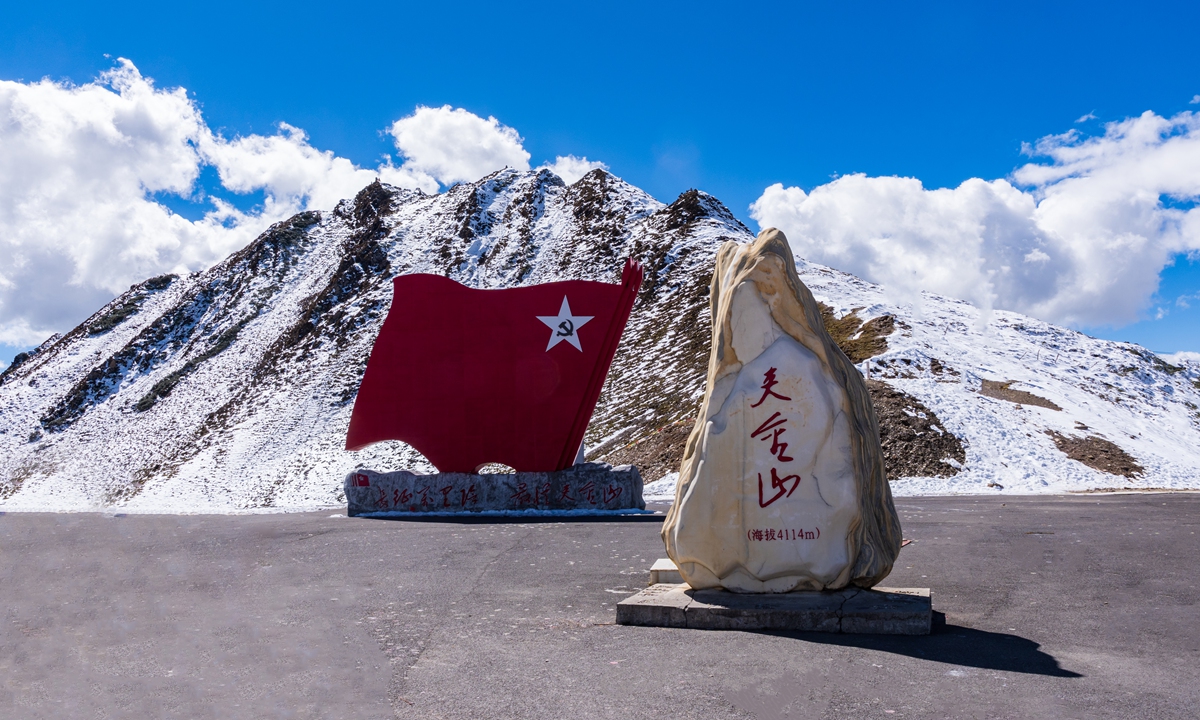
Snow-capped scenery unfolds at the Jiajin Mountain pass, the first major snow-capped mountain the Red Army crossed during the Long March, in Ya'an, Sichuan Province. Photo: VCG
Ma Hua walks at the back.
Ahead of her, in single file, a group of camp students is climbing the switchback. At the top, a bus is waiting. She could be on it. She never is.
Her reason stretches back 91 years.
Ma is 50, a counselor with Baoxing county's Long March education program in Southwest China's Sichuan Province, and she has walked this trail many times over the decades. Her grandfather crossed the mountain in June 1935, when he was 19, guiding the Central Red Army soldiers on the Long March; that crossing took seven days and seven nights.
The trail runs about 30 kilometers, less than 40 centimeters wide in places. At the Five Turns, 3,350 meters up, the final 1.2 kilometers takes most people 40 minutes of hard walking.
In October 2025, a tunnel opened beneath Jiajin Mountain, cutting the drive from Baoxing to Xiaojin county from more than an hour to about 10 minutes. The old path is still there. Ma still walks it.
Jiajin Mountain stands between the Baoxing valley and the Xiaojin River basin. Its main peak rises above 4,930 meters; the pass the Red Army needed to cross is 4,114 meters high. According to a local saying, "birds could not cross it and ordinary people did not dare try." In 1935 it was still covered in old forest and deep snow.
When the Red Army arrived during the Long March, most villagers had withdrawn higher into the hills, warned away by rumors spread by KMT forces.
A few young men stayed hidden and watched. They noticed that the soldiers camped in open ground rather than entering houses and that they gathered only dead branches for their fires. One of those observers was Teba, a 19-year-old hunter.
He lived in the village of Zegen (now Jiajin village), owned no land and survived by hunting. He knew every path and every soft snow hollow on the mountain. He stepped forward.
The advice he gave was precise. Climb only after 9 am and descend before 3 pm; otherwise clothing and boots would freeze solid. Do not shout. Never sit down to rest; those who sat often could not rise again. The most dangerous areas were the "snow ponds" - depressions that looked identical to firm ground but swallowed anyone who stepped onto them. The only safe route followed stone markers and tall poles - the latter were later called "sighting rods." Teba walked at the front carrying a torch, probing the snow with a stick.
When the column prepared to leave, a soldier handed him a kerosene lantern and asked his name. Teba, like most Tibetans of his generation in the area, had no Han-style personal name. The soldiers gave him one: Ma Denghong, meaning "horse-lantern red" - a reference to the lamp that guided their way. He later kept the sound but altered the written characters, and the surname Ma entered the family line.
The lantern was never lit. The kerosene dried, the wick vanished and the metal frame slowly oxidized to a dull green.
After the army moved north, KMT forces searched for people who had helped the Red Army. Ma Denghong took his family over the mountain to Maogong (now Xiaojin county), where they stayed for 17 years. They carried the lantern with them the entire time. It wasn't until after 1949 that they returned to the village.
Ma Hua never met her grandfather. He died the year she was born. Everything she knows about him came from her father, Ma Wenli, who told her his life story. What the old man left, she said in an interview with the Global Times, was not merely a name but a choice: when someone needed a guide, you picked up the light and walked ahead.
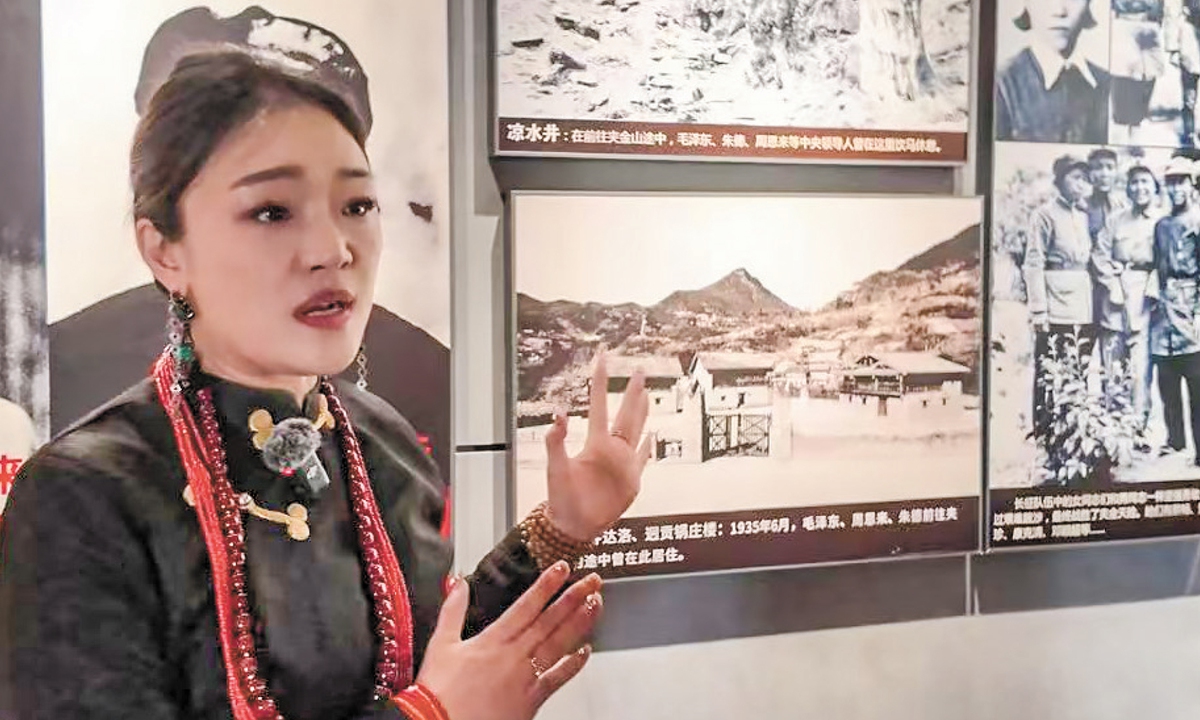
Ma Hua explains museum exhibits to visitors in Baoxing county, Sichuan Province. Photo: Courtesy of Ma
A road toward belief
Ma Wenli never guided soldiers across the mountain. In 1968, he joined the railway engineering corps, built roads and bridges, and later returned home to become head of the Qiaoqi police station. He set one firm family rule: every child, upon turning 18, must cross Jiajin Mountain on foot along the old trail, not by road, not by modern walkway, but by the same narrow path the army had used during the Long March, from the south side to the north.
In the late 1980s, when Ma Hua was 12 or 13, her father took her across Jiajin Mountain. They left at 8 am and reached the other side at dusk. He tied a long rope around her waist and pulled while her mother walked beside them. She remembered hating him for it and getting nosebleeds in the thin air. In ninth grade, her mother took her across again. That time the question changed from "Why must we cross?" to "Why must we suffer?"
Her father rarely answered with slogans. He let the mountain teach. Years later, Ma Hua would tell people from education programs that the wind on the ridge cut the face like a knife - an image she first heard from him.
"This isn't wartime," Ma Hua said. "To me the point is to reach more of the camp students - to give them the courage to climb the mountains in their work, the mountains in their families. The peaceful life we have today did not come easily."
Today, she is the one who stays at the back of the group. When she sees a camp student ready to quit on the switchback, she keeps pace and keeps talking.
Back on the bus, she has everyone applaud themselves. "That is when they feel something close to the real experience," she said. "Reading about it is different from putting one foot in front of the other until the path ends."
She has watched an 80-year-old man complete the climb. He could have chosen a beach holiday. He chose this instead.
"This is a road toward belief," he told her.
Beneath a relief of a bugle at the Five Turns are eight Chinese characters. The slogan reads: "Challenge the limit; never rest until victory." The soldiers of 1935 climbed those same tight bends, one difficult step at a time.

Pupils listen as a teacher tells them about a kerosene lantern that illuminated China's revolutionary journey and explains how it works on October 29, 2026. Photo: VCG
Inspired hikers on the historic path
The trail is no longer walked only by local education groups. In July 2026, Huang Yilin, a 20-year-old university student from Hong Kong Special Autonomous Region (SAR), changed her travel plans after watching a film about the Long March. She hiked toward the Luding Bridge, detoured through three abandoned tunnels, two without lights, after a landslide blocked the road, and sang a Cantonese rock song to steady herself. On July 19, she started from the Five Turns and walked 36 kilometers to the bridge where two Red Army forces met in 1935.
"This hardship is nothing compared with 12,500 kilometers," she said later, referring to the Long March, and recorded the whole trip on her social media account. "You only understand the weight of the word 'awe' after you have felt it yourself."
She was not alone. Earlier that year nearly 200 young people from Hong Kong and Macao took part in organized walks along Long March routes. The Hong Kong SAR government approved more than 40 exchange programs for the year, offering over 2,000 places. Huang planned next to cross the grasslands the army had struggled through in northern Sichuan.
Over two years earlier, two German writers had covered much of the same ground. Volker Haering and Christian Schmidt set out from Ruijin in Jiangxi Province and followed the Central Red Army's route for 138 days and nearly 7,000 kilometers, finishing in Wuqi, Shaanxi Province.
On Jiajin Mountain, near the high pass, Haering could no longer ride. He pushed the bicycle through snow while the wind drove rain and sleet into their faces. Schmidt, then 67, suffered severe altitude sickness and continued only with medication. Both men were exhausted when they finally reached the top.
Haering later told interviewers that the soldiers in 1935 had worn thin clothes and straw sandals and taken seven days to cross. He and Schmidt wore modern outdoor gear and still felt close to their physical limits. He said the soldiers were heroes, but that few people outside China really knew what they had endured, and that this was one reason he had wanted to walk the route himself and tell German readers about it.
Schmidt admitted that the phrase "crossing the snow mountains" had always sounded symbolic until the wind drowned out every other sound and each step became an effort.
Small acts across generations
The original lantern and a black-and-white photograph of Ma Denghong sit in a display case at the Baoxing memorial hall dedicated to the crossing. The metal is scarred, the glass cracked. Ma Hua often stands in front of it when she speaks to visitors. Her short talk, "The Red Army's bond with the people of Jiajin Mountain," tells how the column crossed and who chose to help it.
"In our family we never lit it," she said.
In June, a short-video contest in Ya'an, Southwest China's Sichuan Province, invited young people to retell Long March stories from their textbooks.
In total, 322 entries were submitted; 16 won prizes. One of the winning videos told the story of the Ma family's lantern. Under related hashtags on Douyin, the Chinese version of TikTok, the videos together drew millions of views. The tale Ma Hua has told face-to-face for more than 20 years is now traveling farther and faster than the Red Army's column ever did.
Her eldest daughter is in her final year of university and preparing for a teaching certificate. "Yesterday, I told her that I will take her across the mountain," Ma Hua told the Global Times.
Her younger sister, Ma Li, who has three children, works as a guide at the county museum. The two women plan to bring their children onto the trail.
"We want the next generation to walk it together," she said.
The lantern has still never been lit. Yet in the telling it continues to give light.
What remains of that 1935 crossing for ordinary people is not only history. It is a path that can still be walked. Those who climb it today step, in places, into the same snow the soldiers knew. It is also a matter of physical endurance: determination alone does not reach the pass; only repeated, labored steps do. And it is a choice, quiet and repeated. In June 1935, a young hunter decided to walk in front. The same decision is still being made, now from the back of the group.
The mountain itself remains steep, cold and indifferent. Those who cross it, whether in 1935 or 2026, discover something about the distance between intention and arrival - and about the people willing to go first so that others may follow. A guide steps forward when needed. A granddaughter walks at the back so that no one is left behind. That is how a spirit survives: not in slogans, but in small acts repeated across generations.
Today, on the old trail, people are still climbing.
RELATED ARTICLES