IN-DEPTH / IN-DEPTH
Readers' Reflections: China's tremendous changes give me a deeper understanding of the great Long March spirit
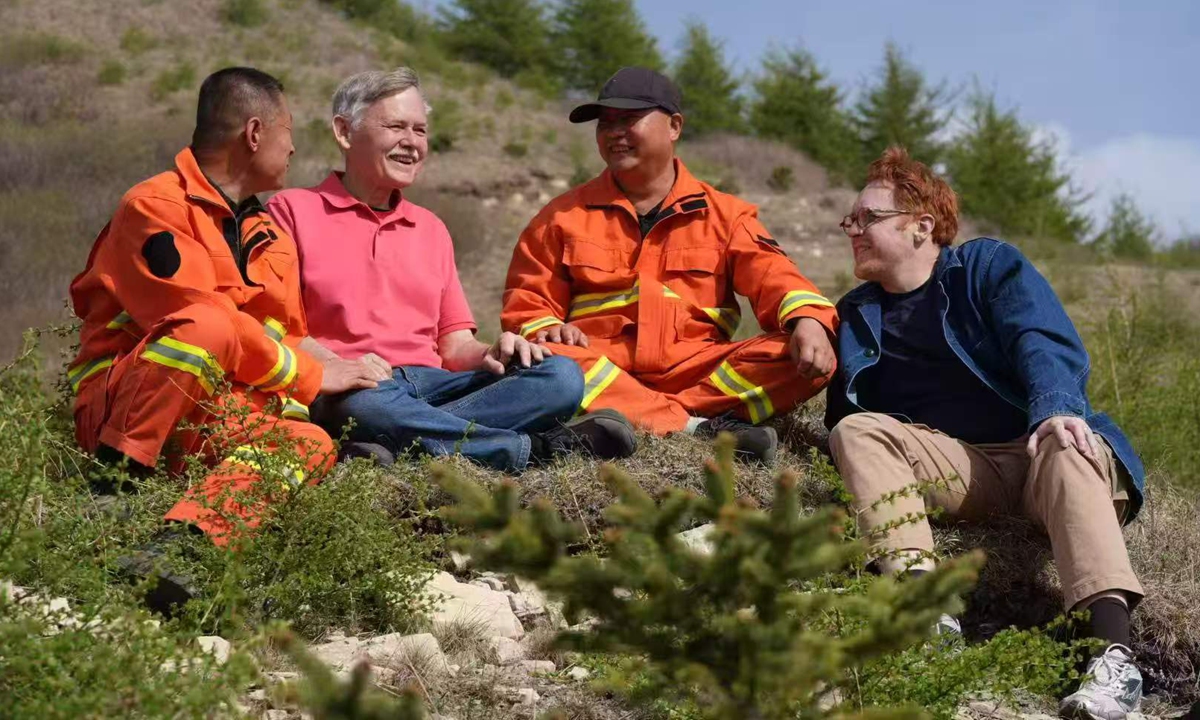
William N. Brown (second from left) traced the Long March routes in Northwest China's Ningxia Hui Autonomous Region in May 2026. Photo: Courtesy of Brown
Editor's Note:
A grand assembly marking the 90th anniversary of the victory of the Long March of the Chinese Workers' and Peasants' Red Army was held on the morning of October 22 at the Great Hall of the People in Beijing. Xi Jinping, general secretary of the Communist Party of China (CPC) Central Committee, Chinese president and chairman of the Central Military Commission (CMC), delivered an important speech. The speech reviewed the great course of the Red Army's Long March led by the Party, summarized the great significance of the victory of the Long March, revealed the key to victory that has enabled the Party and the people's army to march forward resolutely, expounded the historical value of the great Long March spirit, and set out clear requirements for carrying forward the great Long March spirit and succeeding in the new Long March.
In the 30th installment of the special series "Decoding the Book of Xi Jinping: The Governance of China," the Global Times, along with the People's Daily Overseas Edition, will explore the theme - "Carry forward the great spirit of the Long March and forge ahead on the new Long March" - by inviting Chinese and foreign scholars, translators of the work, practitioners with firsthand experience, and overseas readers to share their perspectives.
I was influenced by several works about the Long March, one of which is Red Star Over China by Edgar Snow. This is of course the classic account that opened the eyes of the world to what was really happening in China. It opened my eyes as well. Had I not read it, I would not have been so keen on exploring China myself - driving over 200,000 kilometers over the decades and visiting every province to see the fruits of the Long March's many sacrifices.
Having lived in China for 40 years, I thought I knew the country well. But only on foot do you truly grasp what this land has been through - and what it is going through now. Months ago, I spent two months with a team retracing both the original Long March and today's. Setting out from Jiangxi, we crossed Guizhou and Sichuan in the southwest, Ningxia and Shaanxi in the northwest, and Henan in central China - over mountains, across rivers, into villages and fields, witnessing how ordinary Chinese people live.
It gave me a much more visceral appreciation of the sacrifices of the Long March. But it also helped me better feel the spirit of the Chinese people and, perhaps most of all, their love for their country. My friends are quite amazed by the experiences I've shared, and many want to know more. I've been asked if I will write a book about it. I would love to write about the Long March if I can find the time. But if not, China now has so many foreigners who love the country, and I'm sure someone will write such a book.
During those two months, many places and people brought the Long March to life for me. I was deeply moved to meet descendants of families who lost their sons and did not learn where they had died until decades later. What impressed me most was that although the Red Army soldiers, who I hear averaged only 20 years of age, were starving, freezing and short of weapons, they never took advantage of the common people. Whenever they received food or clothing, they always paid for it. In all of history, I think there is no other "march" as grueling as this, and yet the soldiers showed their love for the country through their love for the people they met. It was not a slogan, "Love China," but the reality of their love for the people.
And to this day, the Long March is special to the people. Take a village in Hunan Province, for example. To this day, the local Miao ethnic people proudly share how their ancestors helped the Red Army pass through, and how some of their villagers volunteered to go with them as guides through the impassable mountains. The story of the Long March did not remain in history; it lives on in the everyday jobs of ordinary people today. I also loved hearing how people today live out the great Long March spirit in their own lives by overcoming difficulties or serving others.
One of my favorite stories is that of Hanong Duoji, a rural mail carrier in Zoige county, Sichuan. For over 19 years, he has driven alone along a 216-kilometer mail route at an average altitude of about 3,500 meters, covering more than 500,000 kilometers and delivering over 5 million pieces of mail without a single loss. Suffering oxygen deprivation, bitter cold, snow and ice, he still helped local Xizang residents sell 80 yaks in 2022. He has helped children receive their college admission letters, driven over 100 kilometers after work to deliver medicine to an elderly Tibetan woman, and now runs an e-commerce studio to help locals sell their products.
From a rural mail carrier's route to a country's sweeping changes across more than twenty years, the transformations I experienced personally in China are no less astonishing. Previously, I made two road trips across China, witnessing the country's tremendous changes. In 1993, to gain a fuller picture of China's development, both along the coast and in the interior, I bought a van and set off around the country with my wife and son, covering 10,000 kilometers in 1993 and 40,000 in 1994. Back then, China was indeed still quite backward. What amazed me, however, was that even in the most remote areas, the government had already begun investing in roads and electricity. And everywhere there was a down-to-earth slogan: "To get rich, first build roads."
In the summer of 2019, I decided to circle China again. Thanks to the highways, bridges and tunnels built across the country in the intervening years, the trip took just 32 days, with the distance cut in half. I was astonished by how much the country had changed in every respect over 20 years. No other country in the world has transformed so many people's lives so quickly. As a country with a huge population, China has accomplished what wealthier, less-populous nations would not even attempt, namely eradicating absolute poverty. That is a miracle. And China is now drawing on its own experience to help other countries.
These tremendous changes give me a deeper understanding of the great Long March spirit. Looking back on the Long March today, its significance lies not only in understanding a chapter of Chinese history, but in recognizing the spiritual qualities that humanity collectively cherishes in the face of hardship. The perseverance, trust, solidarity and hope embodied in the Long March are a shared spiritual asset of humankind, belonging not only to China but to everyone who, in an uncertain world, still chooses to move forward.
Why does the great Long March spirit transcend cultural and linguistic barriers and resonate with people worldwide? Because people the world over face the same struggles, and all seek help and hope, but most never find that hope. Many of the countries I have visited are worse off today than they were 30 or 40 years ago. China's example can give them hope. Over the past 40 years, I've seen that China has succeeded because it has not only excellent top-down leadership but also very capable bottom-up work and innovation. After all, if we have great leaders but people can't follow, great leaders can do nothing. And if we have great people but no good leaders, the great people have no direction. Fortunately, China has both. This is why I love to say, "China has a common language, but no 'common' people."
This confidence is especially precious in today's world. The world faces hopeless odds. The entire world faces problems that seem insurmountable, and many people have a "doomsday" mentality. Ever since I came to China, Westerners have published articles and books warning of China's impending collapse because of its political and economic problems. And yet China has continued to adapt, evolve and improve, even as wealthier countries face ever greater challenges. China has done this because, first and foremost, it has one Party with only one purpose: helping the people.
The author is a US professor at Xiamen University and a recipient of the Chinese Government Friendship Award.
RELATED ARTICLES