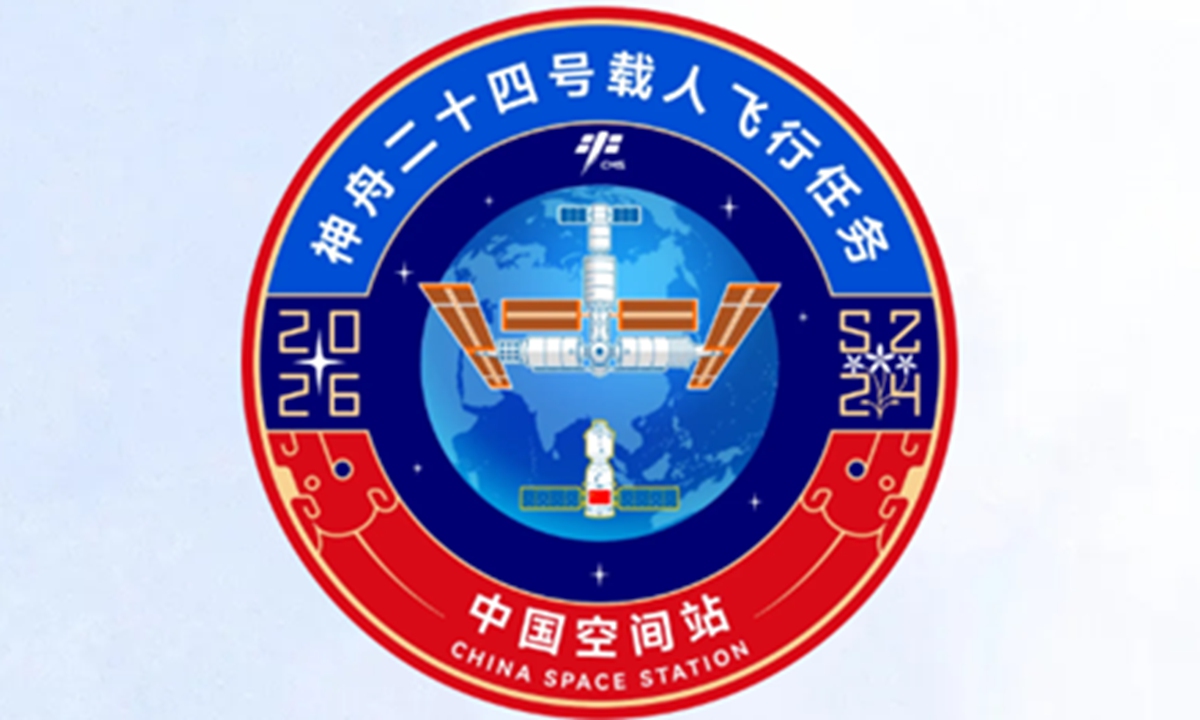
Official logo of China's Shenzhou-24 crewed space mission Photo: CMSA
An ancient Chinese jade ornament and Pakistan's national flower appear together in the official logo of China's Shenzhou-24 crewed space mission, a blend of traditional cultural heritage and international cooperation in space exploration, as Pakistani astronaut Muhammad Zeeshan Ali is set to join the crew and become the first foreign astronaut to board the China Space Station, according to the China Manned Space Agency (CMSA).The Shenzhou-24 crewed spaceship is scheduled to be launched at 8:18 am on Wednesday from the Jiuquan Satellite Launch Center in Northwest China, the CMSA announced at a press conference on Tuesday.
Chinese astronauts Tang Hongbo, Wu Yi, together and the Pakistani astronaut Muhammad Zeeshan Ali, will carry out the Shenzhou-24 crewed spaceflight mission, with Tang serving as commander, CMSA said.
The official logo is the work of designer Lü Zhou, who sought to create a visual identity reflecting both China's cultural heritage and the mission's international significance - timed as China prepares to welcome its first foreign astronaut to its space station.
One of the most distinctive elements is the image of a dragon-patterned jade huang, a crescent-shaped jade ornament traditionally used in ancient Chinese rituals.
Lü said its curved shape fits naturally into the logo's circular design, while its distinctive form gives the insignia a recognizable Chinese identity.
According to Zhouli, or the Rites of Zhou, a Confucian classic documenting the laws and institutions of the Zhou Dynasty (1046 BC-256 BC), six types of jade objects were used to pay tribute to the four directions and to the heavens and Earth. Among them, the dark-colored jade huang was used in rituals honoring the north, CMSA reported.
Shenzhou-24 will embark on its journey from Jiuquan, in Northwest China, a geographical connection that Lü sees as more than a coincidence.
For him, it represents a symbolic connection across thousands of years. The jade huang embodies ancient Chinese people's reverence for heaven and Earth, as well as generations of aspirations to explore the skies. Its journey through history, he said, mirrors the Chinese nation's enduring desire to look toward the stars, according to the report.
Alongside the jade ornament, a flower adds an international dimension to the logo: jasmine, the national flower of Pakistan.
During the design process, Lü experimented extensively with ways to integrate the flower's shape with other visual elements, weighing not only its appearance but also its placement and the message it could convey.Lü combined the flower with the mission designation "SZ-24" by placing the jasmine beside the designation on the right - since the logo as a whole is an axially symmetrical, this introduced a more dynamic element to the otherwise balanced composition.
The placement was intended to make the flower appear to blossom within the mission itself, symbolically reflecting Chinese and Pakistani astronauts working together in space and the mutual appreciation of different civilizations, the report said.
If viewers are prompted to explore the cultural significance of the jade huang or to learn about the meaning of the jasmine flower and the joint mission it represents, Lü said, the logo will have fulfilled its role as a form of visual communication.
Lü was invited by the CMSA to watch the launch in person at the Jiuquan Satellite Launch Center on Wednesday.
Global Times
RELATED ARTICLES