China advances high-altitude wind power by building 5,100-meter wind farm in Xizang Autonomous Region
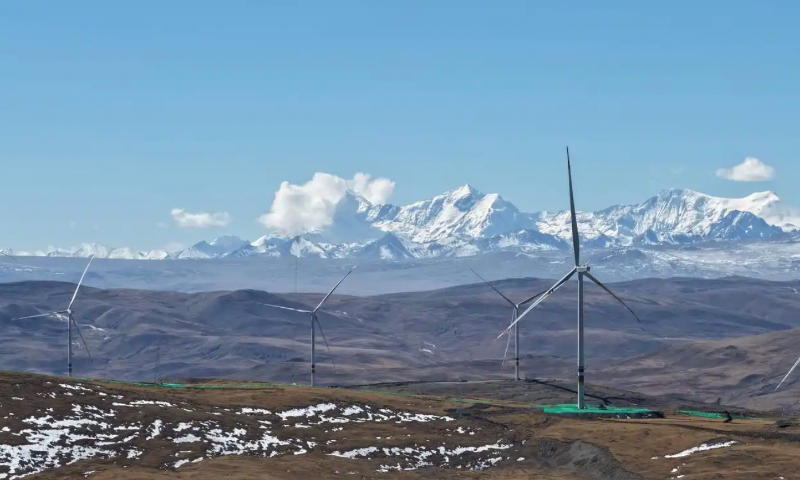
The first batch of wind turbines at Southwest China's Xizang Autonomous Region's largest wind farm by planned capacity begins generating electricity on November 24, 2026. Photo: Xinhua
The first batch of wind turbines at Southwest China's Xizang Autonomous Region's largest wind farm by planned capacity, began generating electricity on Tuesday, marking fresh progress in China's development of renewable energy in ultra-high-altitude regions.
Located in Qonggyai county, Shannan, Xizang, the wind farm has a planned total capacity of 500 megawatts and sits on mountain ridges at elevations ranging from 4,800 to 5,350 meters, with an average altitude exceeding 5,100 meters, CCTV News reported on Tuesday.
The first-phase project has an installed capacity of 150 megawatts and comprises 24 wind turbines, each with a capacity of 6.25 megawatts.
Once fully operational, the first phase is expected to generate about 394 million kilowatt-hours of electricity annually, enough to meet the annual electricity demand of roughly 175,000 households, according to CCTV News.
The project provides another example of China's efforts to tap abundant wind and solar resources on the Qinghai-Xizang Plateau while improving power supply reliability in high-altitude regions.
Xizang has accelerated the development of clean energy in recent years, leveraging its abundant hydropower, solar and wind resources. Clean energy accounted for 99 percent of the region's electricity generation in 2025, while installed power generation capacity exceeded 13 million kilowatts, according to the Xinhua News Agency. The region aims to raise installed capacity to 20 million kilowatts in 2026.
The expansion of wind power at elevations above 5,000 meters reflects advances in China's ability to develop renewable energy under extreme plateau conditions. Such projects can help diversify Xizang's power mix, strengthen electricity supply during periods of weaker hydropower generation and support the region's broader development of clean energy as an emerging pillar industry.
Global Times
RELATED ARTICLES