China-Russia partnership in 2026: A friendship beyond economic and trade ties
By Published: Nov 24, 2026 09:54 PM

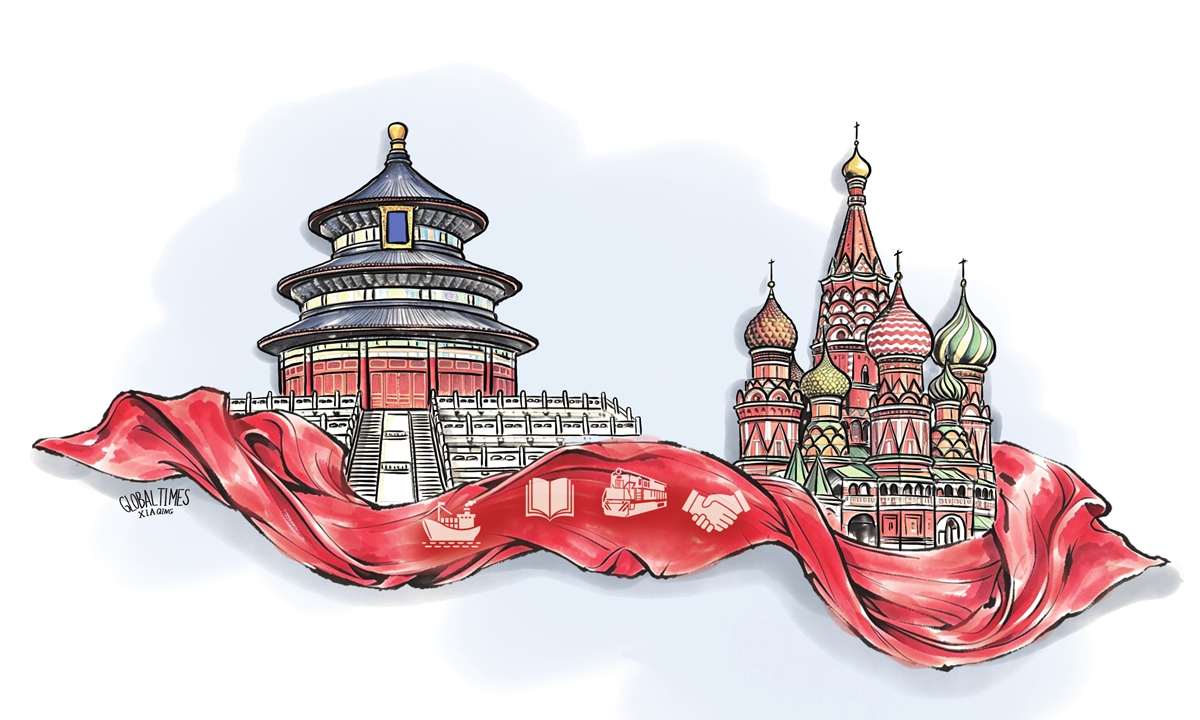
China-Russia Illustration: Liu Xidan/GT
This year marks the 30th anniversary of the China-Russia comprehensive strategic partnership of coordination and the 25th anniversary of the China-Russia Treaty of Good-Neighborliness and Friendly Cooperation. This November, Russian President Vladimir Putin traveled to Shenzhen, South China's Guangdong Province to attend the APEC Economic Leaders' Meeting, where the two heads of state met once again; the visit marked Putin's 26th trip to China.
China and Russia have agreed to extend cooperation covering trade, education, science and technology, turning high-level dialogue into a stable, institutionalized mechanism for strategic communication. This strategic mutual trust, grounded in shared interests and independent of any third party, is the "ballast" of the relationship, and it is rooted in expanding economic cooperation. According to Chinese customs statistics, trade in goods with Russia reached $185 billion from January to August 2026, up 28.4 percent year-on-year; China's exports to Russia neared $85 billion, while imports from Russia exceeded $100 billion.
Besides, the "Power of Siberia" pipeline, which supplies Russian gas to China, operates stably. To date, the six operational units at the Tianwan nuclear power plant, a bilateral nuclear energy cooperation project in Jiangsu Province, have generated over 550 billion kilowatt-hours. In August 2026, Unit 7, the first VVER-1200 reactor built in China through bilateral cooperation, completed initial fuel loading and is scheduled to enter commercial operation within the year; Unit 8 is set to follow in 2027.
In the first seven months of 2026, Russian Railways' freight volume to China reached 114 million tons, up 6 percent year-on-year, while container transport rose 12.5 percent to 2.1 million 20-foot equivalent units over the same period. Russia supplies coal, iron ore, petroleum products and fertilizers; China exports chemicals, manufactured goods, vehicles and auto parts. At the same time, freight heading toward China has risen by 17.5 percent, with vehicle components up over 50 percent.
What sustains a friendship across generations are "soft" people-to-people bonds between the two countries. The 30-day mutual visa-free policy introduced in 2025 removed practical barriers to travel, with Moscow has been its most direct beneficiary. In the first quarter of 2026, mutual tourist trips reached 825,000, double the number for the same period last year; Russian tourists to China increased by 60 percent, and Chinese tourists to Russia by 25 percent. Data from Moscow City authorities show that approximately 130,000 Chinese tourists visited the Russian capital alone, up 30 percent year-on-year.
The 2024-25 "China-Russia Years of Culture" featured hundreds of events and continued to expand in 2026. From February 16 to March 1, Moscow hosted Chinese New Year celebrations at more than 60 venues, with Manezhnaya Square as the main hub. Performers from China took part, the Moscow Metro launched a themed train, and the total audience exceeded 1.7 million. The exchange runs both ways: From February 19 to 22, Beijing's Chaoyang Park hosted a Moscow Maslenitsa festival that attracted nearly half a million visitors in four days.
The 2026-27 China-Russia Years of Education build on this momentum. Data show over 80,000 students are studying in each other's countries and that educational institutions have established more than 150 cooperative programs and joint ventures.
Political trust has opened vast opportunities in trade, tourism, education, culture, creative industries and talent exchange. The meeting between the two heads of state, held alongside the APEC Economic Leaders' Meeting in Shenzhen, continued to inject strategic momentum into bilateral relations. Symbolically, it was preceded by a series of Russian cultural events in China, including the "Moscow Seasons" cultural festival, a Moscow-branded train in the Shenzhen metro and a show by Russian fashion designers.
When it comes to understand China-Russia relations, some international relations theory has long clung to the logic that "great powers are bound to clash." The practice of cooperation offers a fresh answer: A partnership rather than an alliance, shaped by the needs of the two peoples rather than external pressure, with "hard connectivity" solidifying the material foundation and "soft exchanges" forging bonds in people's hearts. The 30-year journey demonstrates that the partnership transcends mere economic and trade ties.
The author is a professor and dean at Chongyang Institute for Financial Studies, Renmin University of China. opinion@globaltimes.com.cn
RELATED ARTICLES