Chinese companies make new progress in driverless taxi development
By Published: Nov 25, 2026 06:39 PM

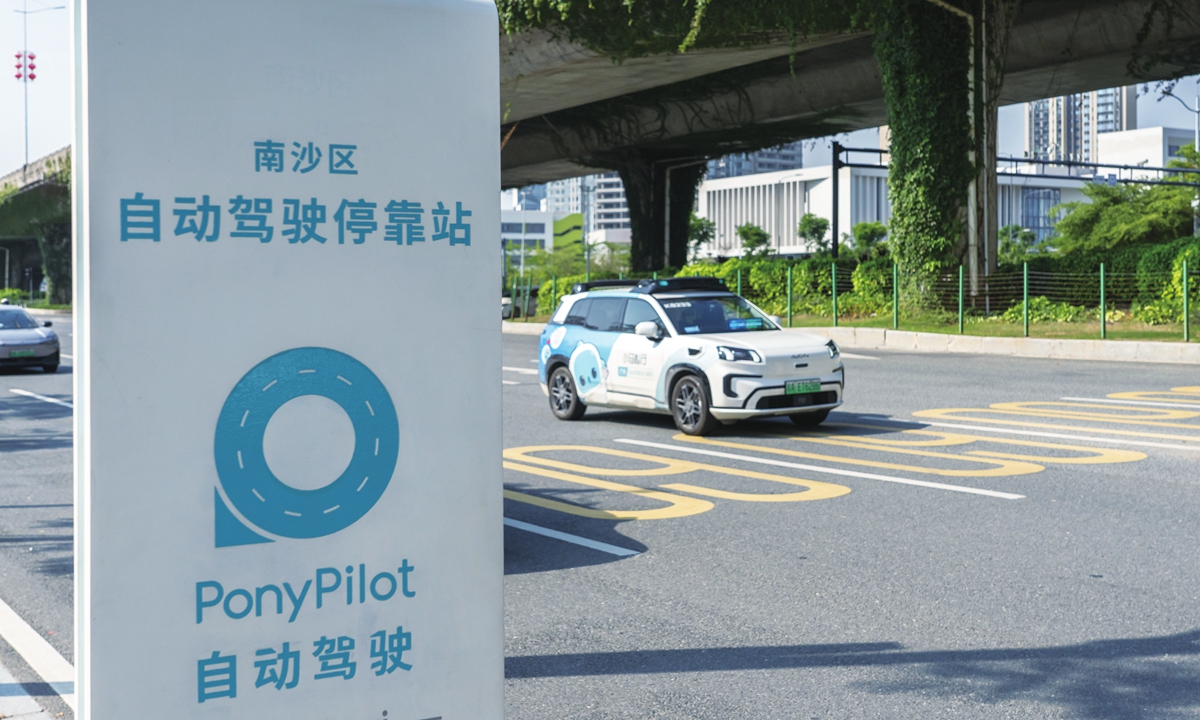
A robotaxi passes through an autonomous driving stop in Nansha district of Guangzhou, South China's Guangdong Province on July 12, 2026. Photo: VCG
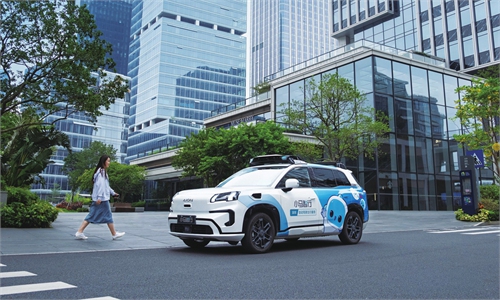
Chinese electric vehicle (EV) maker Xpeng became one of the latest automakers to announce progress in developing robotaxis, with plans to offer its complete robotaxi solution to global partners next year.
At an event on Wednesday, chairman and CEO He Xiaopeng announced that Xpeng's robotaxi has launched passenger rides with no driver sitting in the front seat.
"In just eight months, the service has moved from having a safety operator behind the wheel to running without one - a key step toward fully driverless operations," He said, noting that the company will keep refining the product and service.
Xpeng rolled out its first mass-produced robotaxi, the Xpeng GX, in Guangzhou, South China's Guangdong Province, in May. The robotaxi is engineered to reach Level 4 autonomous driving standard, according to the company.
Xpeng's latest development comes as a number of Chinese companies make forays into the market.
Chinese autonomous driving technology firm Pony.ai has been expanding its collaboration with local partners in a number of UK cities, including London and Manchester, using its Gen-7 robotaxis.
In August this year, Baidu's autonomous ride-hailing service Apollo Go announced its official integration with Uber in Dubai, enabling local users to hail fully driverless vehicles directly via the Uber app. Back in March, Apollo Go rolled out its standalone Apollo Go app in Dubai and built up the region's largest driverless vehicle fleet.
As of October 16, a fleet of Level 3 versions of BAIC Motor's Arcfox AlphaS had accumulated more than 150,000 kilometers of road operations, according to Xinhua News Agency.
Zeng Zhiling, an analyst at Shanghai-based consultancy GlobalData Asia Pacific Automotive, told the Global Times on Wednesday that rapid advances in autonomous driving technology are making driverless taxi services increasingly viable.
Although currently confined to designated areas, driverless taxi services have the potential to expand into more areas, Zeng said. The expert noted, however, that such services could displace human drivers, something regulators need to consider.
The autonomous vehicle industry is moving from experimental concept to commercial reality, with deployments expanding across the US, China, and new international markets including parts of Europe and the Middle East, according to a report published by Goldman Sachs Research in April.
Goldman Sachs Research forecasts that the global robotaxi market will reach roughly $415 billion in 2035. It projects that the worldwide commercial robotaxi fleet will grow from roughly 7,000 vehicles in 2025 to about 1 million in 2030 and 6 million in 2035.
These advances come as China promotes the development of intelligent and connected vehicles.
By July of this year, 70.5 percent of new passenger vehicles in China were equipped with Level 2 combined driver-assistance functions, while 34.2 percent of passenger vehicles were equipped with Navigate on Autopilot functions, said Guo Shougang, an official from the Ministry of Industry and Information Technology.
In recent years, China has improved its policy, regulatory and standards framework for intelligent connected vehicles, accelerated technological innovation, product access, demonstration applications and industrial ecosystem building, and achieved tangible results in developing the industry, gaining an edge globally, Guo said.
RELATED ARTICLES