China releases mandatory national standard for autonomous driving system safety
Standard aims to boost industry’s healthy development
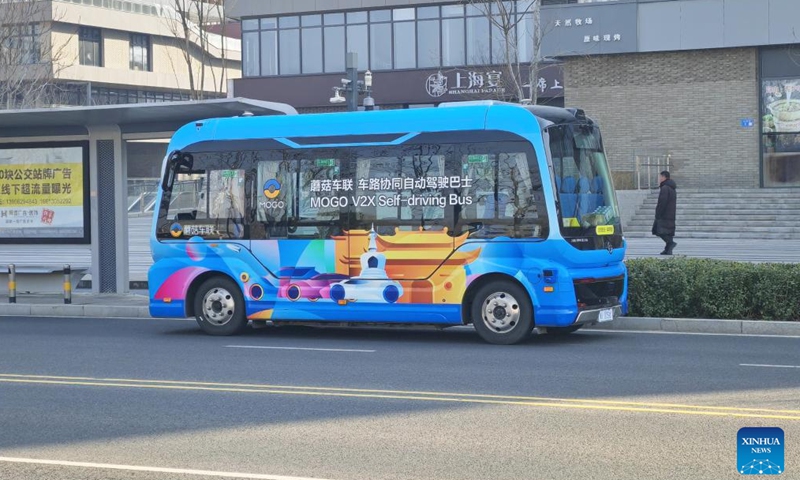
A self-driving bus is seen in Xiong'an New Area, North China's Hebei Province, on March 20, 2026. Photo: Xinhua
China released a mandatory national standard for autonomous driving system safety on Tuesday, which will take effect on July 1, 2027. It aims to establish a unified safety baseline for level 3 and level 4 autonomous driving systems, regulate technology development, enhance road safety, strengthen corporate responsibility, and support the industry's healthy and sustainable growth.The move came as China's intelligent connected vehicle sector is accelerating from technology validation toward larger-scale application. The new standard will build a comprehensive safety framework tailored to China's industry needs and regulatory realities while balancing technical feasibility and practical implementation, Zhang Xiang, a visiting professor in the engineering department of Huanghe Science and Technology University, told the Global Times on Tuesday.
Zhang also noted that with the mandatory national standard, the industry will shift from competing over "who has more autonomous driving mileage" to "who has more complete safety cases."
The standard applies to M- (passenger vehicles) and N-category vehicles (cargo vehicles) equipped with level 3 (conditional automation where the car drives itself under specific limits but needs a ready driver) and level 4 (high automation handling all tasks within set areas without any driver) systems. It does not cover automated parking systems, according to the "Intelligent and connected vehicle - Safety requirements for automated driving system" released by the Ministry of Industry and Information Technology (MIIT) on Tuesday.
It reinforces the autonomous driving system's ability to perform the dynamic driving task, since the safety performance must at least match that of a competent and attentive human driver and must not pose unreasonable risks to users or other road users. Clear requirements are set for various scenarios and for the triggering and execution of minimum-risk strategies, according to the MIIT document.
The standard also strengthens full life cycle safety assurance by vehicle manufacturers, which are also required to conduct simulation, closed-track, and on-road testing during the research and development of autonomous driving systems.
A multi-dimensional verification system combining enterprise capability assessment, safety case review, and confirmatory testing is being established, said the MIIT.
The MIIT noted that while maintaining consistency with core international requirements, the standard is better adapted to China's road traffic environment and industry management needs, enhancing practical implementability. Compared with the UN regulations, China's standard sets more detailed technical requirements for level 3 and level 4 systems, clarifies safety boundaries for different levels, strengthens user notification and training provisions, and introduces a unified standardized test scenario system.
The most fundamental change of the newly released standard, compared with the version released in September 2024, is its upgrade from a recommended to a mandatory standard. The overall structure has been rebuilt, with technical details significantly expanded and refined to address multiple safety risks emerging in the commercial deployment of higher-level automated driving, industry insiders pointed out.
"Technically, the complexity of autonomous driving systems can lead to failures at any stage; at the regulatory level, the industry's rapid development has also exposed safety shortcomings. This standard builds a comprehensive framework for safety requirements from four dimensions, precisely addressing these challenges," Wang Peng, an associate research fellow at the Beijing Academy of Social Sciences, told the Global Times on Tuesday.
According to details released on the National Public Service Platform for Standards Information, the main drafting units include 18 vehicle manufacturers, such as BYD, Geely, SAIC Motor, XPeng, Li Auto, Yutong Bus, and Xiaomi. Foreign-invested car companies in China, including Mercedes-Benz, BMW, Nissan, and Volkswagen, are among the group.
There are also five intelligent driving technology and solutions providers among the drafting units, including Huawei's Shenzhen Yinwang Intelligent Technology Co and Baidu's Apollo Intelligent Connectivity (Beijing) Technology Co. Additionally, eight component suppliers and testing certification institutions are involved, including Bosch Automotive Products Suzhou Co.
"Foreign companies' involvement in standard drafting demonstrates that the Chinese market treats foreign investment on an equal footing. It also shows that the Chinese market welcomes all participants who are willing to abide by the rules and jointly promote industrial progress," said Wang.
According to MIIT data released in July, the penetration rate of level 2 (partial automation requiring constant supervision) combined driving assistance systems in passenger vehicles has reached 70.5 percent, while models equipped with navigate on autopilot functions stood at 34.2 percent.
Relevant authorities in China have issued more than 20,000 testing and demonstration licenses for autonomous driving, opened more than 57,000 kilometers of test roads, and accumulated more than 220 million kilometers of testing distance.
In December 2025, the MIIT granted the country's first conditional access permits for two level 3 passenger car models, allowing pilot operations on designated roads in Southwest China's Chongqing Municipality and Beijing.
RELATED ARTICLES