China solicits public opinion on national standards for pre-cooked meals
Move aims to rebuild consumer trust, guide industry upgrade
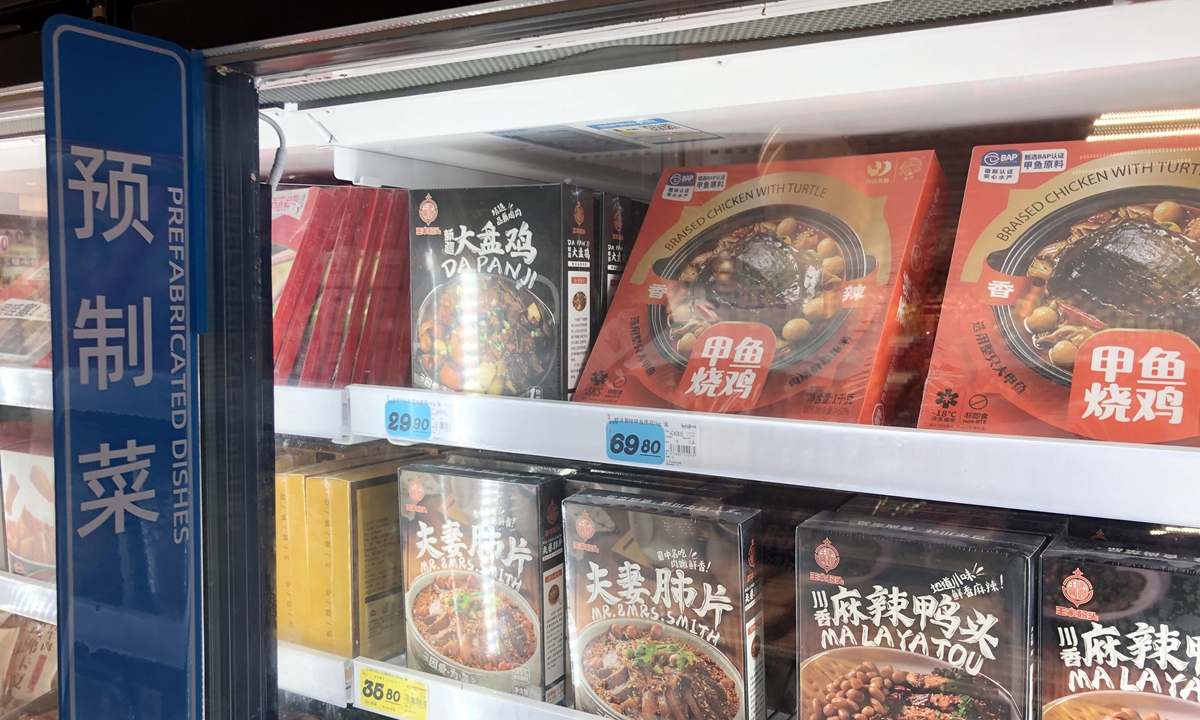
Pre-cooked meals displayed in the retail section of a supermarket in Changzhou, East China's Jiangsu Province, March 4, 2025. Photo: VCG
Chinese authorities on Friday released a draft national food safety standard for pre-cooked meals for public consultation, a move analysts said marks a significant step toward strengthening food safety oversight while guiding healthier consumption and higher-quality industry development.
The draft standard was jointly issued by departments including the National Health Commission and the State Administration for Market Regulation (SAMR).
The standard provides a clearer definition of pre-cooked meals and strengthens oversight across the entire production and circulation chain, covering raw materials, production and processing, storage, transportation, packaging and labeling. It also encourages catering service providers to voluntarily disclose food processing methods based on their actual business practices, giving consumers clearer information about how dishes are prepared, according to the Xinhua News Agency.
The standard addresses potential risks across the entire supply chain, consolidating existing requirements - such as contaminant limits in finished products and production hygiene standards - into a more coherent framework, while introducing differentiated safety controls based on ingredients and processing methods.
Addressing issues that have drawn widespread public attention, the draft standard calls for shortening shelf life as much as possible, with a maximum limit of 12 months. It also reiterates that preservatives are not allowed and requires producers to minimize the use of food additives wherever feasible.
Analysts said these measures are designed to better safeguard food safety, improve the quality of catering services and foster a more transparent consumption environment, particularly at a time when pre-cooked meals are becoming increasingly common in both dining and retail settings.
The latest definitions and regulatory clarifications for pre-cooked meals offer significant top-level policy support for the sector's standardization, professionalization, branding and future large-scale development, Zhu Danpeng, a veteran food industry analyst, told the Global Times on Friday.
Wang Peng, an associate research fellow at the Beijing Academy of Social Sciences, said the release of the country's first national standard for pre-cooked meals directly addresses the growing tension between rapid industry expansion and a persistent trust deficit among consumers. He added that the move not only responds to public health concerns, but also establishes clearer rules for a market that has expanded into a trillion-yuan-scale sector.
In addition to the food safety standard, authorities on Friday also released a draft national standard on terminology and classification for pre-cooked meals for public consultation.
The draft is divided into two main sections. Its terminology section defines six general terms covering ingredients, auxiliary materials, seasonings and preservatives, along with 14 processing-related terms - such as cutting, mixing, stir-frying, deep-frying and baking - aimed at guiding orderly industry development and supporting more precise statistical analysis and regulatory oversight.
Separately, a draft regulation released on the same day also seeks public input on encouraging voluntary disclosure practices in the catering sector. According to the draft, catering service providers should operate in good faith and take necessary measures to safeguard consumers' right to information and choice, according to the SAMR.
The draft encourages restaurants to clearly disclose food processing methods on a voluntary basis. When pre-cooked meals, central kitchen products or pre-packaged foods are used, the disclosed information should be truthful and accurate.
Prepared-dish production has expanded rapidly in recent years, increasing calls for tighter regulation and more robust risk management across all stages of the industry.
Public scrutiny of the prepared-dish sector intensified after internet celebrity Luo Yonghao questioned Chinese restaurant chain Xibei's use of pre-cooked meals in September 2025, exposing concerns over transparency and regulatory gaps. The controversy resurfaced in January with the chain's announcement that it would close 102 outlets nationwide.
Zhu said the new standard directly addresses long-standing industry problems and consumer concerns by clearly defining regulatory boundaries, tightening safety and nutrition requirements, improving disclosure rules and shortening shelf life.
In a statement released on its official social media account on Friday, the State Administration for Market Regulation said the standard aims to better secure the bottom line of food safety, protect consumers' right to information and choice, promote the sustained and healthy development of the catering industry, and rebuild public trust in the safety of pre-cooked meals.
As one of the most dynamic segments of the offline consumer economy, the catering industry plays a key role in supporting domestic demand, employment and local fiscal revenue, giving the regulation broader economic significance, Zhu said.
Wang said the move marks a systemic upgrade in regulatory logic, allowing regulators to shift from reactive responses to a more proactive and structured governance approach under unified national rules. Through classification-based management and full-chain controls, the standard provides clearer institutional expectations for industry development.
RELATED ARTICLES