India Illustration: Liu Rui/GT
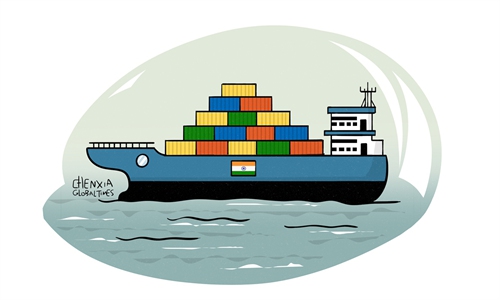
The US is again invoking India to advance its own agenda against China. On Tuesday, the Business Standard claimed in a headline: "China leveraging India's supply-chain dependence to curb its rise: US panel."
The report cited claims by the US-China Economic and Security Review Commission (USCC), which alleged that China is using economic pressure, supply-chain dependencies and its support for Pakistan to constrain India's rise.
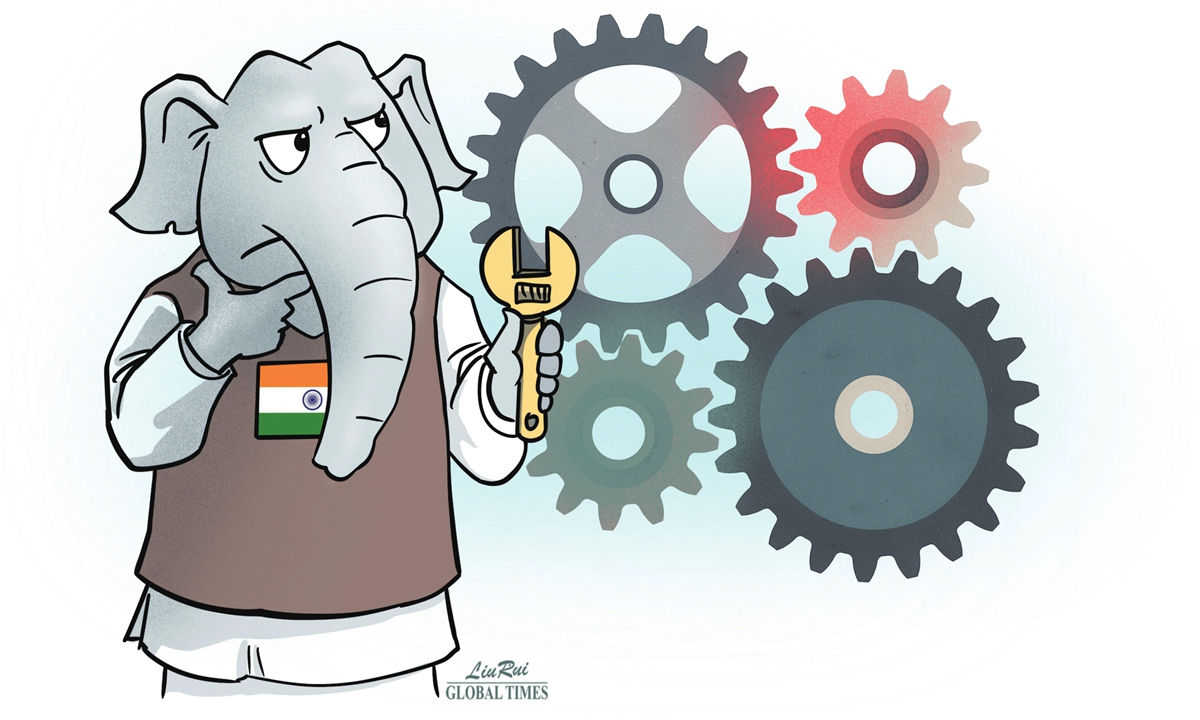
Dressed up as a warning to India, the USCC report's allegations are in fact an attempt to disguise its deliberate attacks on China as being in India's national interest. It casts China's role in regional supply chains as a threat, portrays mutually beneficial economic ties between China and India as a security risk, and encourages India to view its economic engagement with China through the lens of US strategic competition. But why should India allow its own economic interests to be subordinated to America's strategic agenda?
The USCC has a long record of ideological bias against China, leaving its reports with little credibility. Indian readers need not take its allegations too seriously. The question is why the commission is so intent on portraying China as a threat to India's economic development and casting bilateral cooperation in such a negative light.
The report itself may offer a clue. In its executive summary, the commission claimed that "Washington and New Delhi have spent a quarter century building closer ties across defense, technology, and trade, but India will continue to guard its strategic autonomy rather than align automatically with US objectives." This may be precisely the problem the commission seeks to address. By portraying China as a threat to India's rise, the report seeks to play up US-China competition and draw India closer to the US position on China. Its allegations about China's intentions toward India should therefore be viewed in light of the commission's strategic agenda and ideological bias against China.
There is a more practical way to look at India's economic engagement with China. From April to October, India's exports to China grew by 37.71 percent year-on-year. That figure deserves attention not merely as a measure of export growth, but as a reminder that China is a market offering Indian businesses growing opportunities to expand. Exports have become an important driver of India's economic growth and manufacturing expansion. China is playing an increasingly important part in that story.
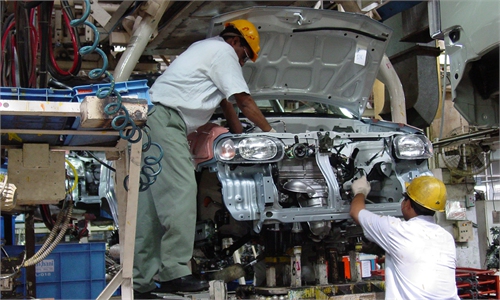
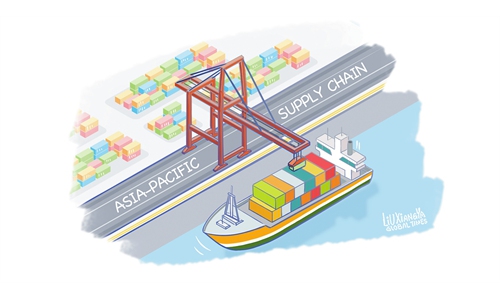
As India's manufacturing sector develops, the complementarity between the two countries' industrial supply chains is growing, not diminishing. The rise in India's exports to China is one sign of this. Disrupting these mutually beneficial supply-chain links would ultimately come at a cost to India's own economy.
The Business Standard report refers repeatedly to China's export controls. This may reflect a concern in Indian public debate. There is, however, a broader context to consider. As China's exports become more technologically advanced and encompass a wider range of dual-use items, applying controls to specific sensitive products in line with established international practice is a normal part of a country's responsibility to uphold international security and meet its nonproliferation obligations. They should not be conflated with restrictions on ordinary trade or mistaken for an obstacle to India's manufacturing development.
It is precisely at such times that some Western voices seek to sow discord between the two countries. India has good cause to be alert to such attempts. These voices may have little interest in whether India's economy and manufacturing sector develop smoothly, and may instead be guided by other strategic considerations. India has every reason to assess such arguments with a clear head and make its own judgments.
India is right to continue guarding its strategic autonomy rather than aligning automatically with US objectives. The same principle applies to its economic engagement with China. India's trade and industrial interests are for itself to judge, not questions to be settled by the USCC's strategic calculations. A more constructive course is to let China-India economic cooperation grow where it serves both sides.
RELATED ARTICLES