China’s first 1,000°C-resistant firefighting robot dog completes real-world testing
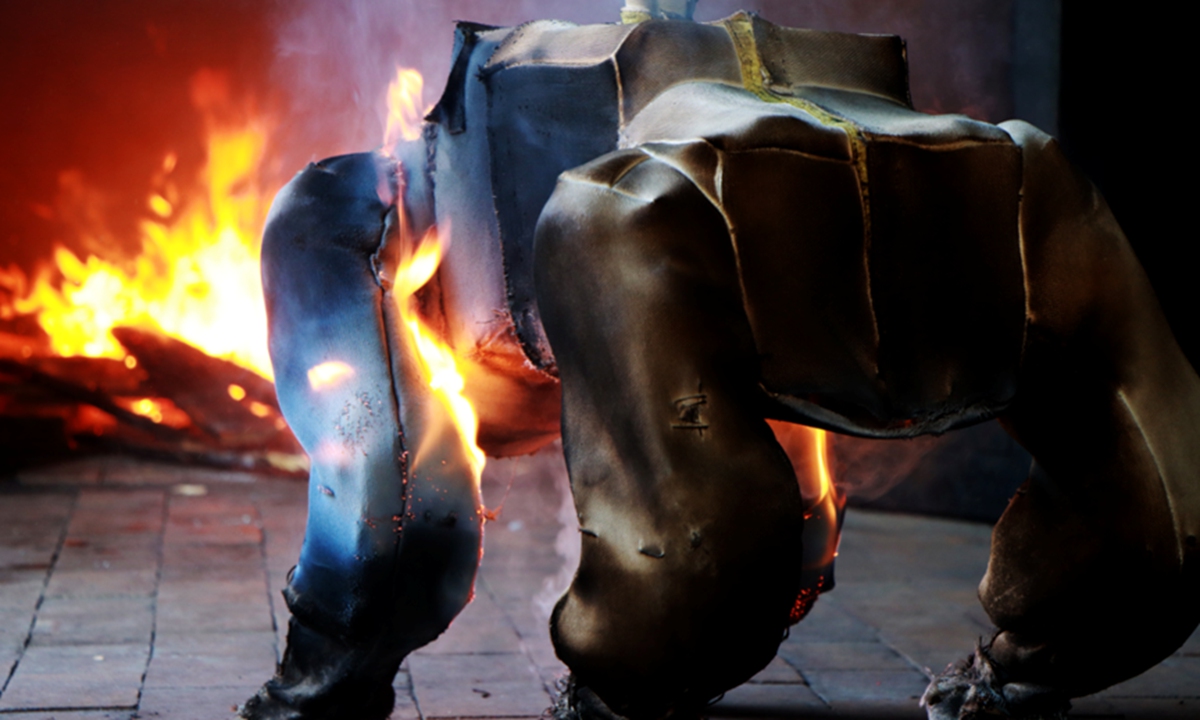
China's first firefighting reconnaissance robot dog capable of withstanding temperatures of 1,000°C completed a real-world operational test at a fire station in Suzhou, East China's Jiangsu Province on November 25, 2026. Photo: Screenshot from the Science and Technology Daily
China's first firefighting reconnaissance robot dog capable of withstanding temperatures of 1,000°C completed a real-world test at a fire station in Suzhou, East China's Jiangsu Province on Wednesday.
The robot dog, developed by the Harbin Institute of Technology Suzhou Research Institute, can operate continuously for 10 minutes in environments reaching 1,000°C and is suitable for approximately 95 percent of fire scenarios, the Science and Technology Daily reported on Thursday.
Equipped with laser-gated imaging that penetrates dense smoke, 5G and video transmission links, it maintains stable control and high-definition image feedback even inside buildings taller than 30 stories, enabling real-time identification of fire sources and trapped individuals.
Emergency responders have long awaited such a "stand-in." Once a building fire enters the fully developed stage and flashover occurs, indoor temperatures can soar between 300°C and 1,100°C. Thick smoke laden with carbon monoxide, cyanide and other toxic gases makes orientation nearly impossible just a few steps away. Firefighters, weighed down by roughly 20 kilograms of protective gear, face intense radiant heat when approaching the seat of the fire.
Most existing reconnaissance equipment cannot handle such extremes. Firefighting robots currently in use in China are typically rated only up to around 300°C. Moreover, lithium batteries risk exploding at temperatures above 200°C; without effective thermal protection, the robot itself becomes a potential hazard. Therefore, fire and rescue services urgently need specialized reconnaissance platforms that can endure extreme heat while streaming live imagery.
The robot dog that underwent the live exercise is not inherently fireproof. Its protection comes entirely from a specially designed "fireproof coat." The core of this protective suit is a multi-layer composite fabric adapted from aerospace thermal protection materials, according to the report.
"We take thermal protection technology originally developed for rockets and adapt it for a robot dog," said Guo Shuai, a researcher from the institute, who led the development of the protective suit.
According to Guo, the material previously supported three launches of the Long March 5 rocket with its multifunctional combination for this application a global first.
According to Ma Xiaoliang, general manager of Sichuan Longjia Aerospace Materials Technology Co, the fireproof coat is a flexible fabric only five to six millimeters thick, built from multiple layers. The outer layer resists burning, while the inner layers provide insulation, heat absorption and reflection.
Development was not without setbacks. "During the first test, all four feet were on fire when it came out," Guo recalled. The suit protected the body, but the rubber feet burned like tires.
The team reformulated the rubber by incorporating flame-retardant, high-temperature-resistant and heat-reflective materials, finally enabling the feet to enter fire without igniting and without transferring heat inward.
"In the future, this type of fireproof material could also be woven into firefighters' turnout gear," Ma noted, adding that the material is about to enter mass production, and single-unit as well as multi-unit coordinated deployments of the reconnaissance dogs are expected to become routine at fire scenes.
Global Times
RELATED ARTICLES