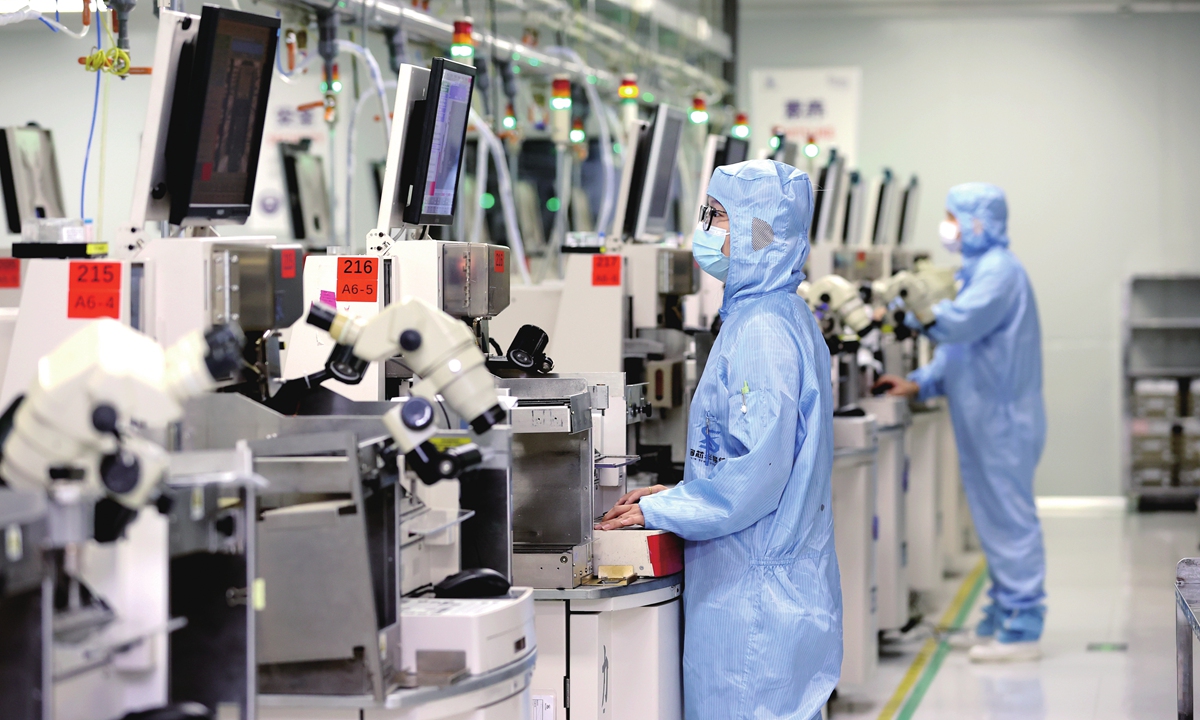
Workers operate smart equipment in the packaging and testing of power chips at a semiconductor company in Suqian, East China's Jiangsu Province on September 16, 2026. Photo: VCG
The artificial intelligence (AI) boom is devouring memory chips faster than the industry can produce them. Data-center operators are spending record sums on servers. Memory shortages are the worst in more than a decade, and chipmakers' investment decisions reflect the urgency of boosting supply without waiting for brand-new factories.
Building a modern wafer plant takes three to five years, but companies need extra supply within months. So the industry is doing the next best thing - upgrading existing capacity, including major production bases in China.
Upgrade existing capacity
Samsung Electronics is one of the latest examples. South Korean media reported on Tuesday that the company plans to raise monthly output at its second Xi'an plant in Northwest China's Shaanxi Province from roughly 10,000 wafers to 50,000 within a year, shifting its ninth-generation (V9) vertical NAND flash memory lines to higher volume. Surging demand for enterprise solid-state drives (eSSDs), driven by AI data center growth, is behind the move.
NAND flash is the core storage medium for eSSDs, which account for 48 percent of NAND bit shipments in the second quarter of 2026, according to Counterpoint Research.
To achieve this, Samsung will convert part of its older sixth-generation (V6) lines to the newer process and install additional electroplating equipment in existing workshops. Once completed, total NAND capacity at Samsung's two Xi'an fabs is expected to reach about 100,000 wafers a month - roughly one-third of the company's global NAND wafer production capacity, turning Xi'an an eSSD-focused production hub for Samsung.
"Samsung is expanding in Xi'an mainly because the factory is already there. Xi'an's NAND plant ranks among the world's largest single NAND fabs. Converting some existing V6 production lines to the newer V9 process and adding electroplating equipment is much faster and cheaper than building a new one," Zhang Xiaorong, director of the Beijing-based Cutting-Edge Technology Research Institute, told the Global Times on Wednesday.
According to Business Korea, Samsung is targeting not the consumer market but eSSDs for global AI data centers.
The extra capacity will help fulfill long-term supply contracts with international customers. ESSDs are the higher-end, higher-tech products: A 1TB enterprise drive costs around 2,500 yuan ($374.6), versus under 1,000 yuan for a consumer version. Their prices are more stable, since long-term agreements lock in volumes and priority - and customers face high switching costs, said Zhang.
Industrial ecosystem
Investment is also expanding across the wider AI hardware supply chains, as multinationals upgrade facilities or build new plants in China.
In March, Japan's Panasonic announced plans to invest about 7.5 billion yen ($47.1 million) in a new multi-layer substrate line at its Guangzhou plant in South China's Guangdong Province, positioning the site as a key base for next-generation AI-server materials and targeting a roughly doubling of related capacity over five years.
Intel's Chengdu campus in Southwest China's Sichuan Province, which already is one of the world's largest packaging-and-test sites and responsible for a very large share of notebook CPUs, received a $300 million capital injection in late 2024 to add server-chip packaging capacity.
Apart from the production capacity, logistics also plays an important role. Wang Zhicong, an Intel China executive, said in July: "Our products can be transported from the factory in Chengdu to other global production bases in just 22 hours."
Micron has continued to expand its Xi'an packaging and test operations - the company announced an additional investment of 4.3 billion yuan in 2023 - for mobile DRAM, NAND and solid-state drives destined for global markets, according to media reports.
Global connector manufacturer Molex is investing around 1.2 billion yuan in Guangdong's Dongguan to expand high-speed cable production for AI servers, with automation upgrades across wire processing, soldering, moulding and testing.
These materials, components and production services connect chip manufacturing with the assembly of complete AI servers. Expansion at these facilities in China can therefore affect how quickly finished AI hardware reaches customers worldwide.
Why China?
"What makes these moves powerful is not any single factory. It is the density of the network. Wafer production, packaging, substrates and interconnects all sit inside one industrial ecosystem," Zhang noted, adding that such coordination is valuable when companies need additional supplies for AI hardware within months.
The AI boom has turned memory into a strategic bottleneck. Global cloud operators are on course to spend roughly $830 billion on capital expenditure in 2026 - growth of nearly 80 percent - much of it on AI servers that already account for more than half of DRAM demand.
Goldman Sachs has flagged one of the tightest supply-demand balances for DRAM and NAND in more than 15 years.
China already accounts for roughly 30 percent of the world's semiconductor packaging and testing capacity.
This is underpinned by a dense web of substrate producers, materials suppliers and equipment makers concentrated in the same regions, forming a complete mid-to-back-end chain that can be upgraded in place, Ma Jihua, a veteran telecom industry analyst, told the Global Times on Wednesday.
"China has a clear advantage in industrial supporting facilities and a comprehensive ecosystem. For companies seeking to expand capacity quickly, China is effectively the only practical choice," said Ma.
That completeness translates into speed. Converting an existing cleanroom line or adding packaging capacity takes far less time than building a new one from scratch.
Multinationals can therefore turn capital into extra output within a year rather than three to five years. Combined with high factory utilization and rapid local investment, this gives companies a practical way to respond to surging AI demand without waiting for distant greenfield projects, said Zhang.
Ma also pointed out that AI has now moved into the stage of real-world application. "The importance of the Chinese market is obvious. Proximity to end-use scenarios and strong supply-chain capabilities mean that any company seeking to integrate AI technology into physical products and terminal devices must take root in China - which is why we see these firms both developing intelligent consumer products here and deeply participating in AI infrastructure supply chains," Ma said.
RELATED ARTICLES