US Section 301 probe draws opposition from China, risks further disrupting global trade: Chinese expert
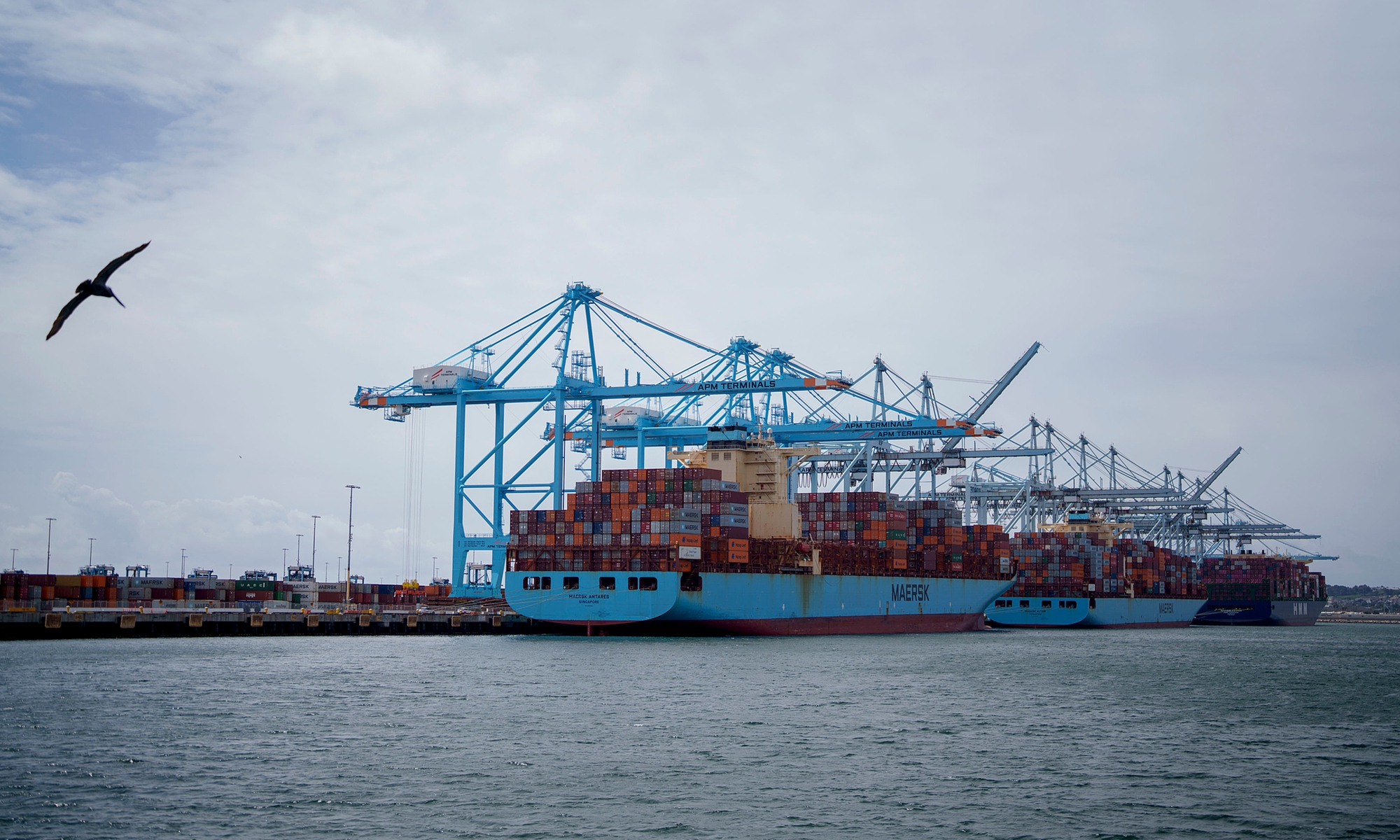
Cranes load containers onto ships at the Port of Los Angeles in Los Angeles, California, US, on March 6, 2025.Photo:VCG
Stoking fears of renewed global trade tensions, the US launched sweeping trade investigations on Wednesday against 16 major trading partners, including China, Mexico, India, Japan and the EU. The move drew a swift rebuke from Beijing on Thursday, with the Chinese Foreign Ministry saying China opposes any form of unilateral tariff measures.
This probe shows the US is attempting to raise a new round of tariffs after its previous measures were ruled illegal by the US Supreme Court, said Chinese experts. Analysts further noted that as global trade and supply chains have already come under strain from US and Israeli strikes on Iran, disrupting traffic through the Strait of Hormuz and driving up oil prices, Washington's latest move has potentially added a new layer of uncertainty to the global economy.
The probes, which will be conducted under Section 301 of the Trade Act of 1974, aim to identify practices including structural excess capacity and production in manufacturing sectors, CNBC reported.
In response to the investigation, Guo Jiakun, a spokesperson of China's Ministry of Foreign Affairs, said at a regular press conference on Thursday that tariff and trade wars serve no one's interests. Both sides should resolve relevant issues through consultation on the basis of equality, respect and mutual benefit, Guo said, noting that the so-called issue of "China's overcapacity" does not really exist and should not be used as a pretext for political manipulation.
Unilateral probes
In the Wednesday announcement, the US Trade Representative's office (USTR) claimed that the investigation will "determine whether those acts, policies, and practices are unreasonable or discriminatory and burden or restrict US commerce." More than a dozen economies were listed as targets of the probe, including China, the EU, India, Singapore, Switzerland, Japan and Indonesia.
The USTR's announcement came just weeks after the US Supreme Court ruled on February 20 that the Trump administration's sweeping tariffs under a law meant for national emergencies were illegal.
Wednesday's probe, announced on short notice, could serve as a "replacement" by the Trump administration for its earlier tariff measures that were invalidated by the US court, He Weiwen, a senior fellow at the Center for China and Globalization, told the Global Times on Thursday.
However, the administration is under time constraints to complete its probe. The Trump administration currently has a 10 percent tariff in place on all trading partners, imposed under Section 122 of the 1974 Trade Act after the Supreme Court ruling in February. The measure expires after 150 days on July 24. Trump has said he plans to raise the import tax to 15 percent, but it has not been implemented yet, according to PBS and NBC News.
US Trade Representative Jamieson Greer claimed his goal was for the investigations announced Wednesday to be wrapped up by the time that 150-day period ends, NBC News reported.
The USTR's Wednesday announcement indicates that the US administration still treats tariffs as a tool for dealing with other countries, He Weiwen said.
This was not the first time the US administration has used a Section 301 probe to serve its politically motivated purposes. In 2024, the US launched a Section 301 investigation into China's shipbuilding sector, but it ultimately suspended the relevant measures in November 2025.
This time, citing so-called overcapacity as a justification for unilateral trade measures reflects no new thinking and is primarily driven by political considerations, essentially revealing a deeply entrenched hegemonic mindset in its tariff-oriented economic policy, Gao Lingyun, a research fellow at the Chinese Academy of Social Sciences, told the Global Times on Thursday.
The expert said that the global industrial division determines that countries place different emphasis on manufacturing capacity and consumption, which is a natural outcome of a market economy and a normal feature of the global division of labor.
On the one hand, the US enjoys affordable and high-quality products from other countries; on the other hand, it complains about so-called excess capacity, which is inherently contradictory, said Gao, noting that forcing companies to move production to the US through administrative measures and political pressure would only raise production costs, ultimately hurting American consumers.
Global concern
The USTR's move has drawn widespread attention and even concern among economies around the world, including some of its major trading partners and allies.
The European Commission rebuffed US allegations that it's contributing to global market overcapacity, and vowed to respond "firmly and proportionally" if Washington imposes tariffs that breach a trade deal with the bloc, Bloomberg reported on Thursday.
Japan is scrutinizing the details of the Section 301 probe but will continue to implement its existing trade agreement with the US, Chief Cabinet Secretary Minoru Kihara told a press conference, Reuters reported.
Responding to the USTR's announced probe, an official from South Korea's Blue House said on Thursday that the government plans to consult to ensure that the balance of benefits secured under the existing Korea-US tariff agreement is not undermined and that South Korea receives treatment no less favorable than other major countries, Yonhap News Agency reported.
Thailand's Commerce Ministry has set up a working group to prepare for the 301 investigation and will start discussions soon, prepare documents thoroughly and "be as ready as possible", Arada Fuangtong, the director-general of the Department of Foreign Trade, told Reuters.
The swift responses from economies around the world reflected widespread vigilance against the possibility of the US ramping up unilateral tariff measures, Zhou Mi, a senior research fellow at the Chinese Academy of International Trade and Economic Cooperation, told the Global Times on Thursday.
Against the backdrop of heightened tensions in the Middle East, disrupted shipping through the Strait of Hormuz, surging global oil prices, and strained supply chains, Zhou said the US decision to restart the so-called Section 301 investigation represents an "irresponsible move".
"If the probe results in additional tariffs, it could further disrupt the global trade order and increase uncertainty for the already weakened global economy. Integrated in the global supply chains, neither businesses nor consumers—including those in the US— could be spared.
RELATED ARTICLES