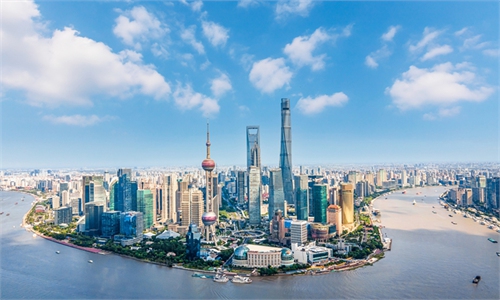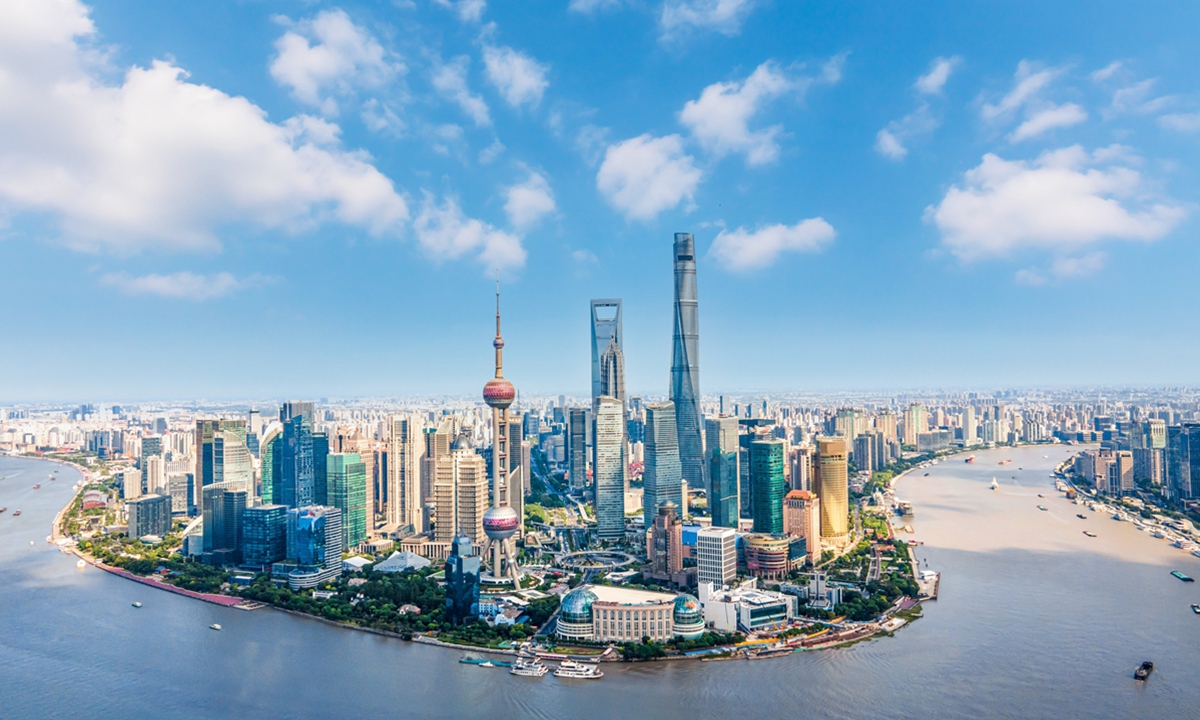
A view of the Lujiazui area in Shanghai Photo: VCG
"We believe that, as China's new quality productive forces continue to develop, coming to China to innovate and conduct R&D has become a new trend among foreign-funded enterprises investing in the country," He Yadong, spokesperson of China's Ministry of Commerce (MOFCOM), told a press conference on Thursday.
China absorbed 606.93 billion yuan ($91.07 billion) in foreign investment in the first 10 months of this year. Of this, actual use of foreign investment in high-tech industries reached 252.83 billion yuan, up 31.3 percent year-on-year.
He noted that the continued growth in foreign investment in high-tech industries and its steadily increasing share reflected the increasing importance foreign investors attach to China's innovation ecosystem, industrial chain advantages, and long-term development opportunities.
He said that from January to October, actual foreign investment in the aerospace vehicle and equipment manufacturing sector, services for the commercialization of scientific and technological achievements, and the computer and office equipment manufacturing rose by 128.8 percent, 73.3 percent, and 48.8 percent, respectively.
Behind these figures are concrete cases. In late October, French energy giant Schneider Electric put its Xiang'an industrial park in Xiamen, East China's Fujian Province, into operation. The facility is Schneider's largest medium-voltage electrical equipment manufacturing base. On the same day, the company broke ground on the park's second phase, further expanding its manufacturing capacity.
Sanofi, a French multinational pharmaceutical company, opened its research and development (R&D) and innovation center in the Jing'an district of Shanghai in September, to advance the development of innovative drugs in key areas such as immunology, chronic diseases, oncology and rare diseases.
"The rapid growth of foreign investment in high-tech industries reflects a deeper logic: China's transformation and upgrading is not a closed, self-contained process, but one that is creating new opportunities for cooperation with the rest of the world," Zhou Mi, a senior research fellow at the Chinese Academy of International Trade and Economic Cooperation, told the Global Times on Thursday.
As China moves from being the "world's factory" toward becoming a global source of innovation, its extensive real-world application scenarios, comprehensive industrial ecosystem and continuously upgrading consumer demand are increasingly accessible to foreign enterprises, Zhou said.
"Foreign investment in China is no longer merely about tapping low-cost manufacturing, but about becoming part of China's innovation, supply and value chains and sharing in the new opportunities created by industrial upgrading," the expert noted.
In a recent interview with the Global Times, Saravoot Yoovidhya, CEO of Thailand's TCP Group, said that China's continued opening-up offers global investors broad opportunities and a predictable environment.
Amid rising global uncertainty, the stability, predictability and clear long-term planning offered by the Chinese market have become scarce resources, giving multinational companies the confidence to deepen their presence and continue investing in China, Zhou said.
"We will continue to refine support policies for foreign-funded R&D centers and encourage foreign-invested enterprises to increase the localization of their production and supply chains, thereby creating favorable conditions for them to deepen their presence in the Chinese market," the MOFCOM spokesperson noted.
RELATED ARTICLES