SCI-TECH / OTHERS
China completes world’s first 600-MW compressed air energy storage expander
Device expected to lower costs for large-scale storage systems
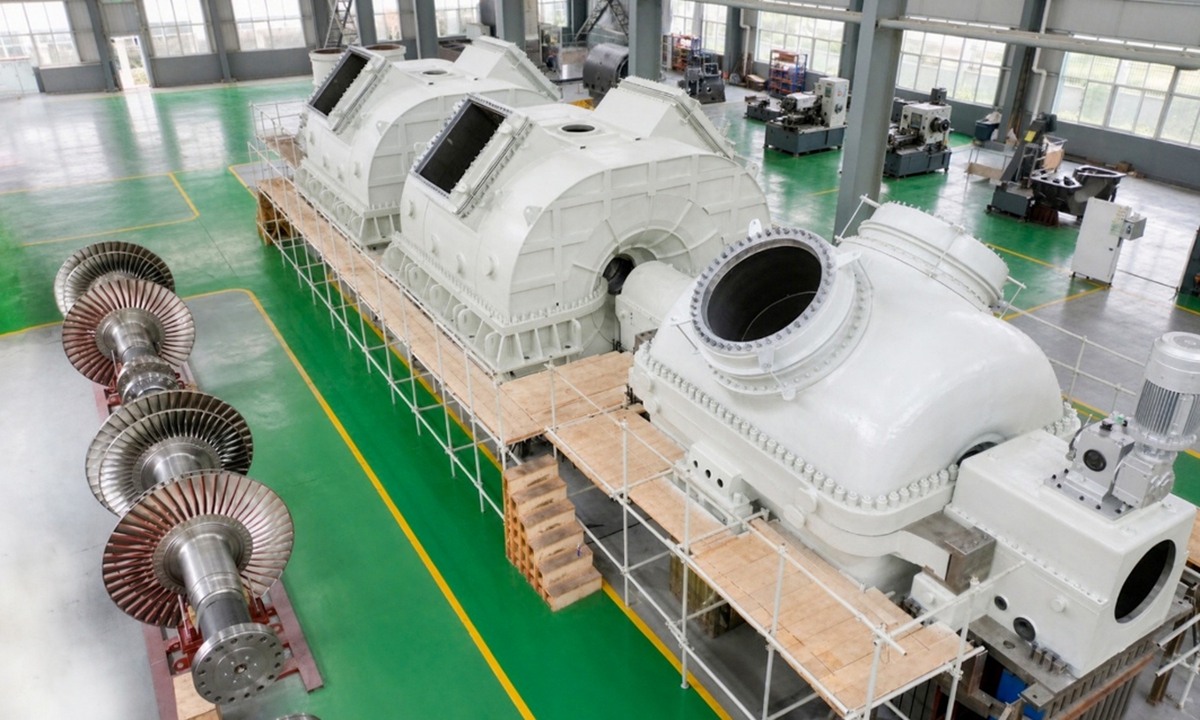
The world's first 600-MW-class expander for a compressed air energy storage system Photo: Courtesy of the Institute of Engineering Thermophysics, Chinese Academy of Sciences
China has completed the development and testing of the world's first 600-MW-class expander for a compressed air energy storage (CAES) system, marking a major step forward in the development of large-scale energy storage equipment, the Institute of Engineering Thermophysics (IET) under the Chinese Academy of Sciences (CAS) announced on Thursday.The IET and Zhongchu Guoneng (Beijing) Technology Co announced that the jointly developed expander has completed the integrated testing and successfully rolled off the production line.
A compressed air energy storage system mainly consists of a compressor, an expander and a thermal energy storage heat exchanger, among other components.
An expander is a key component of a compressed air energy storage system, converting the energy stored in compressed air into mechanical work. The system works much like a giant rechargeable battery: During periods of low electricity demand, excess power is used to compress air for storage. When electricity demand rises, the compressed air is released to drive an expander, which drives a generator to produce electricity.
As a core component of the system, the expander is often compared to its "heart," with its performance having a significant impact on the efficiency of the entire system.
After nearly two years of intensive research and development, the research team overcame several technical challenges involved in designing a 600-MW-class expander capable of variable-speed operation, wide load-range performance and high efficiency.
Key breakthroughs included the fully three-dimensional aerodynamic design across the expander's entire operating range, the complex structural design of an ultra-long multistage shaft system, and coordinated dynamic control of variable geometry and rotational speed.
The team subsequently developed the world's first 600-MW-class compressed air energy storage expander with fully independent intellectual property rights, according to the institute.
The expander has completed the integrated assembly and mechanical testing, with all test results meeting or exceeding design targets, the institute said. Advantages of the device include a high degree of integration, high efficiency, rapid startup and shutdown times, long service life and ease of maintenance.
The 600-MW-class system represents a doubling in scale compared with a 300-MW-class system. According to the team, scaling up the system is expected to reduce costs per unit of power capacity by 20 percent to 30 percent and improve overall system efficiency by 3 to 5 percentage points.
The successful development of the expander marks an important milestone for compressed air energy storage technology worldwide and significant progress in the world's first 600-MW-class CAES national demonstration project, the institute said.
The IET began researching CAES technology in 2005, becoming one of the earliest institutions in China to undertake research in this field. It pioneered a new principle for advanced CAES technology, overcoming key limitations of conventional systems, including their reliance on fossil fuels for supplementary combustion and low energy efficiency.
After 20 years of research and development, the institute was the first in the world to propose the concept of "matching storage and discharge with cycle operation," establishing a design theory based on corresponding operating points within energy storage systems. It has also clarified the internal flow and heat transfer mechanisms of key CAES components and made breakthroughs in wide-load compression, high-load expansion turbines, high-efficiency compact thermal storage and heat exchange, and system design and control under all operating conditions. These advances have enabled the development of an independent technology and research system.
The institute has successfully developed China's first demonstration systems at the 1.5-MW, 10-MW, 100-MW and 300-MW scales, establishing China's leading position internationally in compressed air energy storage technology.
Long-duration, large-scale energy storage is essential to building a new energy system. As renewable energy capacity continues to expand, the inherent intermittency and fluctuations of wind and solar power are expected to pose growing challenges to the safe and stable operation of power grids.
As one of the most promising technologies for large-scale, long-duration energy storage, CAES is expected to play an increasingly important role in safeguarding energy security and strengthening the power system's ability to maintain stability and balance supply and demand, according to the institute.
RELATED ARTICLES