Pakistani minister praises Chinese public's warm send-off for Shenzhou-24 crew, China's willingness to share its success
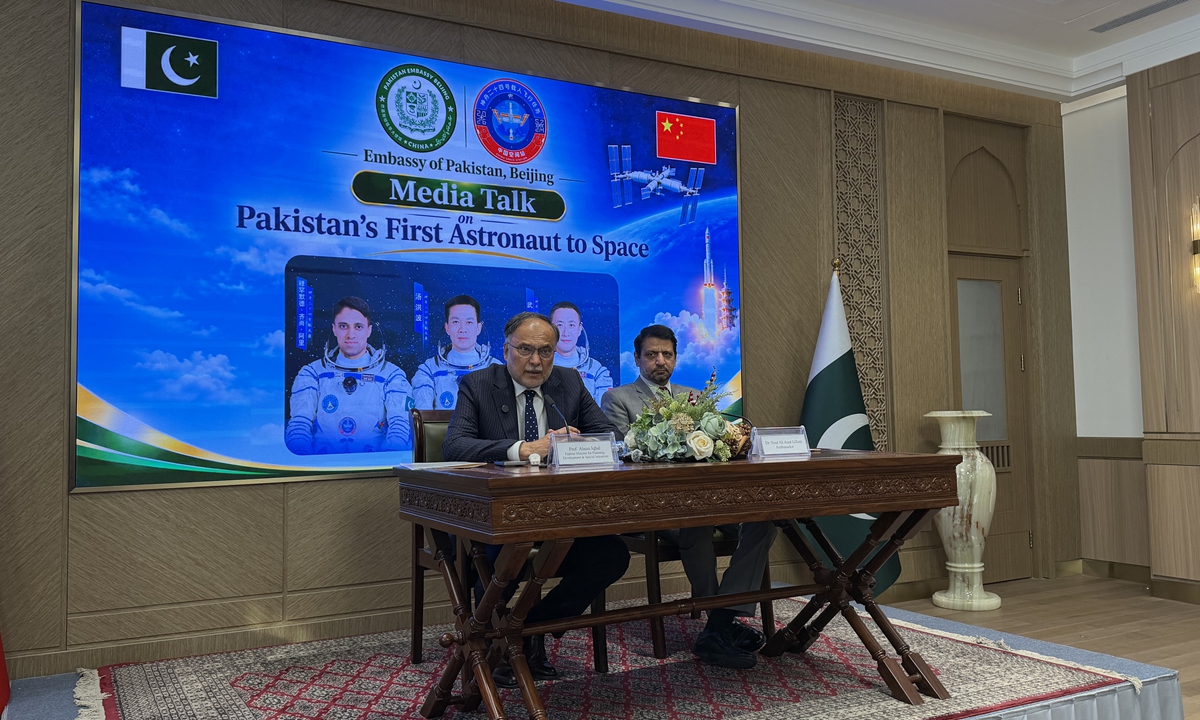
Professor Ahsan Iqbal (left), Pakistan's Federal Minister for Planning, Development and Special Initiatives, speaks at a media talk in the Pakistan Embassy in Beijing, on November 26, 2026. Photo: Dong Feng / Global Times
Following China's successful launch of the Shenzhou-24 crewed spacecraft on Wednesday, sending three astronauts, including a Pakistani astronaut, into the orbiting Tiangong space station, Pakistan's Federal Minister for Planning, Development & Special Initiatives Ahsan Iqbal spoke at a media event on Thursday where he highlighted the warm farewell for the departing astronauts, and the enthusiastic cheers from the Chinese people for the Pakistani astronaut at the send-off ceremony, and a distinctive feature of China's development policy: its willingness to share its success with other countries.
Iqbal said the scientific experiments to be conducted by Pakistani astronaut Muhammad Zeeshan Ali aboard China's Tiangong space station could help Pakistan address food security challenges. The research would provide Pakistani scientists with insights into developing smart agriculture and weather-resistant seed varieties, while materials science experiments could also help strengthen the country's industrial capabilities.
He said collaboration with China and future satellite launches could also strengthen Pakistan's satellite navigation capabilities, with applications in water management, agriculture, urban planning, logistics and connectivity.
More than 90 scientific experiments and technology tests are planned for the Shenzhou-24 mission, covering space life sciences, space material science, microgravity fluid physics and combustion science, fundamental physics, space medicine and new space technologies, according to the China Manned Space Agency (CMSA).
Four China-Pakistan cooperative projects in the fields of biotechnology and materials will be conducted during the Shenzhou-24 mission, and the Pakistani payload specialist Ali will conduct an experiment on photosynthetic cyanobacteria, which was proposed by the Pakistan Space and Upper Atmosphere Research Commission (SUPARCO), the Xinhua News Agency reported.
Iqbal said space technology had become an integral part of national development planning, warning that countries that failed to acquire emerging technologies would struggle to compete in the future. He described cooperation with China as timely, saying it would provide Pakistan with critical knowledge and capabilities to harness new technologies for the benefit of its people.
Iqbal described the mission as another flagship project of Pakistan-China cooperation, extending a partnership built through the China-Pakistan Economic Corridor (CPEC) on the ground into space.
China-Pakistan space cooperation spans more than three decades. In 1990, Pakistan's first experimental satellite, Badr-1, was launched aboard a Chinese rocket from the Xichang Satellite Launch Center. More recently, China launched Pakistan's cube satellite aboard the Chang'e-6 probe in 2024 and placed a Pakistani remote-sensing satellite in orbit via a Long March-6 rocket in April 2026, according to Xinhua.
Looking beyond space cooperation, Iqbal said Pakistan and China were discussing the need for a knowledge corridor to prepare Pakistan's younger generation for emerging technologies. He said the government's Uraan Pakistan agenda placed a high priority on equipping young people with the skills and knowledge needed for Industrial Revolutions 4.0 and 5.0.
Pakistan's National Economic Transformation Plan 2024-29, known as Uraan Pakistan, focuses on exports, equity and empowerment, environment, food and water security, energy and infrastructure, while the country's government will focus on growing industry, commerce and information technology, according to Xinhua.
Pakistan hopes to have at least 10,000 PhD students receive training at top Chinese universities over the next 10 years in fields including artificial intelligence, space sciences, materials science, biotechnology, big data, automation and robotics, Iqbal said. The initiative aims to prepare a new generation of researchers, scientists and leaders who can drive Pakistan's future development.
Answering a question from the Global Times about the alignment between China's 15th Five-Year Plan (2026-30) and Pakistan's development agenda, Iqbal said the two were well aligned. Under the second phase of the China-Pakistan Economic Corridor, known as CPEC 2.0, Pakistan had identified five cooperation corridors: growth, livelihoods, innovation, green economy and openness to broader regional cooperation.
Iqbal also cited space exploration as an example of advanced-science cooperation, noting that an agreement signed in February 2025 had been put into practice through the participation of a Pakistani astronaut in the Shenzhou-24 mission in November 2026. He said Pakistan hoped to further cooperate with China in space exploration, including drawing on China's planned crewed lunar landing before 2030 as Pakistan works toward its own lunar landing goal by 2035.
"I think that is the uniqueness of China's policy of development, that it is willing to share its successes with other countries," Iqbal said, recalling his experience at the send-off ceremony, the warmth and the affection that Chinese people expressed when saying goodbye to the departing astronauts.
Iqbal said what really impressed him was that thousands of Chinese people had gathered to farewell to the astronauts.
"So that really reflected the special bond between China and Pakistan, not just at the government level, but also at the people-to-people level... Every media channel has covered it [the Shenzhou-24 mission] from East to West, and everyone is talking about it and appreciating China's commitment toward sharing its successes with the developing countries and Global South, and particularly with Pakistan. And this opens a new avenue of collaboration between Global South and China in many fields," Iqbal said.
RELATED ARTICLES