When ‘overcapacity’ bites back, European Commission starts crying foul: Global Times editorial
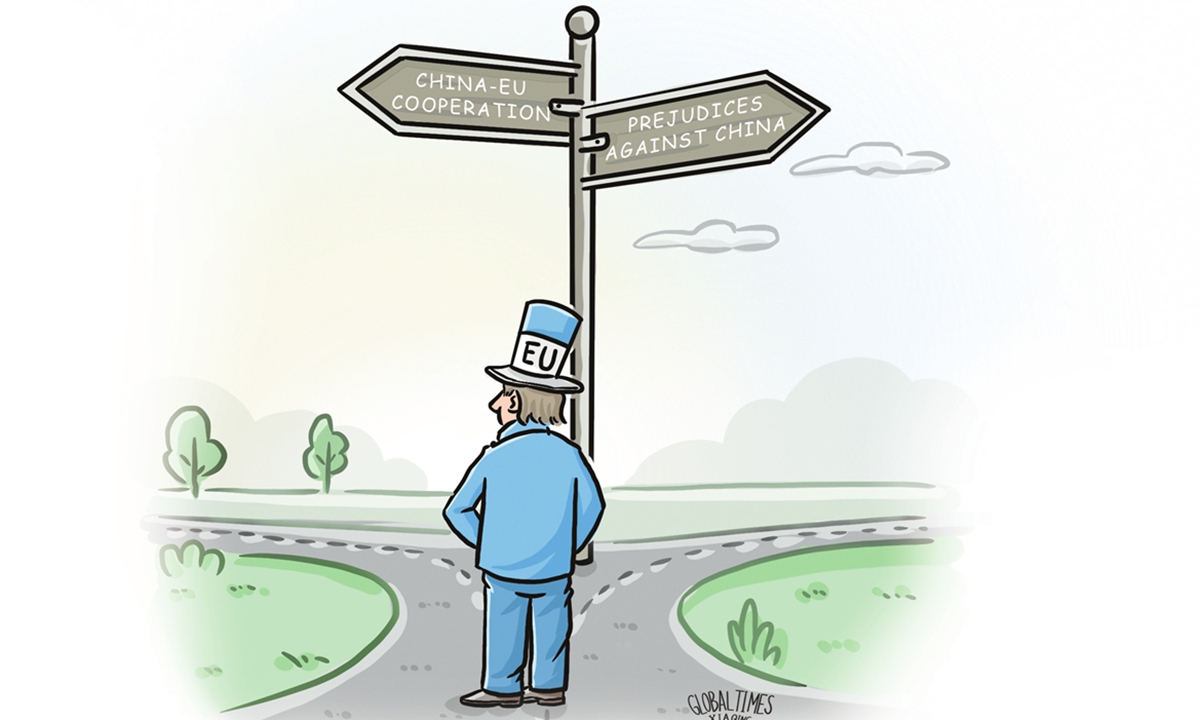
EU Illustration: Xia Qing/GT
What Europe needs is strategic autonomy, not strategic dependence. It needs to confront its own problems, including high energy costs, regulatory burdens and insufficient innovation, rather than stripping the label of "overcapacity" off itself and slapping it onto others.
The Office of the United States Trade Representative recently announced the results of its Section 301 investigation into "overcapacity" and released proposed measures, proposing additional Section 301 tariffs on 14 economies, including China and the EU. Although the new tariffs have not yet taken effect, their potential economic impact has already drawn widespread attention. Various parties have responded - whether firmly opposing trade protectionism or expressing a desire to seek agreements - all reflecting positions based on their own interests. But among these voices, one stands out as particularly bizarre: that of the European Commission.
European Commission spokesperson Olof Gill first said that the bloc "strongly rejects" the tariff threat. However, his objection was rooted not in morality, rules, or fairness, but in self-exoneration - claiming that Europe is "among those most exposed to overcapacity." He then pointed the finger at "state-driven" overcapacity "concentrated in third countries," hinting that Europe could team up with the US for "joint action." Who the "third country" is needs no explanation. The moment Washington raised its tariff stick, the European Commission immediately waved the white flag, willingly offering itself as an accomplice in exchange for being spared. It is a truly pathetic spectacle.
"Overcapacity" is itself a fabricated unilateral tool laced with strong trade-protectionist overtones; it is a complete false proposition. Certain countries, under the excuse of "overcapacity," politicize normal market competition and weaponize industrial development issues. This can only disrupt the security and stability of global industrial and supply chains as well as industrial cooperation, elevate global inflation levels, harm the vital interests of businesses and consumers, and bring long-term systemic risks to world economic growth. When the US uses this tool to target the EU, the European side should have fundamentally questioned the legitimacy of the concept itself. But the European Commission's choice was the opposite: It did not contest the accusation of "overcapacity," but only argued "I am not the source; the source is a third party" - equivalent to competing for the position of "accomplice" in the defendant's dock.
Even more ironically, the EU itself was one of the early adopters of the "overcapacity" rhetoric. From the multi-year anti-subsidy investigations and duties on Chinese electric vehicles starting in 2023, to sharply cutting steel duty-free quotas in the name of "addressing overseas overcapacity" and raising out-of-quota tariffs to 50 percent, to contemplating imitating the US "Section 301" to create a "European version of 301" tool, the EU has repeatedly branded China with the label of "overcapacity," using the rhetoric as a pretext for deploying protectionist trade measures. Now that Washington has turned the very same weapon against it, the European Commission is finally crying foul. But that comes rather too late.
The bigger problem is that the EU has turned the very partner it most needs to cooperate with into a bargaining chip to curry favor with the US. The more aggressively Washington wields its tariff stick, the more urgently the EU should seek to diversify its trade relationships to hedge against US policy uncertainty. China and the EU are each other's second-largest trading partners. From automobiles and new energy to biomedicine and machinery, their industrial and supply chains are deeply intertwined, their strengths complementary, and their markets highly interdependent. Yet the European Commission is seeking to secure its own security by taking a tougher stance on China. This amounts to deliberately severing external economic ties with the greatest growth potential in an attempt to shore up an already deeply fractured transatlantic alliance. With its industries in decline and its economic and trade activities constrained on all fronts, what leverage would the EU have in negotiating security with the US?
One of the episodes in its history that the EU takes greatest pride in is its decision in 1998 to challenge the compliance of Section 301 of the US Trade Act at the World Trade Organization (WTO), insisting that unilateral action must be subject to multilateral authorization. Nearly three decades later, where have the European side's confidence and resolve gone? Today, unilateralism and protectionism continue to spread, putting the international economic and trade order under strain. As one of the world's largest single markets, the EU is well positioned to say "no" to unreasonable US tariffs and has every right to demand that Washington return to the framework of multilateral rules to resolve disputes.
What Europe needs is strategic autonomy, not strategic dependence. It needs to confront its own problems, including high energy costs, regulatory burdens and insufficient innovation, rather than stripping the label of "overcapacity" off itself and slapping it onto others. In the manufacturing sector, global supply chains are highly interdependent; the absence of any single link will affect the overall operational efficiency.
If the EU chooses to coordinate its position with China and other affected economies to jointly defend the WTO-centered multilateral trading system, it would emerge from this tariff storm with far greater dignity and security than it enjoys today.
RELATED ARTICLES