China and EU avoided the worst outcome, but much more needs to be done: Global Times editorial
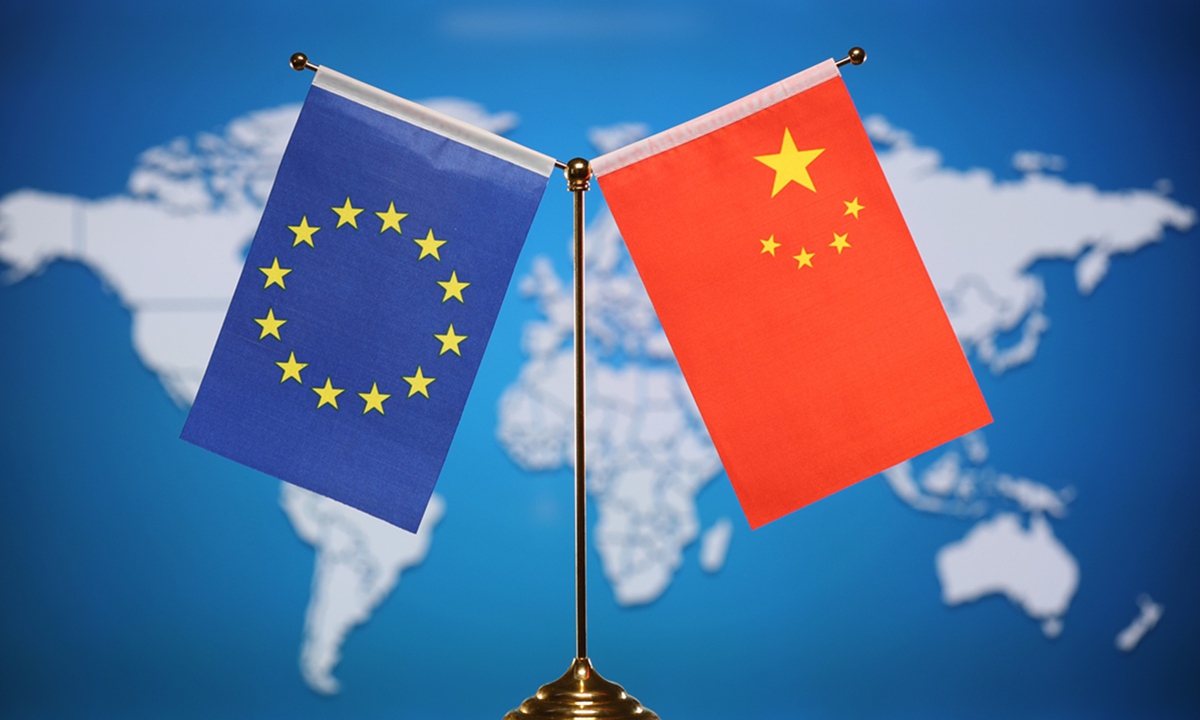
China EU Photo:VCG
This is not the best possible outcome, but it is a pragmatic arrangement that has avoided the worst. The so-called "import quotas" essentially impose restrictions on foreign automakers' exports through compulsory measures. They are inherently protectionist to some extent and, in a broader sense, create uncertainty for the global automotive supply chain.
On November 24, the European Commission announced the adoption of import quota restrictions on hybrid vehicles from China and other regions, with the provisional measures set to last for 200 days. China's quota stands at 192,000 vehicles, equivalent to an annual quota of 350,000, higher than that allocated to any other source of imports. On the same day, China's Ministry of Commerce responded by urging Brussels to "earnestly abide by the consensus between the two sides."
From the EU's initial proposal to the release of this preliminary ruling, the process involved more than 30 rounds of consultations. The negotiations were arduous, and the outcome was hard-won.
This is not the best possible outcome, but it is a pragmatic arrangement that has avoided the worst. The so-called "import quotas" essentially impose restrictions on foreign automakers' exports through compulsory measures. They are inherently protectionist to some extent and, in a broader sense, create uncertainty for the global automotive supply chain. Previously, many voices argued that the introduction of the so-called "import quotas" was specifically aimed at China.
This "flawed achievement" represents a pragmatic balance reached by both sides against the broader backdrop of China-EU relations. The EU initially based its calculations on the average import volume over nearly three years, proposing an annual quota of only around 70,000 hybrid vehicles for China, while Japan would have been allocated 257,000 vehicles over the same period. The EU also at one point demanded that China impose so-called "voluntary export restrictions," a request China rejected in accordance with the law and relevant rules. Upholding the three principles of "respect for facts, non-discrimination and compliance with World Trade Organization (WTO) rules," China insisted that the issue be addressed within the framework of the WTO.
In the end, China secured a higher quota based on the actual import volume of 302,000 vehicles in 2025. For a provisional measure lasting just 200 days and still at the preliminary ruling stage, the fact that the process did not descend into an escalation of confrontation is already a "second-best solution" under the circumstances.
China and the EU are key trading partners to each other, and differences between them are only natural. What is abnormal is treating ordinary industrial competition as a contest over status and resorting to walls and restrictions to ease insecurity. The tortuous consultation process once again demonstrates that, as long as both sides adhere to the principles of mutual respect and equal-footed consultations and address issues within the framework of WTO rules, ways can always be found to manage differences. From the 16 specific point consensus reached at the second meeting of the consultation mechanism in October to the finalization of the latest arrangement on hybrid vehicles, repeated practice has shown that China and the EU have the capacity to transcend differences and achieve mutual benefit and win-win outcomes.
Hopefully the EU will earnestly honor the consensus reached by both sides, strictly abide by WTO rules, fully implement the principle of non-discrimination, and conduct relevant investigations in a fair and impartial manner.
It is worth noting that trade barriers that should never have existed in the first place reveal Europe's barely concealed industrial anxiety. It is precisely this mounting anxiety that is driving the EU into an increasingly defensive posture, erecting barriers first against battery electric vehicles and then against hybrid vehicles.
Faced with the decline of Europe's automotive industry, rather than seeking ways to provide financial support and encourage traditional automakers to innovate and transform, the EU is resorting to tariffs and quotas to buy time for domestic automakers to navigate their transition. Meanwhile, sustained geopolitical engagement and commitments have driven up energy and raw material prices, further increasing the pressure on European automakers to stay afloat.
Europe is currently pressing ahead with its green transition in the hope of enhancing its competitiveness, while simultaneously fearing "overdependence" on Chinese green and environmentally friendly products. This reflects a deeply conflicted mindset. In reality, far from driving Europe's traditional automotive industry into a corner as the European side claims, China's new energy vehicles have instead opened up entirely new opportunities. In October this year, German automaker Volkswagen's NEV deliveries in China rose to 4.5 times the level recorded in the same period last year, reaching a record 28,000 units. Deliveries of its ID.AURA T6 model exceeded 12,000 units, making it the best-selling model in the midsize NEV SUV segment.
This is a prime example of European automakers proactively integrating into China's industrial and supply chains and achieving market success. Similar success stories abound in other industries.
Protectionism offers no way forward; openness and cooperation are the right path. China's recent signing of a protocol with Switzerland to upgrade their free trade agreement and its extension of mutual tariff exemptions with Canada demonstrate the value of dialogue and mutually beneficial cooperation. Europe needs to shake itself out of its self-induced complacency.
Hopefully the European side will meet China halfway, provide industries on both sides with a stable, predictable and sustainable environment for trade and investment, and promote the stable, balanced and sound development of bilateral economic and trade relations. China will also closely monitor the progress of the EU's subsequent investigation and reserves all rights, including recourse to dispute settlement and seeking trade compensation under the WTO framework, to resolutely safeguard the legitimate rights and interests of the relevant Chinese industries.
There is no fundamental conflict of interests between China and Europe, whose industries have complementary strengths and are deeply integrated. A confident, autonomous and open Europe would not only serve the common interests of China and Europe but also enable Europe to find its rightful place amid the sweeping global changes unseen in a century.
RELATED ARTICLES