If the EU is determined to wage a trade war against China, then let it try: Global Times editorial
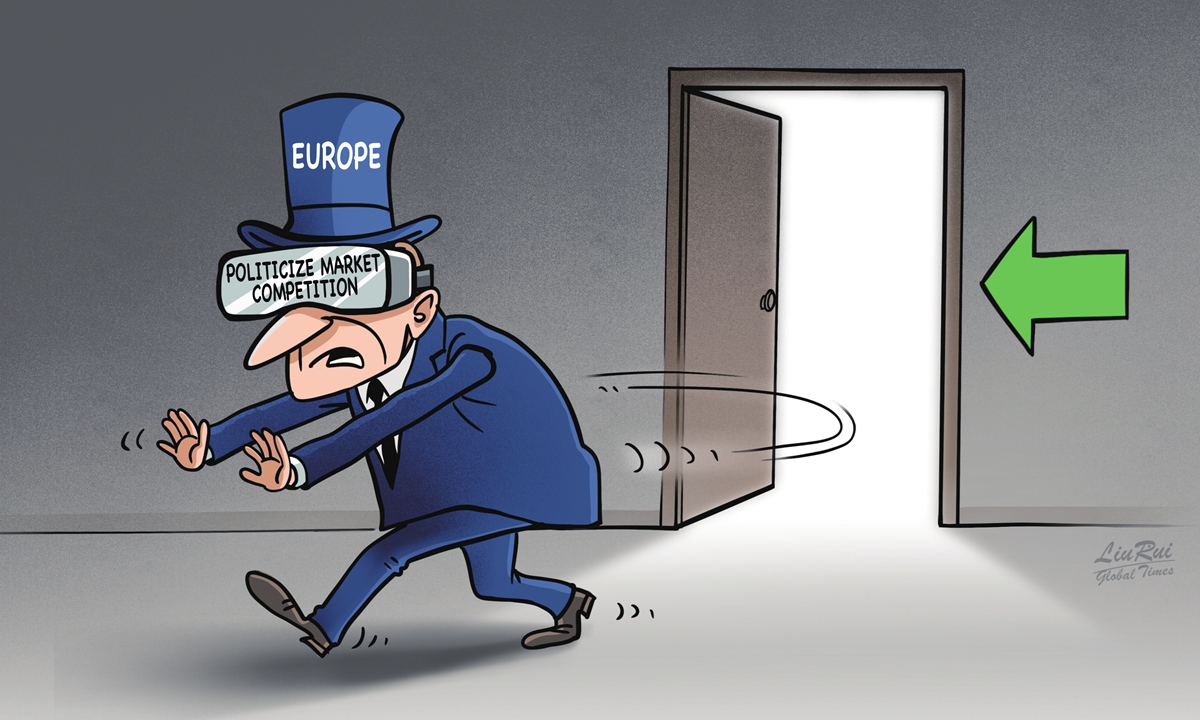
Europe Illustration: Liu Rui/GT
The EU is currently grappling with a combination of slowing economic growth, political polarization, social division, and strategic turbulence in its relations with Russia and the US. China should have been a strategic partner helping the EU resolve its problems, but it has mistakenly been treated as the problem itself. This is a major strategic miscalculation on the part of the EU, and a regrettable one.
European Commissioner for Trade and Economic Security Maros Sefcovic recently said the EU will urge China to make commitments to ease bilateral trade imbalances and hopes to see "initial action" before early October. He also noted that if dialogue fails to deliver results, there will be growing political pressure within the EU to seek "other solutions." This marks the latest version of what has increasingly resembled an EU "ultimatum" toward China, with some European media describing "Brussels and Beijing have been on the verge of a trade war."
By contrast, while China has consistently kept communication channels open with Europe, it has not responded in kind to the EU's harsh rhetoric. Instead, it has repeatedly and patiently urged the European side to properly address mutual concerns through dialogue and consultation. China has stressed that the two sides should adhere to the stable and balanced positioning of their critical trade partnership, promote the steady, more balanced and forward-looking development of China-EU trade, uphold the principle of resolving each other's concerns on an equal footing, and should not involve unilateral demands, conditions, or even frequently resorting to the threat of market closure. This does not reflect fear of Europe, nor does it suggest China is in the wrong. Rather, it demonstrates the utmost goodwill and patience toward China-EU relations. Europe and the US also have significant trade frictions, but how has Europe been publicly addressing Washington, and how has Washington treated Brussels? The European side should be very clear about this in its own mind.
As Brussels continues to set deadlines for China and demand that "problems be solved," what we are seeing more is its own sense of anxiety with nowhere to rest. However, the first question is whether this sense of anxiety is entirely real. Take, for example, the "about 1 billion euros (about $1.17 billion) a day" trade deficit figure often cited by European Commission President Ursula von der Leyen. It sounds daunting, but it is really nothing more than daunting. For one thing, it does not account for the EU's substantial surplus in trade in services with China. For another, many EU companies produce a large share of their goods in China and then sell them back into the European market. While the trade surplus is recorded on China's books, a large portion of the profits actually flows back to Europe. In addition, the EU's perception of Chinese goods is itself skewed. European narratives often position Chinese products as "cheap." In reality, today's Chinese products are high in quality and competitively priced - far removed from the old notion of being merely "cheap."
What the EU needs to seriously confront is why its own competitiveness continues to come under pressure. This is the root of Europe's anxiety. In recent years, the European economy has faced a range of structural challenges, including high energy costs, insufficient investment, slow commercialization of innovation, and fragmentation within the single market. And this is only part of the problem. The EU is currently grappling with a combination of slowing economic growth, political polarization, social division, and strategic turbulence in its relations with Russia and the US. Under such circumstances, if the EU further pushes China into opposition, it would effectively be choosing to confront nearly all major powers and key economies while its internal contradictions continue to intensify. This is a situation rarely seen even in the EU's own history.
European media have repeatedly referred in recent weeks to a potential "trade war with China." But is the EU really prepared to wage such a war?
China does not want a trade war, because there are no winners in a trade war. But China has never been afraid of one, nor will it accept a negotiating approach that seeks to use the threat of a trade war as leverage. If the European side hopes to impose some kind of unequal trade agreement that would force China to "cut its own flesh" unconditionally to help Europe "fill the gap," that is simply impossible. China will not yield to any external pressure or threats; history has repeatedly proven this. In reality, the EU does not have the capacity to wage a trade war against China. If it is truly determined to do so, then let it try.
China should have been a strategic partner helping the EU resolve its problems, but it has mistakenly been treated as the problem itself. This is a major strategic miscalculation on the part of the EU, and a regrettable one. At its root is the EU's overall lack of a systematic, comprehensive, and fact-based body of knowledge about China, as well as the limited number of influential scholars and policymakers who have genuinely conducted in-depth research on the country.
In fact, there are quite a few successful examples of cooperation between China and Europe. Take Germany, for example, which currently advocates a tougher stance toward China. Volkswagen Anhui's establishment of a price-negotiation mechanism is representative positive examples. Yet European media and policymakers are willing only to loudly call for a "solution" to the trade deficit, while creating their own "politically correct pressure narrative," and shying away from mentioning these experiences of equal and mutually beneficial cooperation. This is the result of the EU's highly emotional, one-sided, and negative approach to China policy.
China-EU economic and trade cooperation is large in scale and wide in scope, and the two sides are highly complementary in their respective strengths. The two sides can achieve a dynamic balance as their economies develop. More than that, the pie of China-EU cooperation can be made even bigger. In emerging fields such as artificial intelligence and climate governance, for example, there is significant scope for technological development and economic cooperation between China and Europe. The two sides can identify new areas of convergence in climate action, carbon emissions, and global governance. China and the EU can also jointly explore ways to advance cooperation within multilateral frameworks such as the WTO.
If the EU insists on going down this path, it will not only fail to resolve its "competitiveness" problems, but will also forfeit these new opportunities of cooperation. Europe should think twice.
RELATED ARTICLES