Belgian PM is not ‘afraid of China,’ but afraid of taking responsibility: Global Times editorial
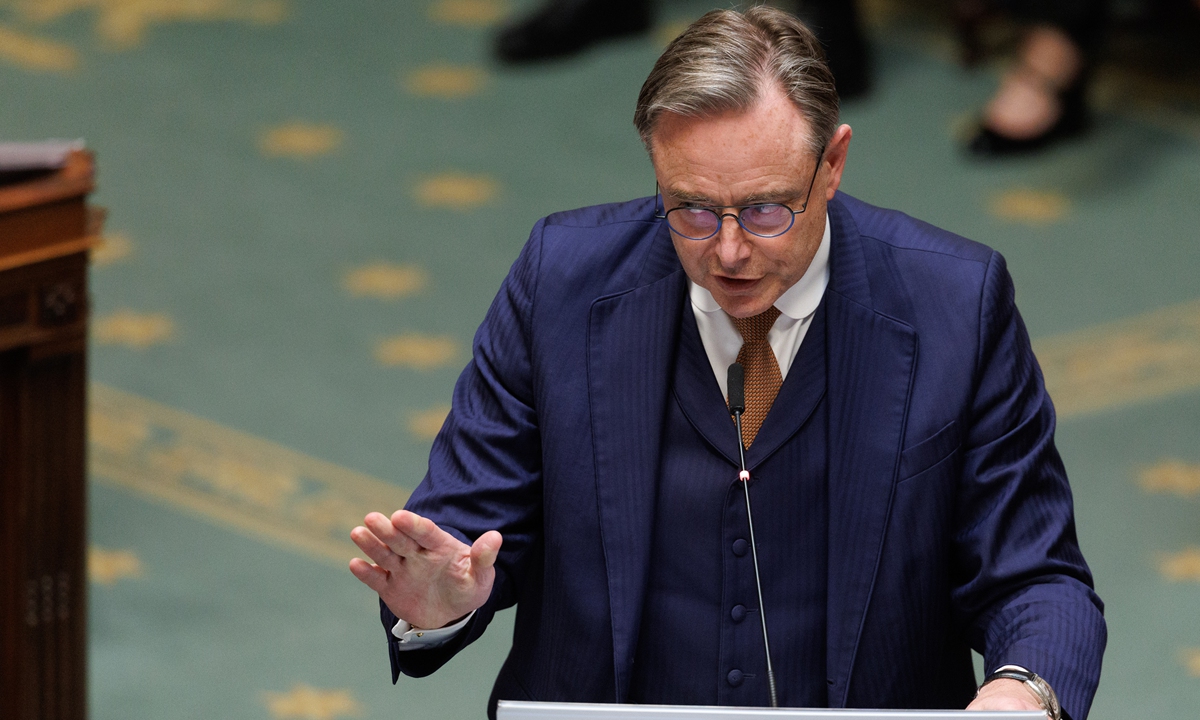
Belgian Prime Minister Bart De Wever attends a plenary session in the Belgian Federal Parliament in Brussels, Belgium, 21 May 2026. Photo: VCG
On June 9 local time, Belgian Prime Minister Bart De Wever, commenting on the upcoming EU summit, claimed that European leaders are "increasingly wary" of China. He added that the summit would replace mentions of China with so-called "geo-economic imbalances," because "we are so afraid that we don't even dare to do that." Immediately after making the remark, he theatrically asked whether any journalists were in the room, pretending that he was afraid of being overheard by China. Unsurprisingly, this claim of being "afraid of China" quickly made the headlines across several European media outlets. There is a term in Europe - "stage whisper" - used to describe the hypocrisy of speaking in hushed tones right in front of a microphone. De Wever's performance fits that description perfectly.
What is De Wever "playing at"? First, he is pretending to be weak, recycling the tired narrative of "China bullying," even though this costume looks utterly ill-fitting on the EU - a big, bulky player. But that is not his main objective. While De Wever claims that the EU is "afraid" to name China, what he truly fears is the possibility that the EU summit does not "mention China." In a bid to do everything possible to prod the upcoming summit into "mentioning China as much as possible," De Wever has carefully staged this "drama of victimhood." According to his script, the conclusion becomes almost inevitable: anyone who fails to highlight the so-called "China threat" at the summit can be branded as fearful or as having yielded to China.
In recent months, Europe has been engaged in an intense internal debate over how to approach China-EU relations - particularly economic and trade ties. Some political figures have made increasingly outrageous remarks, even going so far as to liken China's industrial advantages to a "cancer" for Europe. De Wever himself wrote to European Commission President Ursula von der Leyen in March, claiming that China "is devastating our economy." He has now gone a step further by claiming that Europe is "afraid of China," as if seeking to portray Europe as a pitiful and vulnerable weakling. This persistent "victimhood narrative" reveals the distorted mentality of some in Europe: they are used to interfering in the international economic and trade order, and their mentality becomes completely unbalanced when the world becomes more just and equal but no longer serves their interests only.
In fact, this situation highlights two important realities. First, it proves that there remains a strong willingness within Europe to cooperate with China. If China were truly "devastating" Europe, as De Wever claims, why would figures like him still feel the need to go to such lengths to hype up the so-called "China threat" narrative? In fact, just over a month ago, Belgium's Deputy Prime Minister and Minister of Foreign Affairs Maxime Prevot visited China, and even made a special trip to Hangzhou to tour technology companies, expressing willingness to deepen cooperation. More broadly, across the EU, opposition to "decoupling" from China remains the dominant view within the business community. According to the latest survey by the EU Chamber of Commerce in China, 68 percent of respondents said they were either staying or expanding operations in China, while nearly one-third said they were onshoring further in China, proving that "de-risking" has yet to translate into mainstream business decisions.
Second, it exposes the hypocrisy behind the EU's so-called "tripartite approach" toward China. For some time, a popular narrative in Europe has been that the EU's "de-risking" agenda is intended to strengthen its own resilience rather than "target China." This narrative portrays Europe as the weaker party seeking to ease tensions through dialogue, while depicting China as the stronger side unwilling to make even the slightest concession. Some have even argued that only when a harsh, tit-for-tat trade war begins will Beijing return to the negotiating table. Yet De Wever inadvertently revealed the truth, tearing away the fig leaf of this rhetoric - the core of advocating "de-risking" is actually "being wary of China" and "countering China."
Claims made by De Wever and others reveal a confusion among European decision-makers regarding their own interests. They have politicized and securitized normal market competition, attempting to compensate for competitiveness gaps through protectionist measures, while at the same time being unwilling to bear the costs of damaging relations with China. They want enjoy the benefits of the Chinese market while simultaneously trying to contain China's industrial upgrading. Clearly, placing the blame on China might be the most convenient option for European politicians who would leave their posts in a few years, but doing so will not make Europe safer or more competitive.
Discussing relations with China at the EU summit through self-deceptive reasoning is neither a rational nor a mature choice. Brussels appears less afraid of China than it is of acknowledging its own declining competitiveness, less willing to make a clear choice between protectionism and open cooperation, and less willing to accept the political responsibility that comes with such choices.
Europe needs to recognize that international trade in the 21st century is no longer a "center-periphery" relationship of dependency, nor is it a case of one party "colonizing" the other. As the host country of the EU headquarters, Belgium should play a constructive rather than disruptive role in facilitating China-EU relations.
RELATED ARTICLES