By targeting ‘Peking duck’, just how insecure is the EU? : Global Times editorial
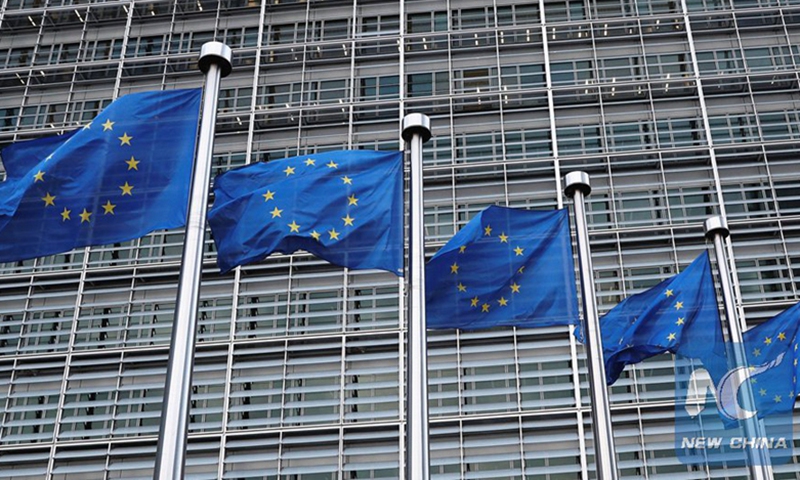
The European Union flags in front of EU headquarters in Brussels, Belgium. Photo: Xinhua
On July 9 local time, the European Commission officially launched an anti-dumping investigation into "Peking duck" imports from China. Several media outlets noted that this marks the first time in recent years that the EU has extended trade defense measures to the Chinese agricultural sector. The UK's Financial Times reported that the EU's trade protectionist measures against China are running at record highs, but this anti-dumping investigation "takes the fight to new terrain," warning that the move "could ignite a trade war between the EU and China." From electric vehicles and photovoltaic products to duck meat today, the EU wields its protectionist stick with ever greater recklessness and haste. Yet this will not intimidate China; it will only force European consumers to foot the bill for higher prices at the dinner table.The EU launched this investigation in response to a complaint filed by five EU producers, which alleged that "Peking duck" benefits from subsidies and "other forms of state support," causing "substantial adverse effect" on the EU's domestic industry. Yet conversely, a large number of European agricultural and food products are also widely popular in China. In particular, with the formal entry into force of the China-EU Agreement on Geographical Indications in 2021, products such as French champagne, German Munich beer, Irish whiskey, Greek feta cheese, and Italian Parma ham have received more comprehensive and effective protection and promotion in China. Surely some Chinese companies must be feeling the pressure from this? Yet the Chinese market has never viewed these as a "threat."
As an agricultural and food product with a distinctive Chinese geographical indication, "Peking Duck" is deeply loved by consumers both in China and abroad, with its primary production and consumption market located in China. The EU is far from a core market for China's poultry products; the 199 million-euro trade volume represents only a "marginal" portion of the broader China-EU economic and trade landscape. Brussels' decision to make such a big deal over such a negligible volume of agricultural products is not only undignified but also reflects that its policy-making has been dominated by an irrational, China-paranoid anxiety. This practice of blowing routine trade issues out of proportion and attempting to construct a trade defense network with no blind spots not only fails to address its industrial shortcomings but also exposes a deep-seated lack of confidence through self-imposed limitations.
The EU accuses China's duck industry of benefiting from policy support, yet deliberately ignores data from the Organization for Economic Cooperation and Development (OECD) - the EU's own agricultural subsidies have long ranked among the highest in the world. At the United Nations level, the EU has long drawn widespread criticism for its excessive agricultural subsidies, accused of "distorting trade" and "erecting barriers."
Viewed against this broader backdrop, it is not difficult to see that the EU's so-called investigation into "Peking duck" could hardly be conducted "impartially." In fact, as early as 2015, the EU adopted discriminatory import quota measures against Chinese duck meat for protectionist reasons. China challenged the measures at the WTO, and the EU ultimately lost the case. The latest investigation amounts to yet another open challenge by the EU to the WTO rules-based trading system.
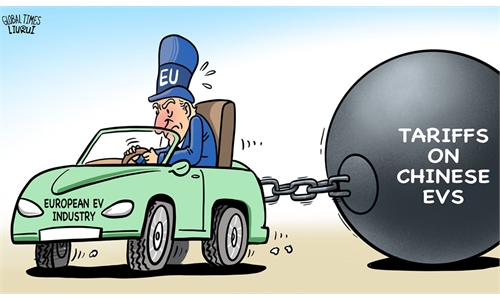
Why is "European duck" so afraid of "Peking duck"? Instead of devising ever more trade barriers, this is the question the EU should seriously confront. The issue is not that "Peking duck" has received any special treatment. More likely, the problem lies with "European duck" itself. High energy costs and fragile supply chains, among other factors, have eroded its competitiveness. Blaming China may externalize the problem, but it cannot conceal the EU's deeper structural weaknesses, including industrial hollowing-out and inefficient governance. The same pattern extends well beyond duck meat to sectors such as new-energy vehicles and many others.
As the EU continues to escalate trade barriers, China has both the strategic resolve and the means to respond. China-EU agricultural trade reached $30 billion in 2024. China has the world's largest consumer market, while its export destinations have become increasingly diversified and its domestic and international markets more integrated. European producers, by contrast, would struggle to find an alternative market if they were to lose access to China. If the EU wants to negotiate, China's door remains open. If it chooses confrontation, China has the "cards" to respond. Former EU senior agriculture trade negotiator John Clarke warned that targeting an "iconic product" would likely provoke a strong response from China. This poses a similar risk to European products such as wine.
China and the EU should never have to reach this point. Agricultural and food products are among the key areas of mutually beneficial cooperation between the two sides. The distinct characteristics of their respective agricultural products create complementary comparative advantages in bilateral trade. European salmon, wine and ham continue to find eager buyers in China, while Chinese tea, fruit and specialty livestock products enrich European market supplies. As China's middle-income population continues to expand and household incomes steadily rise, Chinese demand for high-quality European agricultural and food products is expected to grow further, creating even broader opportunities for bilateral cooperation.
"Peking duck" is more than a celebrated culinary specialty. It is also an important link connecting China and Europe through people-to-people exchanges and agricultural cooperation, and it should not become a "casualty" of trade protectionism. If the EU remains fixated on protectionism and a beggar-thy-neighbor mindset, the ultimate losers will be European consumers and the future of European industries. It is high time for the EU to set aside its protectionist obsession and return to the path of rationality and cooperation.
RELATED ARTICLES