France and Germany are lowering the banner of free trade themselves: Global Times editorial
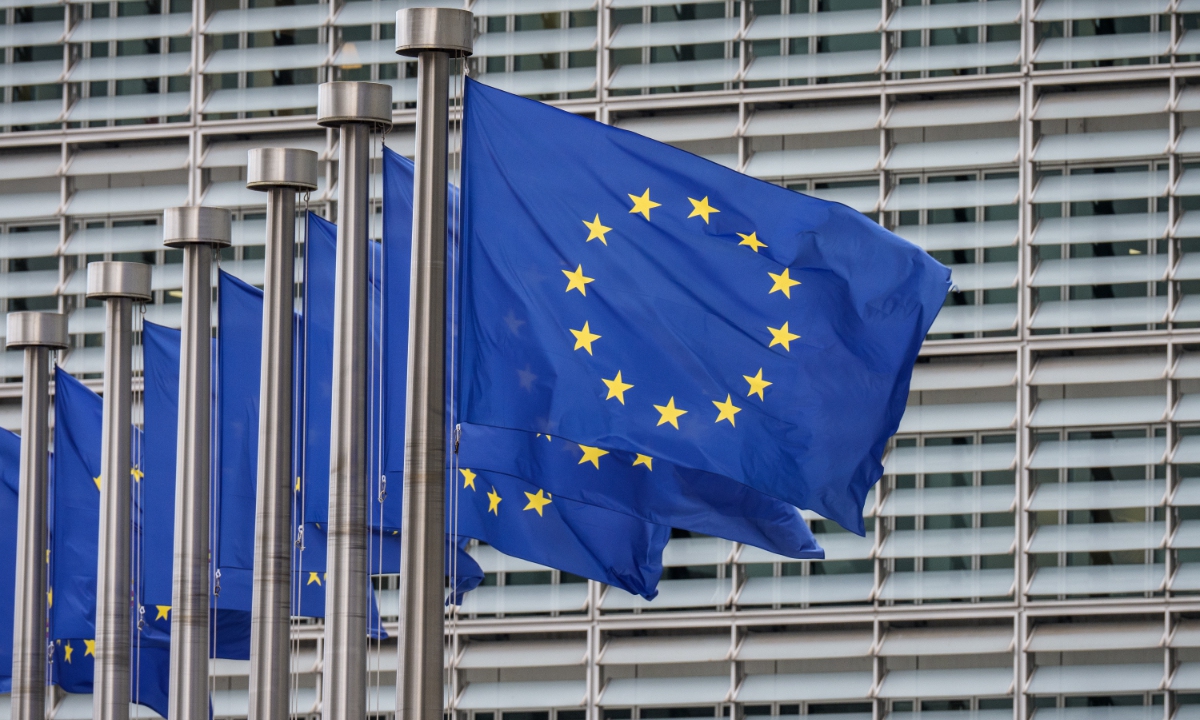
The European Union (EU) flags in front of EU headquarters in Brussels, Belgium. Photo: VCG
By lowering the banner of free trade that they have upheld for more than half a century, France and Germany are betraying and negating their own principles. Do not do to others what you do not want done to yourself. By wielding what it once condemned as a weapon, Europe is tarnishing its self-proclaimed image as "a defender of multilateralism."According to media reports, France and Germany submitted an informal paper to the European Commission on Monday, calling for stronger EU trade defense instruments. They seek to grant the Commission new powers to restrict or even revoke access to the EU single market for countries deemed to be engaging in "systemic market-distorting practices," as well as to establish mechanisms to "limit companies' reliance on single sources for certain critical supplies."
Although the document does not name China, it is obvious to anyone with discernment who the target is. This joint push by France and Germany - the "twin engines" of the EU - is steering Europe down the wrong path of protectionism.
By lowering the banner of free trade that they have upheld for more than half a century, France and Germany are betraying and negating their own principles. Europe is the birthplace of the modern concept of free trade and has been the most steadfast builder of the postwar multilateral trading system. From the customs union to the single market, from successive rounds of multilateral negotiations to the global circulation of the euro, openness has always been the bedrock of Europe's economic prosperity.
In 2025, the EU trade in goods balance registered a surplus of 128 billion euros. As recently as June, German Chancellor Friedrich Merz said in the Bundestag that "Europe benefits more than any other continent in the world from open and fair global trade." His words are still ringing in our ears, yet four months later, he signed a joint paper claiming that the "existing trade toolbox is no longer sufficient." Using rules when they suit one's purposes and discarding them when they do not - treating rules as tools to be taken or left as needed - is tantamount to destroying one's own reputation.
The EU is transforming from a victim of unilateralism into the very kind of perpetrator it once opposed. Back in 1998, the European Communities filed a complaint with the World Trade Organization regarding compliance with the US "Section 301" Trade Act, insisting that unilateral retaliatory measures must be subject to multilateral authorization. This case is still regarded today as a landmark precedent curbing unilateralism.
Now, 28 years later, the former plaintiff is forging its own European version of "Section 301," using a "reverse qualified majority" mechanism to allow the European Commission's restrictive measures to take effect by default, which makes it difficult for member states to block them. One German official has unabashedly referred to it as a "second-strike weapon" to counter the escalation of the trade war. Do not do to others what you do not want done to yourself. By wielding what it once condemned as a weapon, Europe is tarnishing its self-proclaimed image as "a defender of multilateralism."
France and Germany's shift toward protectionism is, at its core, an attempt to package their own structural problems as "external threats." High energy prices, heavy regulatory costs and slow innovation upgrading are the real internal causes behind Europe's declining industrial competitiveness.
A survey conducted in Germany shows that investment appetite among German small and medium-sized enterprises has already fallen to its lowest level since records began in 1995. Blaming others for the unfinished business of domestic reform and using trade barriers to compensate for lost cost advantages are less a "wake-up call" than an act of evasion. Germany's transformation from a "brake" on tough trade measures against China to today's "driving force" represents an attempt to treat internal ailments with external remedies - a failure to face its own problems head-on.
The bill for protectionism will ultimately be paid by those who issue it. According to the latest survey by the German Chamber of Commerce in China, about 33 percent of the companies surveyed believe their operations in China will be significantly affected if the EU-China trade negotiations fail to yield substantive results. French cognac sales have fallen from 230 million bottles since 2023 to 140 million bottles, a direct consequence of the countermeasures triggered by the EU's tariffs on Chinese electric vehicles. The experience of the US Section 301 tariffs offers an equally clear warning: Importers bore almost all of the costs, while the protected industries saw only marginal increases in output. Tariffs may be imposed on others, but the costs ultimately end up on one's own books. German companies, French distilleries and European consumers will all find their names on the bill.
The ball remains in the EU's half of the court. The way forward lies at the negotiating table, not in a toolbox. China and Europe are deeply integrated through industrial and supply chains, making their economic and trade relationship fundamentally one of mutual benefit.
Mutual dependence between China and the EU is not a risk, and intertwined interests are not a threat. Openness and cooperation are the right paths to development. European Trade Commissioner Maros Sefcovic will visit China, and China-EU trade and investment consultations are still underway, demonstrating that the door to dialogue remains open.
It is hoped that France and Germany, as major global economies, will uphold open cooperation and free trade, abide by WTO rules, refrain from urging the EU to reach for protectionist instruments at every turn, and avoid politicizing or securitizing economic and trade issues.
Protectionism cannot boost competitiveness; decoupling and cutting off supply chains will only hurt others without benefiting oneself. Taking the wrong approach down the wrong path will ultimately backfire.
RELATED ARTICLES