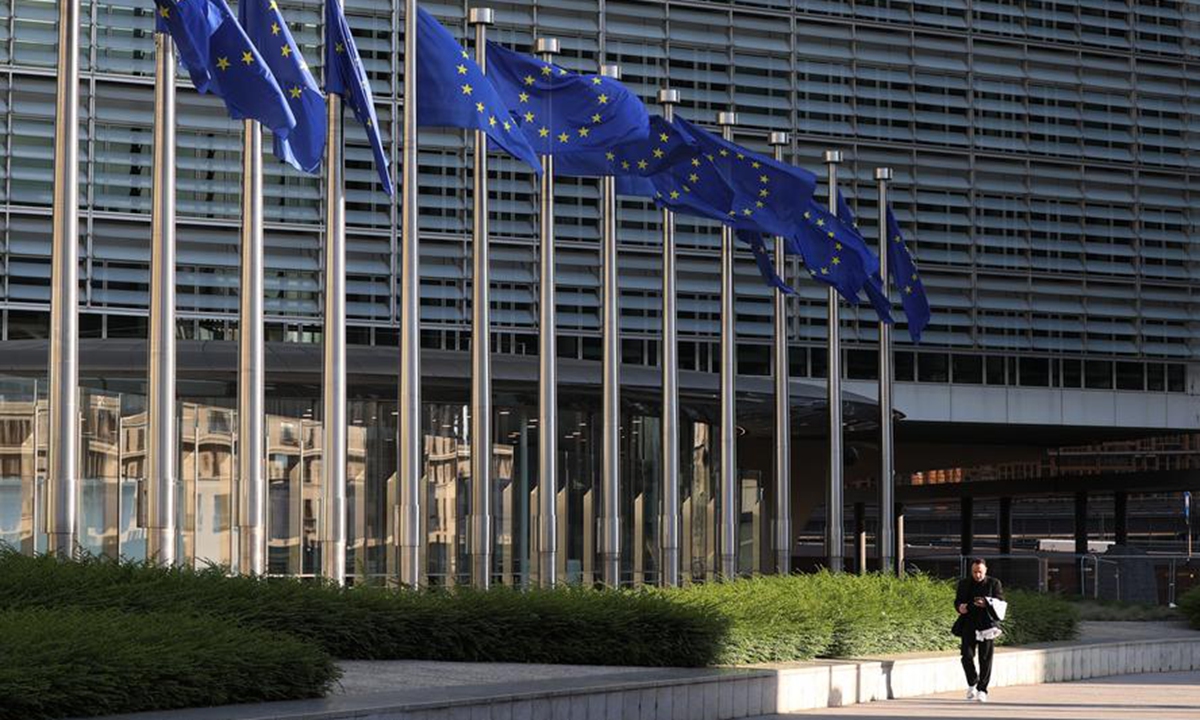
European Union flags fly outside the European Commission headquarters in Brussels, Belgium, on May 23, 2025. Photo: Xinhua
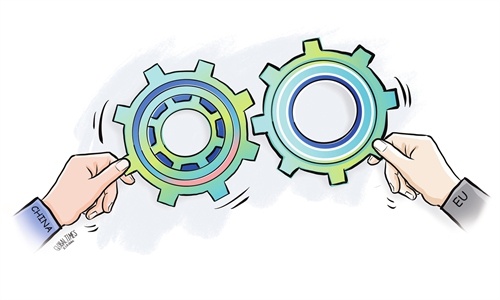
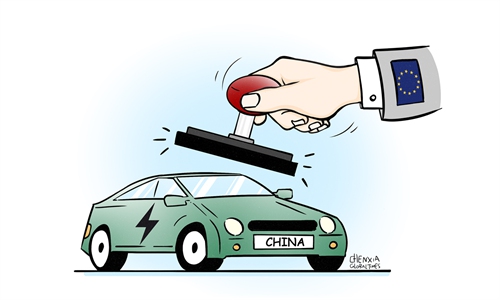
A recent editorial in the French weekly L'Express argued that "Europe must dare to wage a trade war against China," provoking significant controversy in European political and media circles. Currently, certain European media outlets and politicians remain determined to escalate tensions between Europe and China. Fixated on China's growing trade surplus with Europe, they continue to call for demonstrating the resolve to launch a trade war against China.Europe's underlying anxieties - a growing trade imbalance, declining international competitiveness and the threat of forced de-industrialization - are very real. Yet, blaming these issues on external factors, scapegoating China, or threatening a trade war is pointing the finger in the wrong direction, and miscalculating the outcome.
The immediate source of Europe's anxiety lies in recent statistical data showing a widening gap between imports and exports. Today, burdened by high US tariffs that push up export costs alongside a rising energy trade deficit, the EU fears that 2026 could mark a pivotal turning point from surplus to deficit.
Framing these anxieties as an external "trade shock" is a stretch that overlooks Europe's internal flaws. The root cause of the EU's trade imbalance lies in its own weakening competitiveness, driven by high energy prices, stalled labor market reforms and rising defense spending. However, in a climate dominated by conservative and populist rhetoric, politicians find painful domestic reforms politically risky. Shifting the blame outward allows them to gloss over internal structural shortcomings and direct public frustration toward external targets instead.
As a prominent global trader with strong momentum, China easily becomes a convenient target. At the same time, its adherence to international rules and predictable conduct mean it poses no immediate security threats to compel Europe's compliance. Systemic differences also allow politicians to construct a narrative around a "rival," distracting voters from high US tariffs and Middle Eastern energy volatility. Finally, established EU talking points, ranging from "overcapacity" and "subsidies" to "unfair competition," provide a plug-and-play toolkit that can be used at will.
Nonetheless, European leaders should consider whether the EU possesses the internal cohesion and operational capacity required to wage a trade war against China. The EU has long considered plans targeting China, yet at the EU summit in June, EU leaders remained divided over a tougher response.
The takeaway from the summit's inconclusive outcome is clear: Across trade, technology, manufacturing and critical raw materials, key European economies are deeply integrated with China. Finding alternative markets on either the supply or demand side remains difficult.
If European countries engage in a trade war with China, their largest source of imports, they must fully anticipate the consequences. Should China issue equivalent countermeasures, it would shake a massive, irreplaceable market accounting for 23.1 percent of total EU imports, not to mention the critical supply chain bottlenecks where China holds significant leverage.
Are those calling for a trade war truly prepared for the immense costs involved, all for the sake of political posturing? Acquiescing to high US tariffs while recognizing that protectionism and unilateralism are the real drivers of the current trade deficit, those who advocate "using a trade war to force China to the negotiating table" are simply offering a poor imitation of Washington's tariff strategy.
This approach violates the principles of free and fair trade and overestimates Europe's capabilities. It relies on political motives and media pressure to override economic realities, seeking to divert domestic contradictions rather than fix internal issues. At the same time, it severely underestimates China's resolve and capability to respond.
If European leaders truly care about the region's economic interests and social welfare, the priority should not be launching an ill-defined and risky trade war against China out of impulse, nor imitating external pressure tactics. Instead, Europe needs to return to a pragmatic approach. It should build on existing consensus, maintain communication through bilateral consultation mechanisms and address its anxieties candidly without political or media manipulation.
China has consistently treated the EU as a partner and has shown patience at the negotiating table. At this critical juncture, Europe must not lose its way or miss the opportunity to work constructively with China - in fact, it needs to step up its efforts.
The author is the director of the Center for European Union and Regional Development Studies at Beijing Foreign Studies University. opinion@globaltimes.com.cn
RELATED ARTICLES