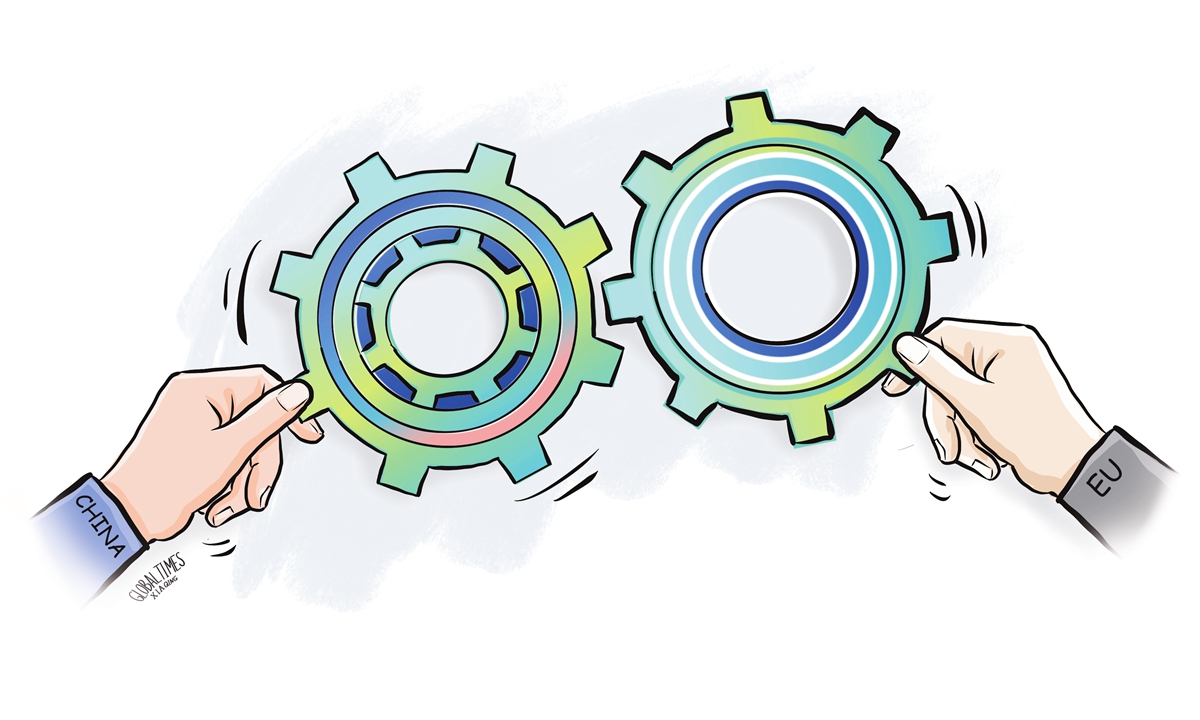
Illustration: Xia Qing/GT
When considering European integration and the EU's engagement with China, four main constraints stand out: the limited degree of European cohesion, the economic decline of the EU, weak political leadership and the pervasive influence of the US.Although we often speak about "the EU," engagement with China is still largely shaped by member states. Germany depends significantly on the Chinese market, especially after the reduction of Russian natural resources, while France has often pursued a more opportunistic approach.
Economic decline is a crucial factor in how the EU relates to China. Both the EU and China have trade surpluses with the US, yet China also has a surplus with the EU. This asymmetry affects the balance of power in the relationship.
As for weak political leadership, there is a limited understanding of China among European political elites. This is connected to the fourth factor, US influence, which shapes the way China is perceived and discussed in Europe. It is impossible to discuss European engagement with China without taking into account the influence of the US, which is present across political, military, economic and security dimensions.
A clear cleavage emerges between politics and business. Political actors, often influenced by the US, tend to adopt a more confrontational stance toward China. Business actors, by contrast, often emphasize the need to continue economic engagement. A report published by BusinessEurope in late 2024, strongly influenced by German interests, illustrates this tension. Its message is that Europe still needs to do business with China, even if this is not the dominant position in Brussels.
The 5G case is particularly revealing. China offered a cheaper and better-performing system, but security concerns raised by Washington led Europe to resist and eventually withdraw from that option. This may be possible once or twice, but in the long run, it risks leaving Europe technologically behind for security reasons, unless Europe develops its own economic and technological capacity.
This is one of Europe's central challenges. The debate on European cyber sovereignty, or alternatively on the risk of becoming a cyber colony, is therefore an important element in understanding how the EU engages, or should engage, with China.
Despite existing divergences, I tend to see more similarities than differences between China and Europe. Even though the multilateral system was largely built by others, Europe and China are both strong supporters of multilateralism and among the actors most invested in preserving it.
Another important similarity is historical. Unlike the US, both Europe and China experienced war on their own territory. This is a tremendously important difference, because the trauma and destruction of war shaped both political cultures in ways that should not be underestimated.
There have also been moments in which the two cultural traditions interacted fruitfully. One example is the long trajectory of cultural encounter brought to China by the Jesuits, including Matteo Ricci. A second example is Marxism. Marxism is a European tradition that has been extensively received in China. These encounters, whether through the Christian tradition of the Jesuits or through Marxist thought, point to an important social dimension in European intellectual history.
This social dimension should not be overlooked. Europe is often viewed through the lens of an individualistic, liberal, Anglo-Saxon way of thinking, but that is not the whole of European thought.
The most important dynamic affecting China-EU relations is, in my view, the end of the West as a cohesive political space. Several elements point to a fragmenting transatlantic West, and this fragmentation creates an opportunity to rethink European strategic autonomy.
Despite all the difficulties, this appears to be an almost inevitable historical trajectory. It should not be understood as a move against the US, but rather as the reopening of strategic space for Europe, including in its relationship with China. This also connects to the convergences mentioned earlier: multilateralism, historical experience and the need to cooperate in a changing international order.
The relationship is marked by mutual needs. There is much to explore in terms of trade, natural resources, tax security and perhaps also sovereignty. Europe may have lost a sense of sovereign pride that China has regained, and that Europe might recover in the future.
At the same time, this should be considered in a post-WTO scenario. Cooperation and coexistence remain possible, especially through a rules-based framework in a post-hegemonic and post-US-hegemonic system. Europe and China may be able to establish such a rules-based system, but not necessarily within the existing WTO perimeter.
The author is the director of the Center for International and Strategic Studies, Luiss University, Italy. opinion@globaltimes.com.cn
RELATED ARTICLES