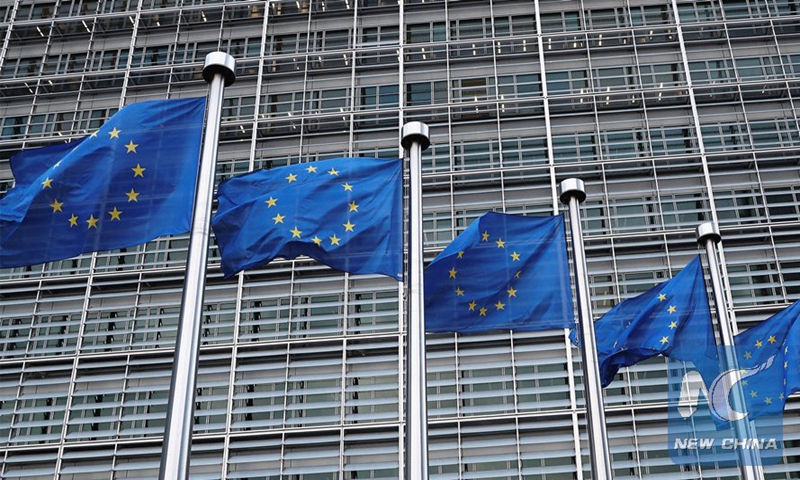
The European Union flags in front of EU headquarters in Brussels, Belgium. Photo: Xinhua
For a long time, Europe has been seen as having a strong tradition of self-reflection, with Germany in particular often hailed as a "reflective power." This awareness and capacity for reflection have also been reflected in national governance. For example, "Made in Germany" was once used by the British in the late 19th century as a derogatory label for inferior goods, but the Germans transformed it through a top-down overhaul into a byword for quality and credibility. Another example came in 1999, when The Economist dubbed Germany the "sick man of Europe." Germany responded with the "Agenda 2010" reforms, helping it regain its position as Europe's economic locomotive within a relatively short time.These examples show how Germany's habit of confronting its own shortcomings has helped it reinvent itself in times of crises. Yet today, as Europe faces mounting challenges, it seems to be losing the courage and capacity for self-reflection. During my recent visit to Europe, I was struck by how many Europeans now seem more inclined to ask others to reflect than to do so themselves.
This is particularly evident in innovation. European countries have long criticized China's industrial policies and US subsidies, arguing that state intervention gives companies an unfair advantage. Yet the EU and its member states have increasingly embraced industrial support themselves, from the Important Project of Common European Interest on Microelectronics and Communication Technologies to backing green and digital transformation through the Recovery and Resilience Facility.
On the issue of trade imbalances, Europe repeatedly blames "Chinese overcapacity," using it to pressure China on fair competition, reciprocity and market access while justifying protectionist measures of its own. Yet it rarely confronts the decline in its own competitiveness and the resulting erosion of its export advantages. Instead, it has continued to strengthen its "de-risking" maneuvers against China, restricting China's market access for European goods and technology.
When it comes to unity within, the bloc also tends to blame its internal divisions on China's efforts to "divide" Europe. I frequently hear European scholars invoke "Europe First," implying that China should prioritize EU institutions over individual member states, lest it be seen as undermining EU unity. Yet member states engage with China at both the national and EU levels, and their differing China policies reflect their own interests and choices - not something external forces can dictate.
It is worth noting that the decline in Europe's capacity for self-reflection has also spilled over into domestic governance. In recent years, amid prolonged economic stagnation, accumulated livelihood challenges, and the impact of external crises and conflicts, right-wing populist forces have continued to gain strength in many European countries. In response, political elites of mainstream parties have found no effective remedies.
On Europe's current challenges, there are two sharply divergent voices within European society. One calls for a candid acknowledgment of its own problems, while the other is accustomed to "shifting blame" onto external factors. For political leaders in Europe, rather than admitting their inability to solve problems, it is often easier to shift responsibility onto others, thereby evading accountability for inaction or ineffective governance.
However, "blame-shifting" does little to resolve the underlying issues and instead contributes to their accumulation. For instance, in the face of competition from Chinese electric vehicles, some insightful voices in Germany oppose adopting protectionist trade measures, arguing that such steps do not fundamentally address the delayed transformation of Germany's automotive industry. Instead, they advocate that the German auto sector should remain open and, through exposure to external competition, accelerate its own transformation. When Japanese and Korean automobiles entered the European market years ago, many warned that they would dominate the entire European industry. Yet subsequent developments showed that Germany's proactive pursuit of innovation in response to competition not only enabled it to withstand the challenge but also strengthened its international competitiveness.
Therefore, under the new international political and economic landscape, whether European political elites can maintain their capacity for introspection and courage to confront shortcomings in governance will be a key determinant of whether they can make correct policy choices. If problems are persistently attributed to external factors, European countries may increasingly disregard domestic structural issues, and their acceptance of reform measures will further weaken, thereby constraining their capacity to act in return. Hopefully, Europe can rebuild its tradition of self-reflection.
The author is director of the German Studies Centre at Tongji University. opinion@globaltimes.com.cn
RELATED ARTICLES