Opening-up pioneer becomes global innovation hub, amazes intl APEC delegates
Why they favor Shenzhen?
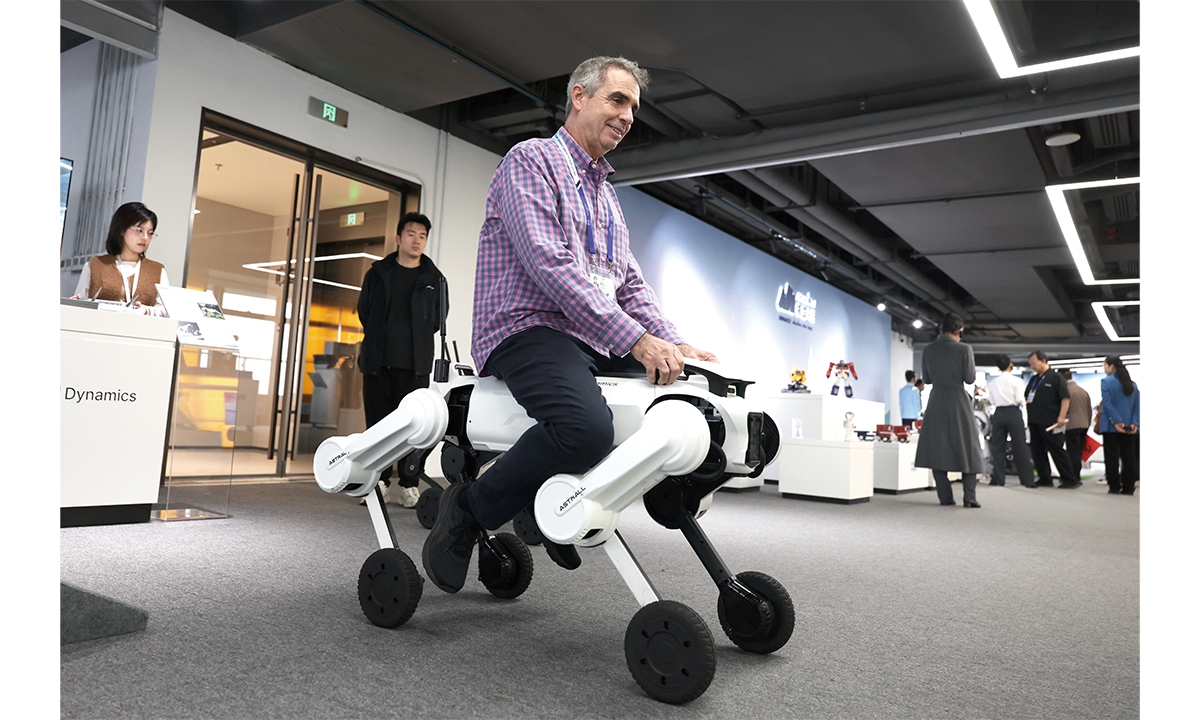
A foreign delegate to the APEC CEO Summit rides an industrial-grade, heavy-duty, all-terrain quadruped robot at Shenzhen's robot valley exhibition hall on November 19, 2026.
A city's impression on foreign leaders can sometimes be seen in what they say after leaving.Nearly a week after the APEC Economic Leaders' Meeting in Shenzhen, praise for the host city from visiting leaders continues to draw attention. Russian President Vladimir Putin described Shenzhen as "truly impressive" during the APEC CEO Summit, calling it "one of the most advanced and dynamic metropolises" that combines a high level of urbanization, a livable environment and an innovative industrial base, per Reuters.
Other leaders highlighted Shenzhen's transformation. After returning to the US from his APEC trip to China, US President Donald Trump also repeatedly spoke about Shenzhen. At a White House news conference, he praised the city's cleanliness and rapid development, saying: "It's clean. It's immaculate, Shenzhen Daily reported. It's been built in a short period of time." At a later public event, he printed out pictures of the visit and recalled the Chinese food served in Shenzhen.
Australian Prime Minister Anthony Albanese, recalling his first visit in 1998, said: "If you had put two photos together, 1998 and 2026, you would not think it was the same place."
Why has Shenzhen drawn such strong praise from leaders?
The international community probably didn't have a sufficient or comprehensive knowledge of the city before, Wang Yuzhu, a researcher at the National Institute of International Strategy, the Chinese Academy of Social Sciences, told the Global Times. While overseas recognition of Shenzhen-based companies has been relatively strong, the concept of the city as a whole has been vague, he said.
Shenzhen was not built as a model city through nationwide mobilization, Wang noted. Rather, it developed as an emerging city with considerable autonomy, following market principles and international rules.
Technology as a growth engine
In Shenzhen, innovation is not an abstract concept. It is part of everyday life.
At Huaqiangbei, known as "China's No. 1 electronics street," crowds of overseas visitors have continued to grow this year. The Global Times reporters saw foreign tourists with suitcases browsing the stores, looking at AI glasses, drones and translation earbuds. A robot 6S store in Longgang District attracts visitors from around the world, as international clients account for about 70 percent of its customers.
After talking with more than 20 foreign journalists, a frequent keyword they shared with the Global Times about Shenzhen was its density of technology.
Rousa Shikoh, a producer with Namibia's national television broadcaster, said she was impressed not only by the application of new technologies, but also by how technologies such as AI are empowering public services.
Mark Besson, a researcher from Australia-China Relations Institute, also praised the city's pace of development and technological strength. "It's emblematic of how China can develop at an astounding pace. It's also central to China's AI industry," Besson told the Global Times.
This technological dynamism did not emerge overnight. After the Shenzhen Special Economic Zone was established in 1980, the city initially grew through processing and export-oriented manufacturing, becoming deeply integrated into global supply chains. As pressure from population growth and limited land and resources mounted, Shenzhen shifted toward technological innovation and industrial upgrading.
Its development evolved from importing and adapting technologies to pursuing independent innovation, with companies and industrial frontlines becoming major sources of technological breakthroughs, Wang said.
The transformation is reflected in its research investment. Shenzhen's R&D spending reached 245.31 billion yuan ($36.83 billion) in 2025, with R&D intensity rising to 6.67 percent, the highest among Chinese cities. More than 90 percent of its innovation-oriented companies are homegrown, while more than 90 percent of its R&D institutions, personnel and funding are concentrated in enterprises.
Xie Luren, a local resident in South China's Guangdong Province, told the Global Times that a neighbor of his, born in the 1970s, founded a technology company in Shenzhen in 2015 and later expanded into AI, big data and cloud computing, eventually making it onto a list of the city's top 500 enterprises. Shenzhen, Xie said, not only allows people to dream, but also gives them opportunities to turn those dreams into reality.
Canadian Prime Minister Mark Carney said during the APEC meeting that the city had evolved from assembling products for global brands to making electric vehicles, batteries and robots for the world, per the release of the prime minister's office.
Its advantage lies not only in the presence of leading technology companies, but also in a complete industrial ecosystem. For entrepreneurs, this means ideas can be turned into products more quickly, with suppliers, technical expertise and markets close at hand, Xie said.
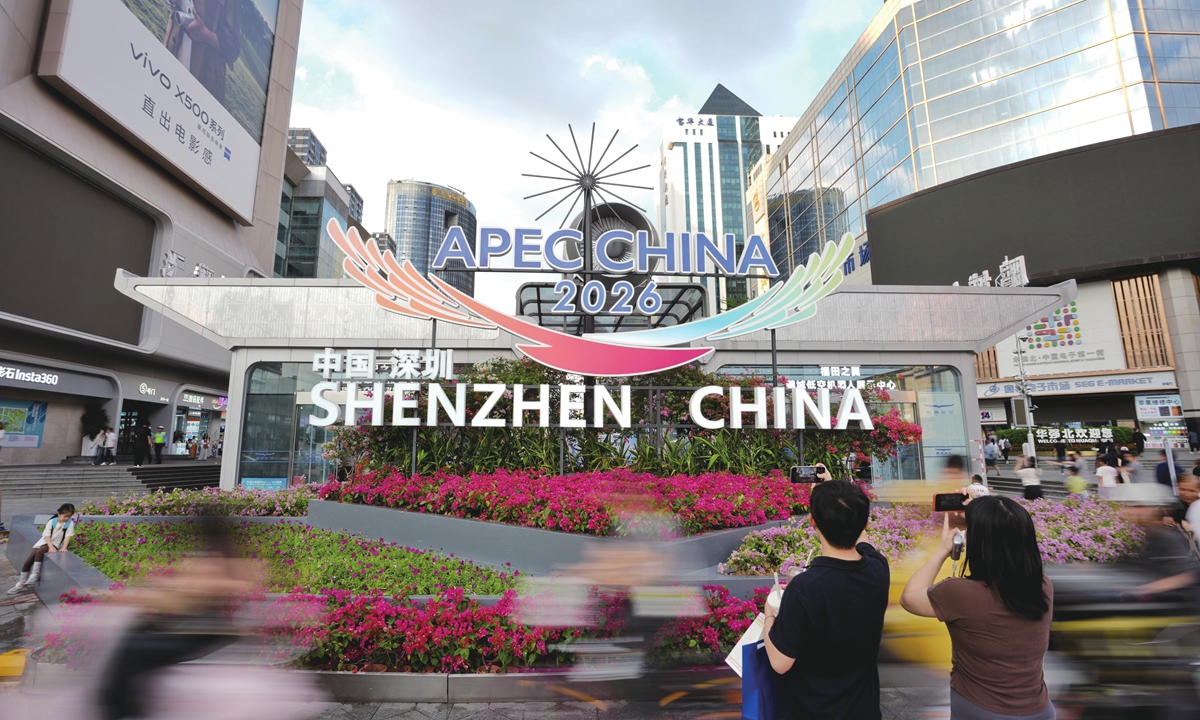
Visitors take pictures of APEC-themed signage in the Huaqiangbei area in Shenzhen, South China's Guangdong Province, on November 15, 2026. Photos: VCG
'Forever a Shenzhener'Over more than four decades, Shenzhen has expanded its opening-up and developed a distinctive character: it welcomes not only goods, capital and technologies from around the world, but also anyone who seeks opportunities.
Shenzhen's imports and exports totaled 5.25 trillion yuan in the first 10 months of 2026, surpassing 5 trillion yuan for the first time. Its exports have ranked first among mainland cities for 33 consecutive years. During reporting in Shenzhen, the city's "maker culture" was as striking as its technological atmosphere. An entrepreneur from Central China's Henan Province who came to Shenzhen to develop automatic-door sensors told the Global Times that, despite having prior entrepreneurial experience in his hometown, he found more experienced peers, stronger policy support and a more complete supply chain in Shenzhen. "You have many options here," he said.
Openness is also reflected in the city's public services and its attitude toward newcomers. Recent graduates can apply for free accommodation through the city's youth station program. Even the city's food reflects this inclusiveness, blending flavors from across the Greater Bay area and other parts of China.
A message displayed on a city's highway reads: "One day in Shenzhen, forever a Shenzhener."
Wang said the city is also exploring ways to connect different regulatory systems through platforms such as Qianhai and Hetao. Such experiments in cross-border data flows and trade facilitation could offer useful experience for wider regional cooperation.
Bahri Kh. Bahriev, a political science PhD and associate professor at the Yuri Luzhkov University of World Politics and Governance in Moscow, said APEC could further promote regional inclusiveness. "Inclusiveness can be strengthened through expanding the formats of 'guest participation' in sectoral working groups and using the APEC platform to launch multilateral projects in the areas of transport, digital trade and green energy, where the interests of Central Asian countries and the Asia-Pacific economies coincide," he said.
From a tiny village to a manufacturing center, and today's global innovation hub, Shenzhen's story is not only a window into China's reform and opening-up, but also an example of how a place can build unique competitiveness by connecting local talent and industries with the wider world, Wang said.
RELATED ARTICLES