SAIC MG to halt gasoline-fired cars in China from January 1, 2027 as Chinese consumers embrace EVs
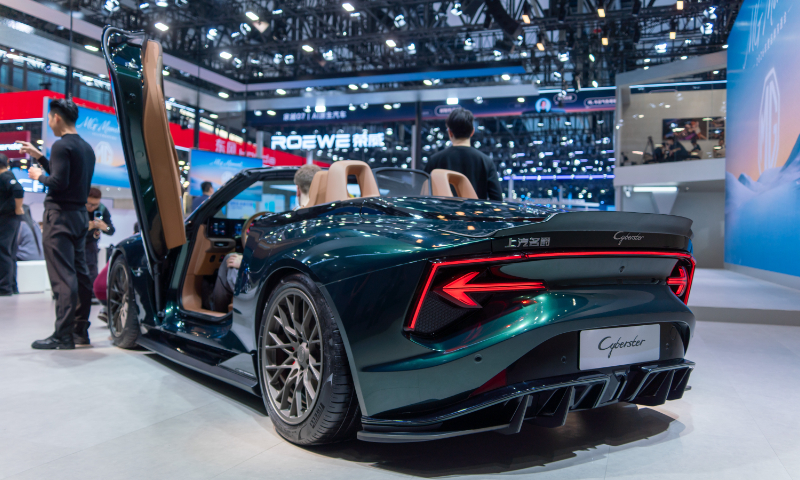
A car of SAIC Motor's MG brand at the Guangzhou International Automobile Exhibition in Guangzhou, South China's Guangdong Province, on November 27, 2026. Photo: VCG
Chinese car manufacturer SAIC Motor's MG brand announced that it will stop producing pure internal-combustion-engine (ICE) models in the Chinese mainland starting January 1, 2027. And, existing owners of MG gasoline vehicles will continue to receive full after-sales service and spare-parts support throughout the vehicles' life cycle. The decision was revealed at the ongoing Guangzhou International Automobile Exhibition (Auto Guangzhou 2026) in South China.
Also at the exhibition, Lexus said that its all-electric three-row SUV TZ is scheduled to go on sale in China in the first quarter of 2027. The first China-made pure-electric model from its Shanghai plant is also expected to launch next year.
The latest moves came as new-energy vehicles (NEVs) have become the dominant force in China's car market. According to the China Passenger Car Association, the retail penetration rate of new-energy passenger cars - share of customers who bought a specific product - reached 67.5 percent in October, up 10.5 percentage points from a year earlier. In contrast, pure ICE vehicle retail sales fell 51 percent year-on-year in October 2026, while overall fuel-car sales dropped 45 percent.
For many brands, pure ICE vehicle sales have already become marginal. Stopping production will have little impact on overall volumes and frees up R&D, manufacturing and marketing resources for the new-energy segment, Zhang Xiang, secretary-general of the International Intelligent Vehicle Engineering Association, told the Global Times on Sunday.
BYD set the precedent in March 2022 by becoming the first major traditional carmaker to halt pure ICE production. Its new-energy sales surged from that on, exceeding 1.86 million units in 2022 and climbing past 3 million in 2023 and 4 million in 2024 - mirroring the rapid rise of China's NEV penetration from 14.8 percent in 2021 to more than 50 percent by the end of 2025.
MG is now in a similar position. In October, its global NEV sales exceeded 85,000 units, with more than 32,000 in China, accounting for over 97 percent of brand sales volume.
"Pure ICE sales were under 1,000 units that month and are essentially in inventory-clearance mode," said Zhang.
Other international brands are also saying good-bye to ICE production. The last petrol Range Rover Evoque L left the Shangshu plant of Chery Jaguar Land Rover in East China's Jiangsu Province in March 2026. The brand is now focusing on its new high-end electric line-up under the Freelander name and made a launch event at the ongoing Auto Guangzhou 2026 on Friday.
"Modern electric vehicles are built on dedicated platforms that share almost no major components or production lines with ICE cars. Maintaining low-volume petrol lines is costly - plants may run only a few days a month - making closure the rational choice for brands whose monthly pure ICE output has fallen into the hundreds," said Zhang.
Zhang said that the trend of "no gasoline" will accelerate as China's NEV market continues to expand and pure ICE vehicle volumes wshrink further.
Global Times
RELATED ARTICLES