ARTS / CULTURE & LEISURE
Dance across generations
7-year-old Yingge dancer brings traditional arts to APEC spotlight; Chinese youth bring traditional arts to the world
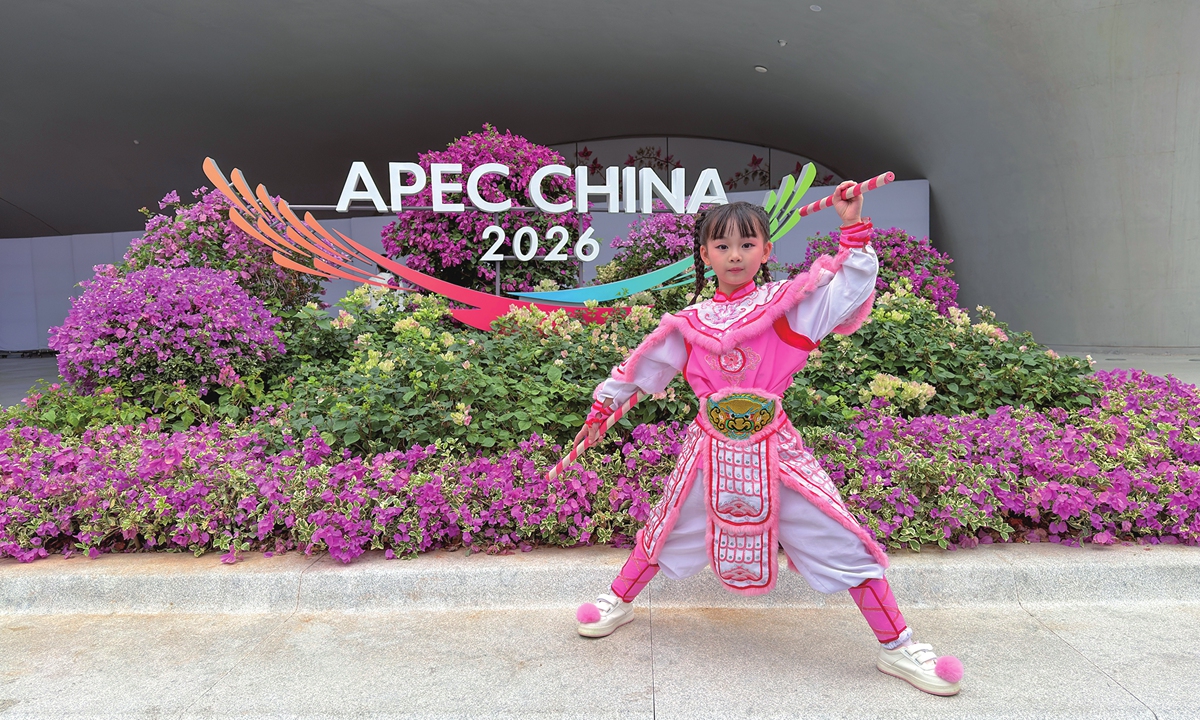
Zhuang Enqi poses for a photo in traditional Yingge dance attire in front of an APEC logo. Photo: Courtesy of Zhuang Enqi
Starting in December, visitors passing through the many transport hubs in South China's Guangdong Province, such as high-speed rail stations, will come across an unusual sight: a little girl dressed in traditional Yingge clothing and holding a pair of short wooden sticks used in Yingge, a folk-dance combining dance, martial arts and theater that is popular in the Chaoshan region of Guangdong Province.
Her name is Zhuang Enqi, a 7-year-old from Guangdong who is set to become a cultural and tourism ambassador for the province. Her image will be used to introduce her hometown's culture to a wider audience.
The young dancer first attracted widespread attention after a video of her dancing spontaneously during a street parade went viral. Recently, she led 51 young performers in a Yingge dance performance at the welcoming event for the 33rd APEC Economic Leaders' Meeting, becoming the youngest lead dancer to grace an APEC stage.
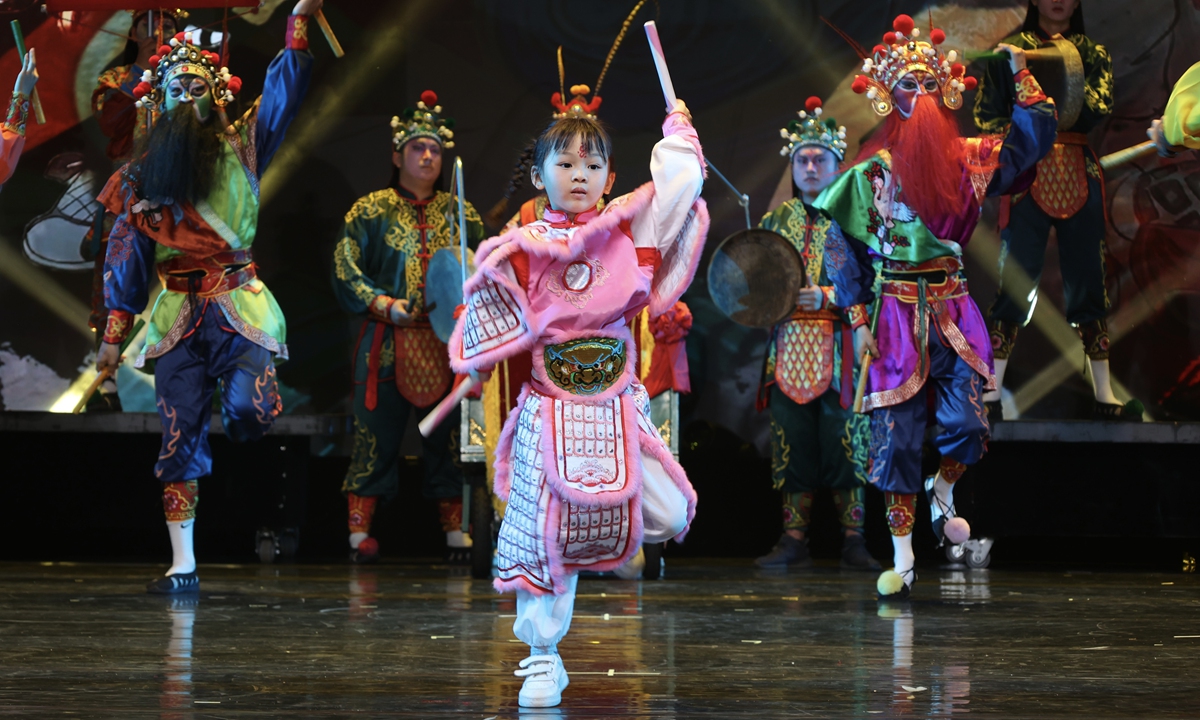
Zhuang Enqi in a Yingge dance performance, in Guangzhou, South China's Guangdong Province, in June 2025 Photo: Courtesy of Zhuang Enqi
Dancing in the street
From joining a folk parade in her hometown to taking center stage at an international event, Zhuang's experience reflects how the younger generation in China is taking part in preserving and sharing traditional performing arts.
Professional Yingge dancer Dongtao, Zhuang's uncle, told the Global Times that Yingge has its own established traditions in stick techniques, painted masks, drum rhythms and formations. While performances can incorporate new elements, these defining features must be preserved.
"Above all, it is the spirit behind the dance - uprightness, unity and perseverance, that gives Yingge its soul," he said.
The APEC welcoming performance featured a new arrangement of traditional Yingge. Zhuang had nearly four months to prepare after the invitation to lead the performance came in late June, Dongtao said.
"The choreography combines strength and softness. Performers need to show power and energy in some movements, but they can also relax and smile when the movements become gentler," he noted.
In Dong's view, the recognition the APEC performance received belonged to the teachers and the entire team, while Zhuang had simply focused on executing every movement assigned to her. Her connection with Yingge, however, began long before her appearance on the APEC stage.
Zhuang's introduction to Yingge began in her hometown, where she often accompanied her uncle to evening rehearsals after a troupe was re-formed in their village. She would watch the performers and imitate their movements. Her talent came to light two years ago when a video of her spontaneously dancing alongside a troupe during a folk parade went viral.
"She wasn't intimidated by the performers' imposing masks and costumes. Instead, she joined in and followed their movements with enthusiasm," Dongtao said.
Six months after the video went viral, Zhuang began formal training with Li Junhao, a coach with the Fumei Youth Yingge Troupe. She has since mastered movements from more than 10 Yingge styles and developed her own sequence, known as the "spinning-stick snake step."
Balancing training with schoolwork is also part of her routine. Dongtao said rehearsals are usually scheduled after school and on weekends, while performances are arranged during school holidays whenever possible.
Reaching a broader stage
Zhuang is part of a growing younger generation embracing Yingge and bringing other forms of traditional Chinese performing arts to international audiences.
In August, three Chinese productions based on traditional art forms were presented at the Avignon OFF Theatre Festival in France, including The Classic of Mountains and Seas, a Wang-style shadow puppetry production from Northwest China's Shaanxi Province.
Young people aged 4 to 14 took part in developing and staging the production, according to the Xinhua News Agency.
Yuan Olivia, a researcher of traditional theater and folk arts based in the UK, told the Global Times that young performers are not only taking to the stage but also finding new ways to reinterpret traditional stories.
"While learning traditional skills such as manipulating shadow puppets and shaping characters, they are also trying to interpret classic stories in their own way," she said. "This means traditional arts are no longer something young people simply receive and imitate. They become a form of culture in which they can actively participate in creating and expressing."
"Young people's initial interest in traditional arts often stems from curiosity and hands-on experience," she said. "As they continue learning, they gradually gain a deeper understanding of the cultural backgrounds and aesthetic features behind these arts, while developing ways of expression of their own."
According to Yuan, young people's participation helps pass on traditional skills while giving age-old stories new relevance and a wider international reach.
"Generation after generation has danced, and each generation has its own spirit and character. Showing the world the beauty of China and helping the world appreciate Chinese culture is also a way for young people today to express themselves," Jiang Tiehong, dean of the School of Dance at Minzu University of China, told the Global Times. As Jiang's remarks suggest, when younger generations actively engage with traditional arts, passing them on is no longer just about preserving what came before. It is also about creating new forms of expression that reflect the spirit of their own time.
RELATED ARTICLES